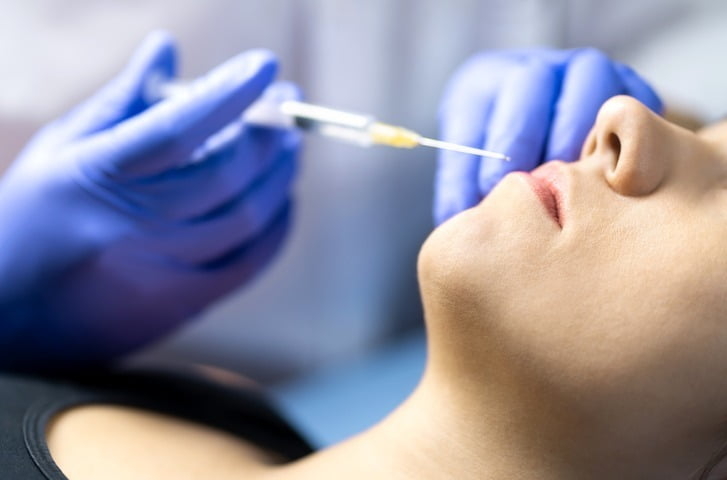
At a dermatology clinic in Myeong-dong, Seoul, last Sunday, coordinators fluent in Chinese, Japanese and English were busy guiding foreign customers. More than 90 percent of the patients that day were foreigners who had stopped by the clinic during a trip to Korea. A notice at the entrance read: "Every Sunday is reserved exclusively for foreign customers" — the clinic had set aside an entire day of the week for their convenience.
The amount foreign visitors spent at domestic medical facilities in the first half of this year rose 98 percent from a year earlier — the highest growth rate across all major spending categories. The figures suggest that skin and cosmetic procedures are no longer a bonus add-on to a Korea trip but the very reason for coming.
According to BC Card's "Foreign Visitor Spending Trend Report" released Monday, foreign card spending at medical facilities jumped 98.0 percent in the first half of this year compared with the same period last year. That far outpaced other major categories over the same period — retail and sales (47.6 percent), accommodation (50.2 percent) and health and hygiene (50.5 percent) all posted gains in the 40 to 50 percent range. As a result, medical facilities' share of total foreign spending climbed from 12.6 percent to 16.3 percent.
Medical spending remains heavily concentrated in Seoul, which accounted for 92.8 percent of nationwide medical facility payments by foreign visitors.
The most notable shift is in the composition of medical specialties. In Seoul, dermatology and skin care led with a 67.5 percent share of spending by specialty, followed by plastic surgery at 21.3 percent, specialist clinics at 3.4 percent, pharmacies at 2.0 percent, and general and tertiary hospitals at 0.7 percent.
The rankings have completely flipped from three years ago. As recently as the first half of 2024, plastic surgery held a commanding 46.2 percent share against dermatology's 32.6 percent, but dermatology overtook it in 2025 and this year the gap has widened to more than threefold. Over three years, dermatology's share rose 34.9 percentage points while plastic surgery's fell 24.9 percentage points. The shift reflects a broader change in how visitors approach medical tourism — from trips centered on going under the knife to trips that fit a procedure into an otherwise packed itinerary.
Pharmacies posted the sharpest growth of any category, with spending up 1,176.9 percent year on year — the highest among all medical specialties. Their share expanded 1.7 percentage points, from 0.3 percent to 2.0 percent. Traditional Korean medicine (193.1 percent) and dermatology (109.8 percent) followed. The trend of buying ointments and medicines at a pharmacy after a procedure is taking hold, weaving medical care and shopping into a single itinerary.
The map is shifting within Seoul as well. Gangnam-gu retained the top spot in medical tourism spending with a 39.8 percent share, but that was down 10.4 percentage points from a year earlier. Seocho-gu rose 6.7 percentage points to 27.6 percent, and Jung-gu gained 3.4 percentage points to reach 7.5 percent. Mapo-gu slipped 1.2 percentage points to 19.7 percent.
Growth was more pronounced outside Gangnam. Measured by the number of dermatology transactions, Seocho-gu led all districts with a 273.2 percent year-on-year increase, followed by Jung-gu at 225.3 percent and Yongsan-gu at 111.0 percent. Gangnam-gu grew just 26.9 percent. Seocho-gu continued to draw demand for high-end skin and cosmetic procedures, Jung-gu stood out for pharmacy spending, and Yongsan-gu saw notable activity in traditional Korean medicine and dermatology.
Spending rose across all major nationalities. By payment amount, Singapore posted the highest growth at 115 percent, followed by the United States at 100 percent, Japan at 98 percent, China at 92 percent, Hong Kong at 71 percent and Taiwan at 66 percent.
In every country, however, the growth rate in the number of transactions outpaced the growth rate in spending. Singapore led at 167 percent, followed by Taiwan at 114 percent, the United States at 112 percent, Japan at 104 percent, China at 103 percent and Hong Kong at 95 percent. The fact that the number of users and visits grew faster than total spending means the average amount per transaction has fallen. Medical tourism, once dominated by a small number of high-spending patients seeking expensive procedures, is entering a phase of broader, volume-driven growth as it reaches ordinary tourists.
The nationality mix by medical specialty has also shifted. Dermatology drew a diverse international clientele — Taiwan at 24.7 percent, Japan at 20.2 percent, China at 19.6 percent and the United States at 16.9 percent — with Japan's share up 1.7 percentage points and the United States' up 2.5 percentage points. In plastic surgery, China's share expanded 4.9 percentage points to 23.1 percent from 18.2 percent, while Taiwan's fell by the same margin, from 12.4 percent to 7.5 percent. Pharmacies saw the most dramatic realignment: Taiwan's share surged 28.1 percentage points to 32.4 percent from 4.3 percent, while the United States fell 22.3 percentage points and China dropped 17.8 percentage points.
BC Card said foreign visitors to Korea are "moving beyond simple sightseeing toward multi-purpose travel that combines medical services, K-beauty and cultural experiences," adding that "a new medical tourism ecosystem is forming in which medical care and shopping connect naturally, and medical tourism is set to become a new growth pillar for Korea's inbound tourism industry."
The analysis is based on spending data by nationality, industry and region drawn from approximately 3.3 million foreign-issued cards in BC Card's database.
won@heraldcorp.com