![Doosan Group headquarters [Doosan]](https://wimg.heraldcorp.com/news/cms/2026/08/03/news-p.v1.20250723.99b560390a8745e1ac94002b674268c4_P1.png)
Doosan Group, long known as a traditional heavy industry powerhouse, has completed the final piece of its semiconductor puzzle by acquiring a controlling stake in SK Siltron — the world's third-largest wafer maker — for about 2.3 trillion won ($1.6 billion). The deal gives Doosan a full semiconductor trifecta spanning copper-clad laminates (CCL) for AI accelerators, back-end testing and front-end wafer manufacturing, marking what analysts say is the culmination of the group's "Beyond Heavy Industry" transformation.
SK Inc. and Doosan Corp. each held board meetings Friday and disclosed approval of a share purchase agreement covering 70.6 percent of SK Siltron. The deal came roughly seven months after SK Inc. designated Doosan Corp. as its preferred negotiating partner in December last year, with the final transaction price to be confirmed after further adjustment procedures.
The extended timeline between the preferred-bidder designation and the signing had fueled speculation in some quarters that the deal might fall through, but the two sides pressed on, underpinned by SK Group's broader portfolio rebalancing strategy and mutual trust, ultimately reaching a final agreement. The transaction allows SK Inc. to strengthen its financial position through the stake sale and free up capital for future growth investments.
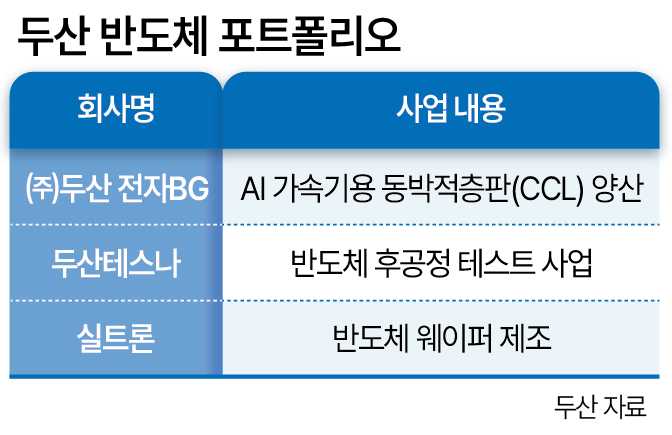
Semiconductor trifecta complete, spanning front- and back-end processes
Through the acquisition, Doosan Corp. — the group's operating holding company — has achieved a sweeping transformation of its business portfolio under the "Beyond Heavy Industry" banner. The group has been restructuring around three core pillars: energy (Doosan Enerbility, Doosan Fuel Cell and others), smart machines (Doosan Bobcat, Doosan Robotics and others), and semiconductors and advanced materials (Doosan Corp.'s Electronics Business Group and Doosan Tesna, among others).
The SK Siltron deal in particular completes Doosan's vertical integration in semiconductors, giving the group a strong lineup across the value chain. Doosan Corp.'s Electronics Business Group has been posting record results on the back of surging CCL supply for AI accelerators, and the group has now added a front-end wafer maker to its portfolio — following the 2022 acquisition of Doosan Tesna, South Korea's top back-end testing company.
Doosan has also been committing aggressive capital to the semiconductor segment in line with soaring AI infrastructure demand. The group has decided to invest 180 billion won in a CCL factory in Thailand targeting mass production by 2028, and more than 420 billion won in Doosan Tesna's second factory and equipment in Pyeongtaek. The strategy is to lock in dominant positions in high-barrier markets and build a high-margin earnings structure.
![SK Siltron's headquarters in Gumi [SK Siltron]](https://wimg.heraldcorp.com/news/cms/2026/08/03/news-p.v1.20260528.4813c9ccd4bb4d02bd5f153a17e21c5b_P1.jpg)
Global top-3 wafer technology in hand, with a 3 trillion won sales target for 2031
Founded in 1983, SK Siltron is the only South Korean company with proprietary silicon wafer manufacturing technology for semiconductors. It ranks among the top three globally in the 12-inch (300mm) wafer market. Wafers are a high-value-added core material that directly determines semiconductor yield, and high technology and quality barriers to entry mean that SK Siltron and four other global leaders — Shin-Etsu Chemical, Sumco, GlobalWafers and Siltronic — together command more than 90 percent of the total market.
SK Siltron counts Samsung Electronics, SK hynix and TSMC among its customers. Last year it posted sales of about 2 trillion won and operating profit exceeding 400 billion won. Meanwhile, its US subsidiary, which handled the silicon carbide (SiC) wafer business, will be wound down as the company focuses on its core operations.
After the acquisition, Doosan Corp. plans to keep SK Siltron as a wholly owned subsidiary without pursuing a listing, concentrating instead on enhancing shareholder value. The company has set a sales target of about 3 trillion won for SK Siltron by 2031, riding expected growth in the wafer market driven by expanding AI investment.
In the memory wafer segment, Doosan aims to break into the global top two by deepening ties with key customers and winning new ones. In the non-memory wafer market, currently dominated by two Japanese companies, Doosan plans to grow its share through technology development and customer acquisition.
Semiconductor, energy and robot synergies to power Doosan's AI solutions push
Doosan plans to leverage its expanded semiconductor lineup as a springboard to become an "AI solutions company" — one that offers customers an integrated package for building AI infrastructure.
The vision goes beyond supplying core semiconductor materials to encompass the power infrastructure essential for data centers. Doosan is significantly expanding its clean energy capabilities, including small modular reactors (SMR) — drawing attention as a power source for AI infrastructure — as well as gas turbines and hydrogen fuel cells.
The group also plans to collaborate with Nvidia to roll out an intelligent robot solution based on an agentic robot operating system next year, followed by industrial humanoid robot products in 2028, maximizing company-wide synergies across its semiconductor, energy and robot businesses.
"This acquisition gives Doosan Corp. a new engine for future growth while at the same time establishing a sustainable earnings base," a Doosan official said. "We will redouble our efforts to enhance shareholder value on the strength of a stable business portfolio."
keg@heraldcorp.com