![A grid-scale ESS battery container product by LG Energy Solution [LG Energy Solution]](https://wimg.heraldcorp.com/news/cms/2026/08/02/news-p.v1.20260802.110ac6339837452780b2fd30a2584284_P1.jpg)
South Korean exports of battery cells and power equipment to the United States surged last year as the American ESS market continued to expand, though analysts say companies must develop strategies to navigate rapid shifts in supply chain structures.
According to a KOTRA report titled "Structural Changes in the US ESS Market and Strategic Implications," released Sunday, US imports of South Korean lithium-ion battery cells reached $2.26 billion last year, up 71.0 percent from $1.32 billion the year before.
South Korea's market share also climbed from 5.6 percent to 11.4 percent over the same period, placing it third behind China (59.3 percent) and Japan (12.7 percent).
For large-capacity liquid-insulated transformers exceeding 10,000 kVA, imports of Korean products reached $728.5 million — a 99.4 percent increase — with market share rising from 12.5 percent to 18.1 percent.
The report said ESS investment in the United States continues to grow, driven by an expanding share of renewable energy in the power mix and rising electricity demand from AI data centers. It also noted that procurement competition in the ESS market is shifting away from price-based criteria toward supply chain eligibility.
The United States has used tariffs to curb the price advantage of Chinese batteries and has imposed regulations restricting the use of products from prohibited foreign entities linked to China and other countries of concern within ESS project supply chains.
In response to tightening rules on origin and supply chain compliance, companies are establishing battery production bases in the United States and expanding their local supply networks.
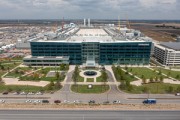
South Korean firms LG Energy Solution, Samsung SDI and SK On are all moving to deepen their participation in North American supply chains through local production facilities. LG Energy Solution has already built a large-scale mass production system at its factory in Holland, Michigan, and began its first shipments this year from its plant in Wroclaw, Poland.
Samsung SDI's prismatic LFP line for ESS in the United States is currently in the mass production quality verification stage, with cell mass production set to begin in October and customer supply of its SBB 2.0 solution expected before year-end. SK On is also reviewing ways to operate its existing facilities and assets more efficiently, including converting some North American electric vehicle lines to ESS lines and expanding ESS order intake.
Automakers such as Ford are leveraging their existing battery manufacturing base to enter the ESS market as electric vehicle growth slows, while system integration firms are broadening their North American project pipeline by leading with ESS system supply and energy management system-based operating solutions.
The report said companies must develop differentiated market-entry strategies tailored to current conditions — including localization and securing production capacity and delivery timelines — on a product-by-product basis.
likehyo85@heraldcorp.com