
Six in 10 South Koreans believe Cheong Wa Dae policy chief Kim Yong-beom should be replaced amid recent stock market turbulence linked to leveraged exchange-traded funds, a new poll shows. More than three in four respondents also said it was inappropriate for Kim to attribute the market volatility to "active investment by retail investors."
The survey, conducted Thursday by the Reform Party's think tank, the Reform Research Institute, polled 504 men and women aged 18 and older nationwide. It found that 61.0 percent of respondents said Kim should be "replaced to take responsibility for policy failures."
Only 18.4 percent said he should stay on "for policy continuity," while 20.6 percent said they were unsure.
Support for replacing Kim exceeded support for keeping him across all age groups. Those aged 18 to 29 showed the highest rate at 65.3 percent, followed by those in their 30s at 65.1 percent, those in their 40s at 64.4 percent, those in their 60s at 61.0 percent, those aged 70 and older at 56.6 percent, and those in their 50s at 55.3 percent.
By gender, 67.3 percent of male respondents and 54.9 percent of female respondents said Kim should be replaced.
Regarding Kim's recent remarks attributing stock market swings to active investment by retail investors, 75.5 percent of respondents said the explanation was inappropriate — 54.2 percent said it was "very inappropriate" and 21.3 percent said it was "generally inappropriate."
Only 16.6 percent said the remarks were appropriate, with 5.2 percent saying "very appropriate" and 11.4 percent saying "generally appropriate." Another 7.9 percent said they were unsure.
The view that the remarks were inappropriate was dominant across all age groups and regions. Among age groups, those in their 50s recorded the highest rate at 82.6 percent, followed by those in their 30s at 77.8 percent, those in their 40s at 75.7 percent, those in their 60s at 74.2 percent, those aged 18 to 29 at 72.3 percent, and those aged 70 and older at 68.9 percent.
When asked to identify the single biggest cause of recent stock market instability, 58.2 percent of respondents pointed to "the government's economic policy."
That was followed by "changes in overseas economies, including the United States" at 14.8 percent, "a correction after share prices had risen sharply" at 13.1 percent, and "investment by retail investors" at 3.5 percent. Some 10.3 percent said they were unsure.
The share blaming government economic policy was highest among respondents in their 30s at 66.8 percent, followed by those in their 50s at 62.7 percent, those aged 18 to 29 at 62.4 percent, those in their 40s at 59.1 percent, those in their 60s at 52.8 percent, and those aged 70 and older at 46.1 percent.
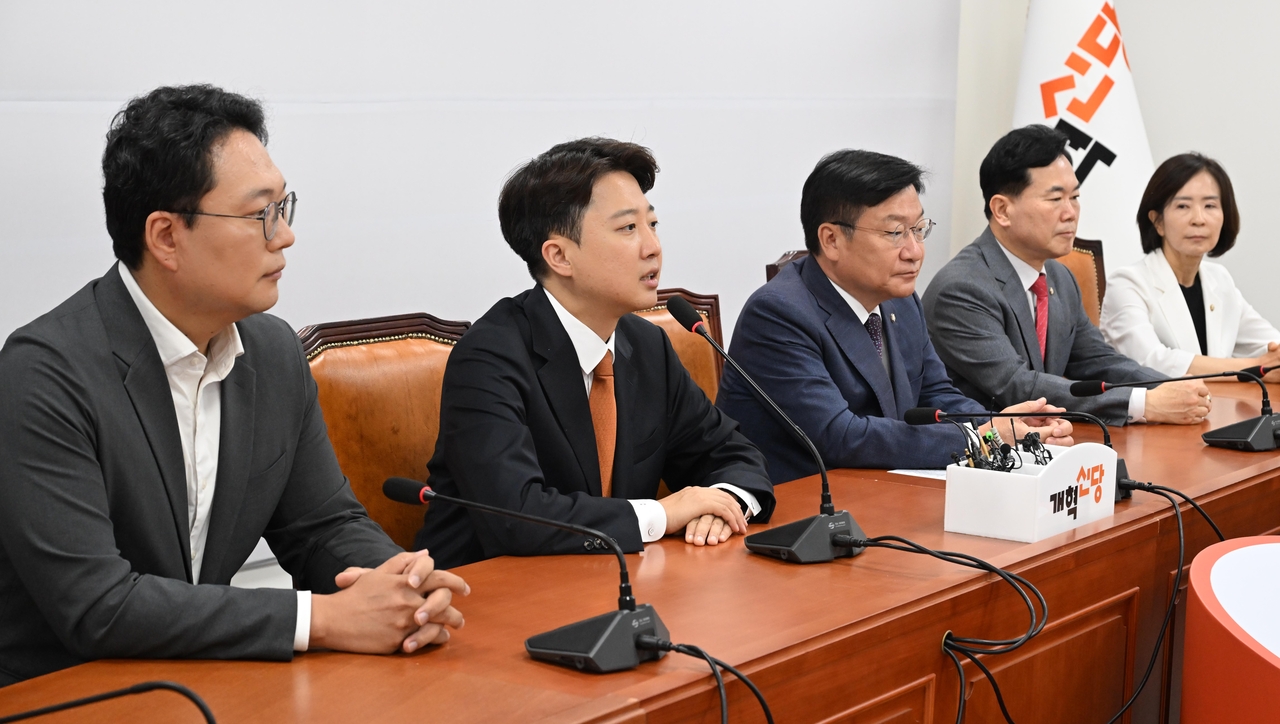
Reform Party leader Lee Jun-seok said three in four citizens found it inappropriate to blame the stock decline on retail investors, adding that "no policy measure can earn public trust if it is built on the perception that market anxiety is the people's fault."
Lee also said citizens identified the government's economic policy as the biggest cause of stock market instability, and called on the president to "conduct a comprehensive review of the entire economic team."
The survey was conducted Thursday by the Reform Research Institute using an automated response system with wireless random-digit dialing. It covered 504 men and women aged 18 and older nationwide. The response rate was 1.73 percent, and the margin of error was plus or minus 4.4 percentage points at a 95 percent confidence level.
thanks@heraldcorp.com




