Concerns are growing that South Korea's digital asset market could lose its competitive edge as the country has yet to define the scope of activities that financial institutions and digital asset businesses are permitted to carry out — even as the United States moves to expand the institutional framework for using public blockchains as financial infrastructure.
Hashed Open Research (HOR), the policy think tank of blockchain investment firm Hashed, said Thursday it had jointly published a report with the Washington-based Solana Policy Institute (SPI) titled "The Future of Digital Assets and Capital Markets: Choices for the US and Korea."
The report said the US is establishing clear institutional pathways for traditional financial institutions to use public blockchains through legislation such as the GENIUS Act and the CLARITY Act. By contrast, it said South Korea continues to face uncertainty in business development because the permitted scope of activities and licensing standards for market participants remain undefined.
HOR and SPI identified overhauling the licensing framework as the top priority for South Korea's digital asset regime. While current discussions have focused on defining the types of licenses, the specific range of activities that banks, securities firms and electronic financial service providers can conduct under their existing licenses has not been concretely established.
On stablecoin payments, the report flagged as key unresolved questions whether securities firms can hold on-chain wallets and whether banks with trust licenses can provide digital asset custody services. It also recommended that financial authorities issue interim operational guidelines even before legislation is enacted.
The report also called for regulatory improvements to activate the real-world asset tokenization market. It noted that in the US, a wide range of assets — including government bonds and funds — are being tokenized through the private placement exemption under Regulation D of the securities laws, which allows asset sales to accredited investors.
The report said South Korea must also establish clear standards for handling dollar-denominated stablecoins, for which demand among domestic companies is high. It noted that even when Korean corporations seek to use Tether (USDT) or Circle (USDC) for payments, remittances and settlement, sufficient standards have not been established for corporate account opening and reserve asset management.
The report also said South Korea should reconsider its approach of building STO infrastructure around private blockchains. Private chains restrict participating institutions, impose cost burdens and can cut off the flow of global capital, it argued.
SPI CEO Miller Whitehouse-Levine cited Solana's Confidential Token Extension as an example, saying privacy concerns "can be sufficiently addressed through technical mechanisms designed to disclose information only upon legitimate requests from regulators."
Kim Hyo-bong, a partner attorney at Bae, Kim & Lee, said the licensing issue "is the most urgent matter for all participants, from issuance to retail distribution," and urged authorities to "quickly present a clear blueprint for what each market participant is permitted to do."
Kim Esther, a researcher at HOR, said "the core issue is not the speed of legislation but its direction," adding that "to channel Korea's world-class manufacturing infrastructure, K-content and high digital adoption into an on-chain ecosystem, the country must break out of its closed framework and move toward an open market."
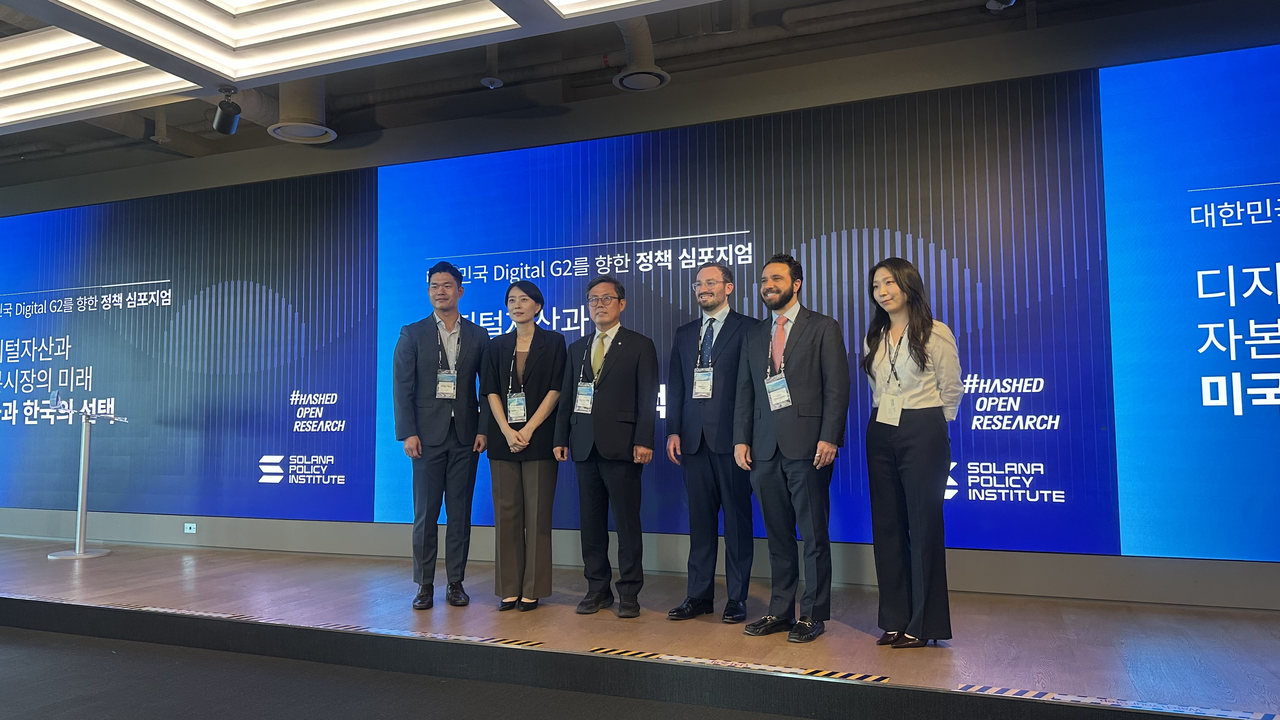
Meanwhile, HOR hosted a policy symposium on June 23 at Hashed Lounge in Gangnam, Seoul, inviting digital asset industry officials, lawmakers and legal experts. Ahn Do-geol, a Democratic Party of Korea lawmaker who attended the event, said the party plans to pass a basic digital asset law in the second half of the year.
kyoung@heraldcorp.com