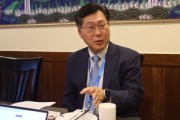
![Moon Jae-ho, director of the Korea Fair Trade Commission's cartel investigation bureau, announces the results of a review into the Korea Laying Hen Association's prohibited conduct as a business operator group at Government Complex Sejong in Sejong on May 14. The Fair Trade Commission ordered the association to cease the practice and imposed a fine of 594 million won ($429,000) after finding it had set a benchmark farmgate price for egg transactions between its member producers, sellers and distributors and notified those members of the price. [Yonhap]](https://wimg.heraldcorp.com/news/cms/2026/07/29/rcv.YNA.20260514.PYH2026051408190001300_P1.jpg)
South Korea's Ministry of Agriculture, Food and Rural Affairs has revoked the nonprofit incorporation license of the Korea Laying Hen Association. The ministry determined that the association's practice of setting farmgate egg prices and notifying its members violated the conditions under which it was incorporated.
The ministry announced Wednesday it had revoked the association's nonprofit incorporation license under Article 38 of the Civil Act.
When the ministry approved the association's incorporation in January 2023, it attached conditions requiring compliance with fair trade law and a ban on setting or notifying members of farmgate egg prices. The association, however, continued to set and notify members of farmgate egg prices until Jan. 21 this year, the ministry said.
The ministry also cited harm to the public interest. The Korea Fair Trade Commission ruled in June that the association's price-setting and notification practice constituted a prohibited act by a business operator group, issuing a corrective order and a fine. The commission found that actual transaction prices had formed around the association's announced prices, effectively restricting price competition.
Before issuing the revocation, the ministry followed procedures required under the Administrative Procedures Act, including advance notice, an opportunity for the association to submit its views, and a formal hearing. After reviewing the association's submissions and hearing statements, the ministry found no grounds sufficient to overturn its findings of a license condition violation and harm to the public interest, and finalized the revocation.
The government said prices should in principle be determined through free competition between producers and sellers in the market. When a specific organization sets prices in advance and notifies its members, farms tend to transact at similar prices, reducing price competition and making it harder for consumers to benefit from fair pricing, the ministry said.
The ministry currently surveys and publishes actual farmgate egg transaction prices through the Korea Institute for Animal Products Quality Evaluation, and plans to pursue regulatory improvements to enhance the reliability and utility of that market data. It also said it would strengthen oversight of producer organizations to ensure they serve the public interest responsibly, and would work to establish fair trading practices and stable egg supply management.
The Korea Laying Hen Association called the revocation unlawful and vowed to pursue legal action, including an administrative lawsuit. The association argued that requiring it to stop announcing prices — a condition unrelated to nonprofit incorporation — had no legal basis under the Framework Act on Administration.
The association also noted that the Fair Trade Commission had cleared it of wrongdoing over its price announcements in 2019, and that governments and private bodies in the United States and Europe similarly provide price information to protect farmers who lack market intelligence. Revoking the incorporation license on the basis of a condition that was itself legally invalid amounted to compounded unlawfulness, it said.
The association said it would challenge the legality of the revocation through an administrative lawsuit and, if it determines that an abuse of authority or excess of discretionary power occurred, would also pursue legal action against the officials responsible.
adastra@heraldcorp.com