Margin financing balances held by investors aged 60 and older at South Korea's major brokerages approached 10 trillion won ($6.82 billion) in the first half of this year — a 181.6 percent jump from the end of 2024. Analysts say the surge reflects demand from retirees looking to grow their savings as the Kospi hit record highs, surpassing 9,300 last month. The index has since tumbled below 7,000, and the scale of forced liquidations by brokerages has also reached record levels. Investment fraud targeting older Koreans is also on the rise, underscoring the need for more cautious investing.
Data submitted to the office of People Power Party lawmaker Kim Sang-hoon by 10 major brokerages — including Mirae Asset, Korea Investment, Samsung, KB, NH, Shinhan, Meritz, Kiwoom, Hana and Daishin Securities — showed that margin financing balances held by investors in their 60s and older stood at 9.61 trillion won as of end-June. Those in their 60s accounted for 7.14 trillion won, while investors aged 70 and older held 2.47 trillion won. Together, they represented 30.4 percent of the total margin financing balance of 31.62 trillion won.
Margin financing balances refer to the outstanding amount investors have borrowed from brokerages for stock investments and not yet repaid — a widely watched indicator of debt-fueled investing.
The total margin financing balance, which stood at 13.53 trillion won at the end of 2024, grew to 23.2 trillion won by the end of last year before swelling to the 31 trillion won range in the first half of this year. By age group, investors in their 50s held the largest balance at 9.8 trillion won, followed closely by those aged 60 and older at 9.61 trillion won.
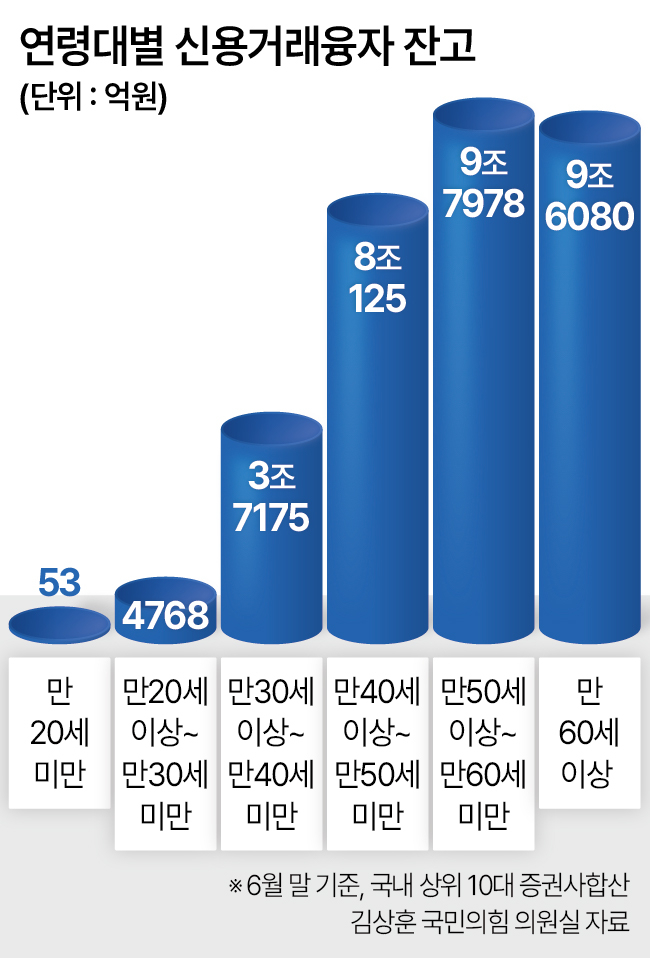
The pace of growth was particularly steep among investors in their 60s and 70s. Margin financing balances held by investors aged 70 and older surged 224.4 percent, from 761.6 billion won at end-2024 to 2.47 trillion won by end-June this year. Those in their 60s rose 169.3 percent over the same period, from 2.65 trillion won to 7.14 trillion won. Both figures far exceeded the overall growth rate of 133.6 percent, ranking first and second among all age groups — excluding those under 20, whose balances are negligible. The two groups with the largest absolute balances — investors in their 50s (up 111.7 percent) and 40s (up 114.7 percent) — actually grew below the average.
June stands out as a particularly telling month. As market volatility intensified — driven by concerns over overvaluation in AI semiconductors and the launch of single-stock leveraged ETFs in late May — circuit breakers were triggered three times, prompting most age groups to cut their margin balances. Investors in their 60s and 70s, however, continued to expand their debt-fueled positions even amid the turmoil.
Analysts see this as a warning sign. Most investors aged 60 and older are retirees with little or no earned income. When share prices fall sharply and collateral ratios deteriorate, brokerages are forced to liquidate holdings — meaning losses translate directly into the erosion of retirement savings. The weight of that risk differs fundamentally from what working-age investors face, given their remaining capacity to repay.
Forced liquidations on margin loans have expanded sharply this year. The amount jumped 596.5 percent, from 56.5 billion won in January to 393.5 billion won by end-June. Among investors in their 60s and those aged 70 and older, forced liquidations surged more than 700 percent compared with January — outpacing every other age group.
Investment fraud targeting older Koreans is also rampant. Common schemes include illegal stock-tip group chats run by people impersonating financial influencers, fraud involving unlisted shares marketed as imminent listings, and scams tied to private trading programs.
Hong Ji-yeon, a senior researcher at the Korea Capital Market Institute, said margin trading amplifies buying demand during rallies but intensifies selling pressure through forced liquidations during downturns — a procyclical dynamic. "Given the retail-dominated market structure and limited hedging tools available, volatility is likely to increase as leverage is unwound going forward," Hong said. "Sustained risk management and policy responses are needed."

jiyun@heraldcorp.com
hajun825@heraldcorp.com