This month, corporate dollar borrowing has jumped sharply as the won-dollar exchange rate reversed course and began strengthening. Dollar loan balances at the five major banks rose 19.4% from the previous month in July, marking the largest increase both in rate and in absolute amount so far this year. Companies chose to borrow dollars directly rather than converting won at current rates, betting the exchange rate will fall further.
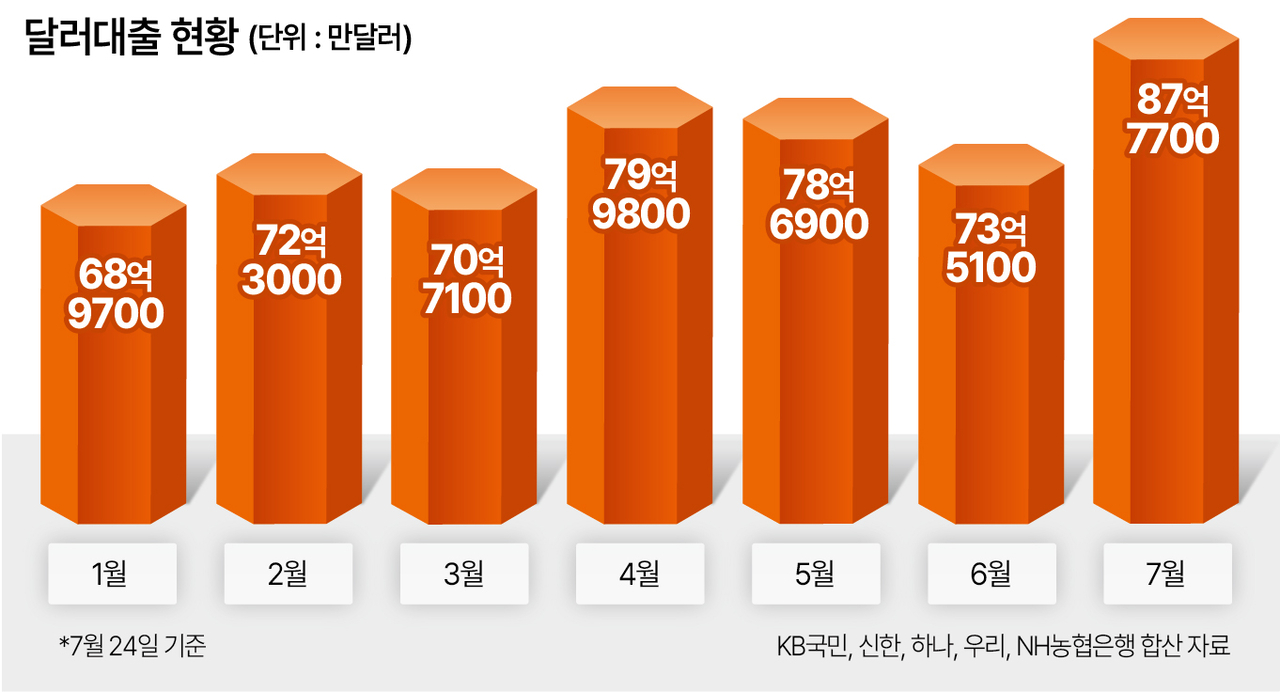
Dollar loan balances at the five major banks — KB Kookmin, Shinhan, Hana, Woori and NH NongHyup Bank — stood at $8.78 billion as of Friday, up 19.4%, or $1.43 billion, from the previous month's $7.35 billion, according to financial industry data released Tuesday. Both the rate of increase and the absolute gain were the largest recorded this year, and the outstanding balance also hit its highest level of the year.
Dollar loan balances had climbed from $6.9 billion in January to $8 billion in April before declining for two consecutive months in May and June. They rebounded sharply in July.
The rebound reflects a pronounced strengthening of the won this month. The won-dollar rate peaked at 1,550.80 won on July 2 before falling 82.30 won, or 5.3%, to 1,468.50 won on Monday — the first time the closing rate had entered the 1,460-won range in roughly two and a half months.
The Bank of Korea's benchmark interest rate hike, a better-than-expected economic growth rate, and improved foreign-currency supply and demand all drove the won's strength. The Bank of Korea's Monetary Policy Board raised the benchmark interest rate by 25 basis points to 2.75% on July 16. Second-quarter GDP growth also came in well above market forecasts, fueling expectations of further rate increases.
Foreign investors' net selling of domestic shares — a factor that had pushed the exchange rate higher since May — swung to net purchases of 5.47 trillion won this month, also contributing to the won's appreciation. A rise in dollar sales by export companies added further support.
Dollar loans allow companies that need dollar funding to borrow the currency directly rather than converting won, using the proceeds as working capital. By borrowing dollars now instead of exchanging won at the current elevated rate, a company can reduce its won-denominated repayment burden if the exchange rate falls by the time the loan comes due. Given that dollar loans are typically short-term working capital facilities with maturities of one year or less, the recent surge in borrowing appears to reflect a corporate calculation that the exchange rate will keep declining for now.
A commercial bank official said demand for actual dollar funding had remained steady, but borrowers had grown reluctant to convert won at elevated exchange rates to obtain dollars, driving up demand for direct dollar loans. "There is also a judgment that if the exchange rate falls further in the second half of the year, borrowers could even pocket exchange-rate gains," the official added.
Deregulation of foreign-currency lending has also been cited as a factor behind the rise in dollar borrowing. Resident foreign-currency loans had in principle been restricted to overseas end-use demand, to prevent excessive foreign-currency borrowing. The Bank of Korea moved to ease those restrictions to improve foreign-currency supply and demand — first allowing export companies to take out foreign-currency loans for domestic facility investment in late February last year, then expanding the scope to include domestic working capital from Feb. 27 this year.
Eligibility is limited to companies engaged in exports as defined under Article 2 of the Enforcement Decree of the Foreign Trade Act; sole proprietors and small business owners are excluded. The borrowing limit is capped at a company's export performance over the preceding year or its projected exports for the current year. The change has effectively broadened corporate financing options, letting companies choose between won-denominated and foreign-currency loans based on whichever carries a lower funding cost.
The key question is whether the exchange rate moves as borrowers expect. If the rate reverses by the time a loan comes due, the full won-denominated repayment burden falls on the borrower. That risk is why banks have begun tightening risk management at the point of extending dollar loans. Another commercial bank official said lenders were scrutinizing each corporate borrower's dollar fund management plan and actual working capital needs before approving loans.
won@heraldcorp.com