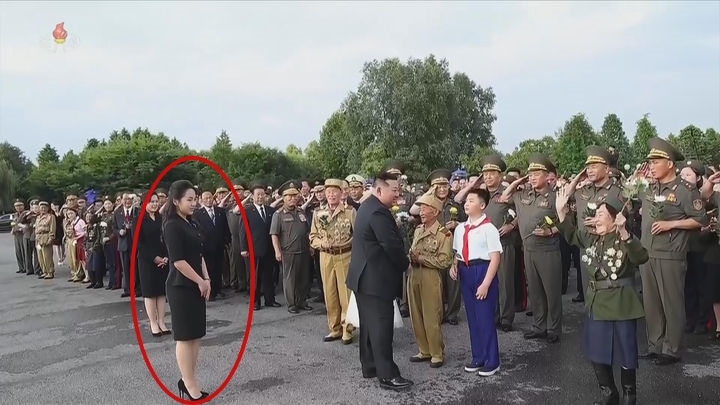
North Korean leader Kim Jong-un visited a war martyrs' cemetery Sunday alongside his wife, Ri Sol-ju, and daughter Kim Ju-ae to mark the 73rd anniversary of the Korean War armistice — an occasion Pyongyang calls "Victory Day." Kim Ju-ae, making her first public appearance in roughly two months, stood between her parents and joined in laying flowers, prompting analysts to read the appearance as a deliberate message about the succession line.
North Korea's Korean Central Television reported Monday that Kim visited the Fatherland Liberation War Martyrs Cemetery in Pyongyang, the Taesongsan Revolutionary Martyrs Cemetery, and the Chinese People's Volunteer Army Martyrs Cemetery in Hoechang County, South Pyongan Province, on Sunday.
Footage released by state media showed Kim Jong-un, Ri Sol-ju and Kim Ju-ae arriving together at the martyrs' cemetery. Dressed in a black dress and high heels, Kim Ju-ae stood between her parents as the family laid flowers, and she was also seen standing directly behind her father as he greeted Korean War veterans.
The appearance marked Kim Ju-ae's first public outing in 52 days, since June.
At the Fatherland Liberation War Martyrs Cemetery, Kim Jong-un described the Korean War as "a great victory in which newborn Korea, in a lopsided battle against the imperialist ringleader the US and its followers, defended to the death not only the dignity and sovereignty of the state but also world peace and security."
He said "the miracle of July 27" was "a precious ideological and spiritual asset that must be thoroughly inherited without the slightest change, generation after generation, as the nation grows stronger and the gains of the revolution accumulate."
North Korea consistently frames the Korean War as a victory over US aggression and emphasizes that successive generations must carry on the spirit of what it calls the "victorious generation."
Lim Eul-chul, a professor at Kyungnam University's Institute for Far Eastern Studies, said the armistice anniversary "symbolizes the historical legitimacy of defending the North Korean system." He said the image of the third generation — Kim Jong-un — and the fourth generation — Kim Ju-ae — laying flowers together at the martyrs' cemetery "is designed for domestic propaganda effect, signaling that the bloodline of revolutionary achievement and anti-US, self-reliant struggle is firmly passing to the fourth generation."
Kim then visited the Taesongsan Revolutionary Martyrs Cemetery, where he knelt and laid flowers before busts of Kim Chaek, Kang Kon and Choe Hyon. He also paid tribute to Chinese soldiers killed in the war at the Chinese People's Volunteer Army Martyrs Cemetery in Hoechang County. Ri Sol-ju and Kim Ju-ae did not accompany him on those visits, however.
At the Chinese People's Volunteer Army Martyrs Tower, Kim placed a wreath in his own name and personally laid flowers at the grave of Mao Anying — the eldest son of former Chinese leader Mao Zedong, who was killed in action during the Korean War.
North Korean state media said Chinese soldiers "helped our people's just war with their blood during the most difficult, fateful years," calling the sacrifice "the cornerstone of China-North Korea friendship centered on socialism." The tributes were seen as an effort to reaffirm the two countries' "blood alliance" on the occasion of Victory Day.
Ministry of Unification spokesperson Yun Min-ho said the ministry would "monitor related developments, as North Korea has signaled that a grand celebration marking the 73rd anniversary of Victory Day will be held in Pyongyang."
Analysts have taken note of Kim Ju-ae's repeated appearances at major state events. Her participation in a symbolically charged memorial ceremony alongside both parents — standing at the center of the proceedings — is being read not as a simple family outing but as a political performance intended to project, both domestically and internationally, the legitimacy of power succession within the Kim family and the cohesion of the regime.
rainbow@heraldcorp.com