
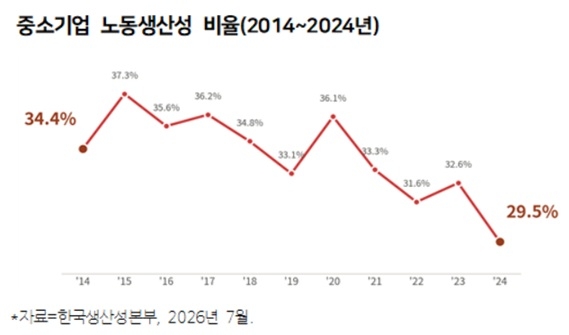
The productivity gap between large companies and small and medium-sized enterprises has widened to its largest in a decade. SME labor productivity stood at 29.5 percent of large firms' in 2024, the lowest level since 2014, when it was 34.4 percent.
The Korea Productivity Center (KPC), chaired by Park Sung-joong, released a report Monday analyzing labor productivity in the manufacturing sector by company size and industry.
According to the report, average labor productivity per worker at large manufacturers — measured as real value added divided by the number of employees — reached 460 million won ($314,000) in 2024, up 8.2 percent from the previous year. At small and medium-sized enterprises, the figure fell 2.0 percent to 136 million won.
By industry, the widest gaps appeared in coke and petroleum refining and in electronic components and telecommunications. Both sectors require large-scale capital investment and are dominated by a small number of major firms, concentrating production at the large-company level.
Overall manufacturing productivity rose 4.7 percent to 224 million won, rebounding from a 5.5 percent decline the previous year, when it stood at 214 million won. The recovery was driven largely by the semiconductor boom.
Semiconductor production and exports surged on the back of growing investment in AI servers and rising demand for data center construction. Real value added grew 6.9 percent while the workforce expanded by only 2.1 percent, pushing productivity higher.
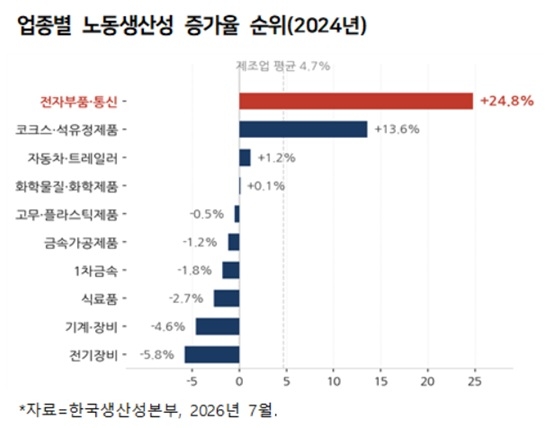
The electronic components and telecommunications sector led the improvement in overall manufacturing productivity, though the gains did not translate into broader job creation.
Productivity in the sector grew 24.8 percent — more than five times the manufacturing average of 4.7 percent. Over the decade from 2014 to 2024, the sector posted average annual productivity growth of 7.2 percent, more than three times the manufacturing-wide average of 2.2 percent, reflecting a structural shift toward semiconductor-driven gains.
Strip out electronic components and telecommunications, and productivity declined across a wide range of traditional manufacturing industries: primary metals fell 1.8 percent, fabricated metal products 1.2 percent, non-metallic minerals 5.5 percent and food products 2.7 percent.
The KPC said the recovery in the semiconductor sector drove the improvement in manufacturing labor productivity, while traditional industries such as basic materials and light manufacturing continued to struggle. The productivity gap between large firms and SMEs, as well as between regions, has also widened, it added, calling for diversification away from a semiconductor-centric industrial structure to broaden the manufacturing growth base and for stronger supply chain linkages to spread productivity gains from large firms to SMEs.
freiheit@heraldcorp.com




