![A screenshot of "Yubin Archive," an illegal college entrance exam material sharing channel operating on Telegram. [Yoon Seung-hyeon/The Herald Business]](https://wimg.heraldcorp.com/news/cms/2026/07/24/news-p.v1.20260724.dc0287fae37f486f90fd7370de66dcdf_P1.png)
Last year, authorities arrested the operator of "Yubin Archive," a Telegram channel used to share exam-preparation materials — including test papers produced by hagwon in the Daechi-dong district — and shut the channel down. At its peak, it had more than 300,000 members. Now the channel has resurfaced under the same name.
A newly established nonprofit that accepts no donations, with the goal of narrowing the education gap and reducing private tutoring costs.
That is how Yubin Archive, operating on Telegram, describes itself. As of Friday, 268,000 people had joined the channel. Anyone who needs exam materials — students and others alike — can enter simply by searching online, with no identity verification or password required. Beyond the main materials room, the channel runs a network of related sub-channels: a chat room, an information room, a question room, subject-specific materials rooms and a marketplace.
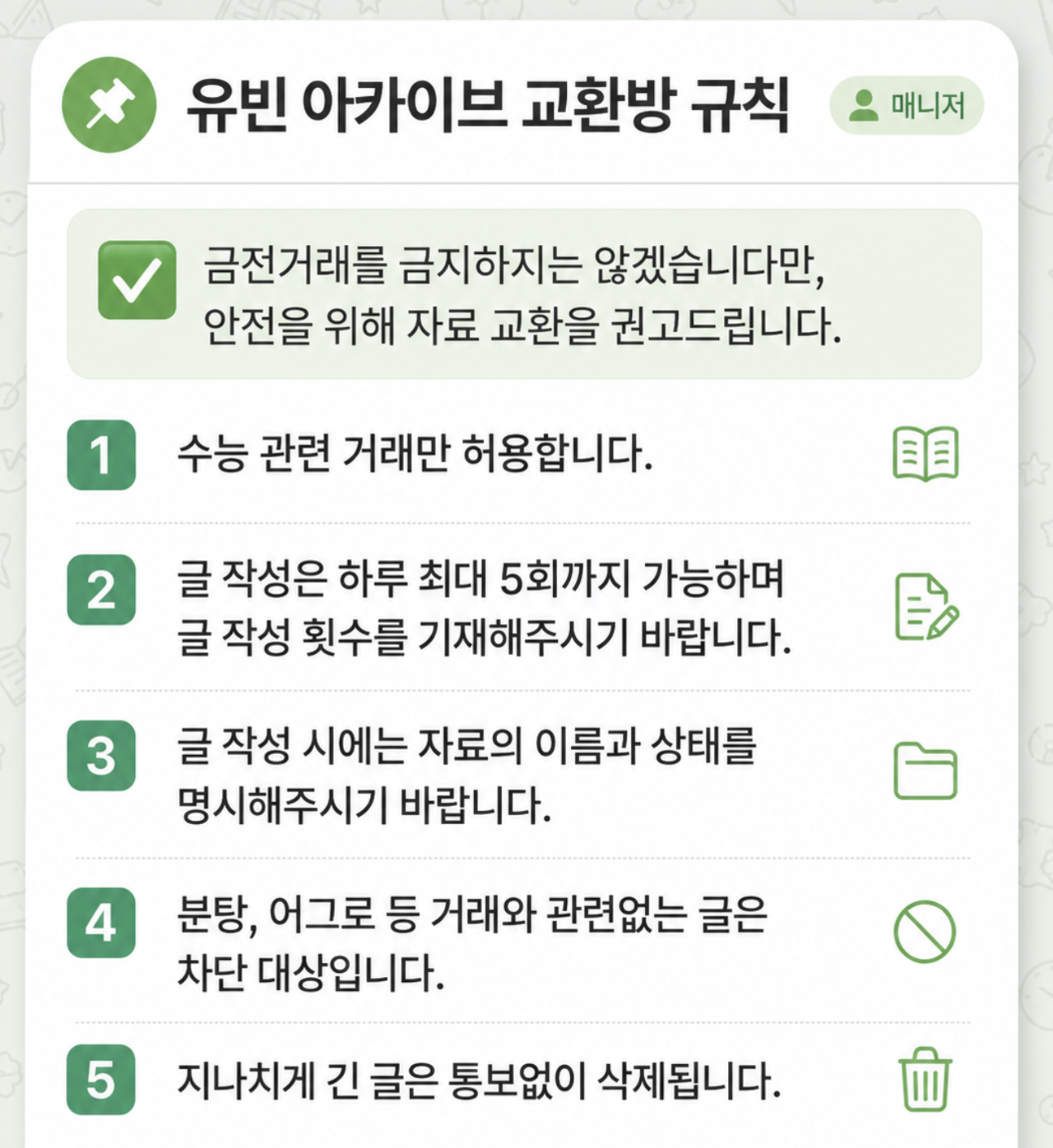
More than 5,000 people have joined the marketplace, where students buy, sell and swap exam-prep PDF files. The channel's rules state: "We will not prohibit monetary transactions, but we recommend material exchanges for safety." Users post with tags such as "buying" or "swapping," listing the private mock exams or hagwon materials they want alongside what they have to offer. From early morning to well past midnight, requests to buy or trade materials flow in without pause.
Operator arrested, channel shut — then 260,000 students came back
Yubin Archive has already been through one government investigation. The operator of the original channel, opened in July 2023, was arrested in August last year by the Ministry of Culture, Sports and Tourism's copyright crime investigation unit. The operator was found to have earned revenue through paid sharing rooms and was referred to prosecutors in December last year.
But demand for illegal exam materials did not disappear. Because the hundreds of thousands of users at the time were too numerous to investigate individually, the probe focused on the operator.
After the original channel was shut down, a new one appeared under the same name and, in roughly a year, grew to 260,000 members. The identity of the new operator is unknown.
An official from the Ministry of Culture, Sports and Tourism's copyright special judicial police unit said there had been a practical limit to what investigators could do. "There were so many students using it at the time that we simply could not investigate all of them," the official said. "We had no choice but to focus the investigation on the operator."
According to the ministry, investigations into illegal exam material sharing have continued since August last year, but no additional operators have been arrested and no major sharing channels have been shut down. The Daejeon District Prosecutors' Office said the case involving the original operator is "currently under investigation."
'Three textbooks for 160,000 won' — cost drives students to PDF channels
Students say the main reason they use illegal PDF channels — even knowing it is against the law — is the high cost of exam-prep content.
Im, an 18-year-old high school senior preparing for the College Scholastic Ability Test, said he doubted many test-takers avoided PDF channels altogether. "Even if you pay for a pass on an online lecture site, you still have to buy the textbooks separately," he said. "A few days ago I put three textbooks in my cart and it came to 160,000 won ($109)."
Im said downloading free materials and having them printed and bound allowed students to cut textbook costs on top of their online lecture pass fees. "Most people around me are usually in several PDF channels at the same time," he said.
Particularly heavy is the cost of private practice mock exams — known as "silmo" — that students work through repeatedly in the run-up to the CSAT. Major private mock exams produced by well-known instructors, large repeat-year hagwon and online lecture companies sell for roughly 10,000 to 30,000 won per subject.
Ryu Hyeon-seo, 19, who sat the CSAT last year and now attends Korea University, said she sometimes worked through a Korean language or mathematics mock exam every day after summer vacation. "I never calculated it exactly, but there were weeks when I spent more than 100,000 won on private mock exams," she said.
Beyond cost, analysts say exam anxiety — the fear of not having been exposed to a wide enough range of questions — also pushes students to seek out materials illegally. A 25-year-old instructor at a repeat-year comprehensive hagwon class said many students believed that the more mock exams they completed, the better. "There is probably an element of anxiety — the feeling that they need to encounter as many different question types as possible, beyond just their own hagwon or instructor — that drives them to these material-sharing channels," the instructor said.

'Every question costs money to make' — hagwon industry decries illegal distribution
The hagwon industry pushes back against the idea that private mock exams and textbooks are mere "paper materials," stressing that they are copyrighted works produced at considerable expense.
Im Seong-ho, head of Jongno Hagwon, said producing a single question requires developers, reviewers, editors and designers, all of which entail significant labor and fixed costs. "Even the design is subject to copyright," he said.
He added that even teachers at hagwon are extremely cautious about using outside printed materials because of copyright concerns. "We also receive a considerable number of tips about illegal material distribution through our monitoring," he said.
An official at another major exam-prep company said instructors at smaller hagwon, not just large ones, were also known to use illegal sharing channels such as Yubin Archive. "They say they do it to survive, but when you think about the production costs and labor that go into every single question, it is infuriating," the official said.
A current teacher offered a more skeptical view of the value of materials from illegal sharing channels. A high school teacher in Gyeonggi Province said that for students who are not at the very top, downloading and working through large volumes of materials and mock exams yields little benefit. "Reviewing EBS textbooks linked to the CSAT during that time is more effective," the teacher said.

'Illegal even with public interest goals' — crackdowns hit limits with hundreds of thousands of users
Experts say the justifications the channel puts forward — narrowing the education gap and reducing private tutoring costs — do not shield it from copyright liability.
Jeong Sang-jo, a professor at Seoul National University School of Law, said that even if the channel's stated purpose is to reduce educational inequality, operating or managing a space while knowing the shared materials are illegal copies makes it difficult to escape liability. "The greater the degree of involvement — going beyond simply providing a sharing space to classifying and archiving materials — the greater the legal responsibility could become," he said.
Jeong Yeon-deok, a professor at Konkuk University School of Law, said that if paid mock exams are non-public materials not yet released to the general public, sharing them could constitute an infringement of the author's right of disclosure. "Claiming a public interest purpose does not allow one to avoid copyright liability," he said. He added that even if an operator did not personally copy or upload materials, managing and running a space where illegal sharing takes place could give rise to aiding-and-abetting liability.
However, experts note that with hundreds of thousands of students actually sharing and using illegal materials, enforcement alone has practical limits, and copyright education by itself is unlikely to suppress demand.
Jeong said copyright education has been ongoing for many years, but students tend to use materials intensively during the specific period when they are preparing for exams and then move on. "It will not be easy to stamp out illegal exam material sharing by simply cracking down on operators or stepping up copyright education," he said.

brunch@heraldcorp.com