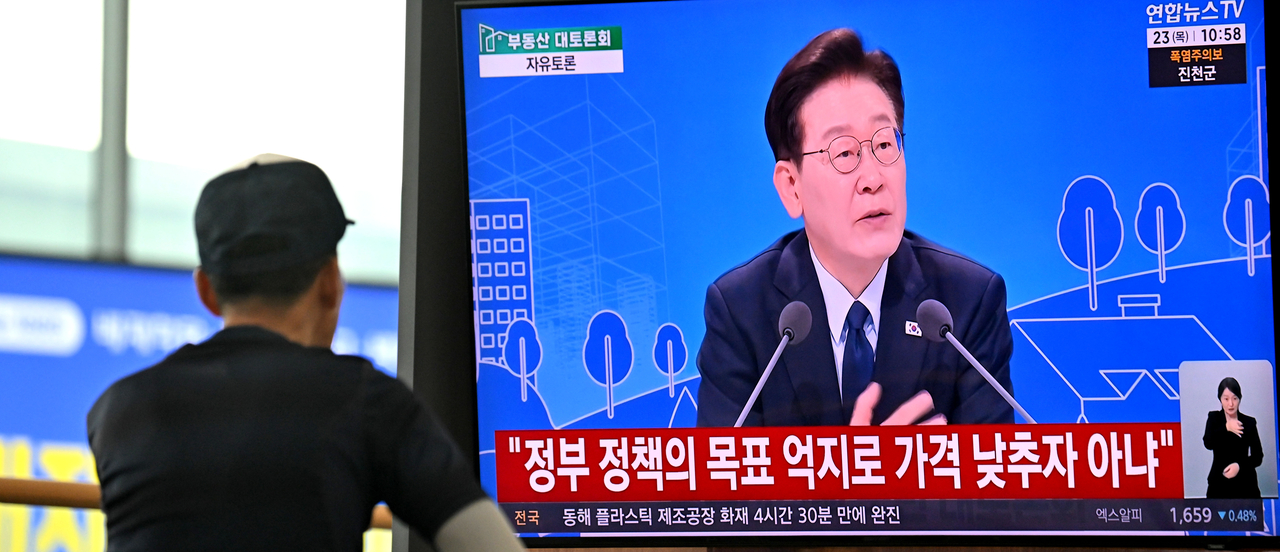
President Lee Jae Myung's job approval rating has edged down for three consecutive weeks, according to a new poll.
In Gallup Korea's fourth-week July survey released Friday, 51 percent of respondents gave a positive assessment of Lee's job performance. Thirty-eight percent said he was doing poorly, while 11 percent offered no opinion.
The survey was conducted Tuesday through Thursday among 1,003 people aged 18 and older nationwide. Lee's approval rating has fallen 1 percentage point each week for three straight weeks since the first-week July survey, which recorded 54 percent.
Among those who rated Lee positively in the fourth-week survey, "diplomacy" was cited most often at 17 percent, followed by "economy and livelihoods" at 15 percent, "doing well overall" at 9 percent and "communication" at 8 percent. Among negative assessments, "real estate policy" topped the list at 22 percent, followed by "economy, livelihoods and the high exchange rate" at 10 percent, "doing poorly overall" at 7 percent and "ethical issues and avoiding his own trial" at 5 percent.
By party, the Democratic Party of Korea recorded 44 percent support and the People Power Party 23 percent. Compared with the previous survey, the Democratic Party rose 4 percentage points while the People Power Party fell 3 percentage points. The Rebuilding Korea Party and the Reform Party each stood at 2 percent, the Progressive Party at 1 percent, and those with no party affiliation at 27 percent.
The survey was conducted via telephone interviews using randomly selected virtual mobile numbers. The margin of error is plus or minus 3.1 percentage points at a 95 percent confidence level, with a contact rate of 39.7 percent and a response rate of 10.7 percent. Further details are available on the website of the National Election Survey Deliberation Commission.
bigroot@heraldcorp.com