![A postal worker sorts comprehensive real estate tax notices at a Seoul post office. [Yonhap]](https://wimg.heraldcorp.com/news/cms/2026/07/22/rcv.YNA.20241126.PYH2024112616000001301_P1.jpg)
As the prospect of higher property holding taxes on ultra-high-priced single-home owners grows, the threshold question is set to become a central flashpoint at a major real estate policy forum Thursday. Where the line is drawn will determine whether the tax falls mainly on Gangnam or spreads across all eight districts of the Han River belt — Seongdong-gu, Yangcheon-gu, Yongsan-gu, Dongjak-gu, Gangdong-gu, Gwangjin-gu, Mapo-gu and Yeongdeungpo-gu.
President Lee Jae Myung signaled his intent to overhaul the tax system at a Cabinet meeting Tuesday, saying the government would ensure "the tax regime is reorganized fairly and reasonably, grounded in the common sense and expectations of the people." The government is also reviewing plans to strengthen holding taxes on ultra-high-priced and non-resident single-home owners, as well as a temporary reduction in capital gains taxes, ahead of a planned announcement of real estate tax law amendments later this month. Market watchers broadly expect the threshold for ultra-high-priced homes to be set somewhere between 3 billion and 5 billion won ($2.19 million to $3.65 million).
An analysis of Seoul apartment market prices as of July 10 by Budongsan114 found that 29,969 units — about 2.0 percent of Seoul's total 1,469,011 apartments — were valued above 5 billion won.
Setting the threshold at 5 billion won would concentrate the tax burden on Gangnam and Yongsan. Among districts, Gangnam-gu had the most units priced above 5 billion won at 14,855, followed by Seocho-gu with 10,315, Yongsan-gu with 2,388 and Songpa-gu with 1,023. Together these four districts account for 95.4 percent of all Seoul apartments above 5 billion won, making it in effect a "Gangnam tax."
Lowering the threshold to 3 billion won, however, would extend the tax's reach across the Han River corridor. In Yeongdeungpo-gu, 7,308 units exceeded 3 billion won, followed by 5,373 in Yangcheon-gu, 2,732 in Seongdong-gu and 1,261 in Gwangjin-gu.
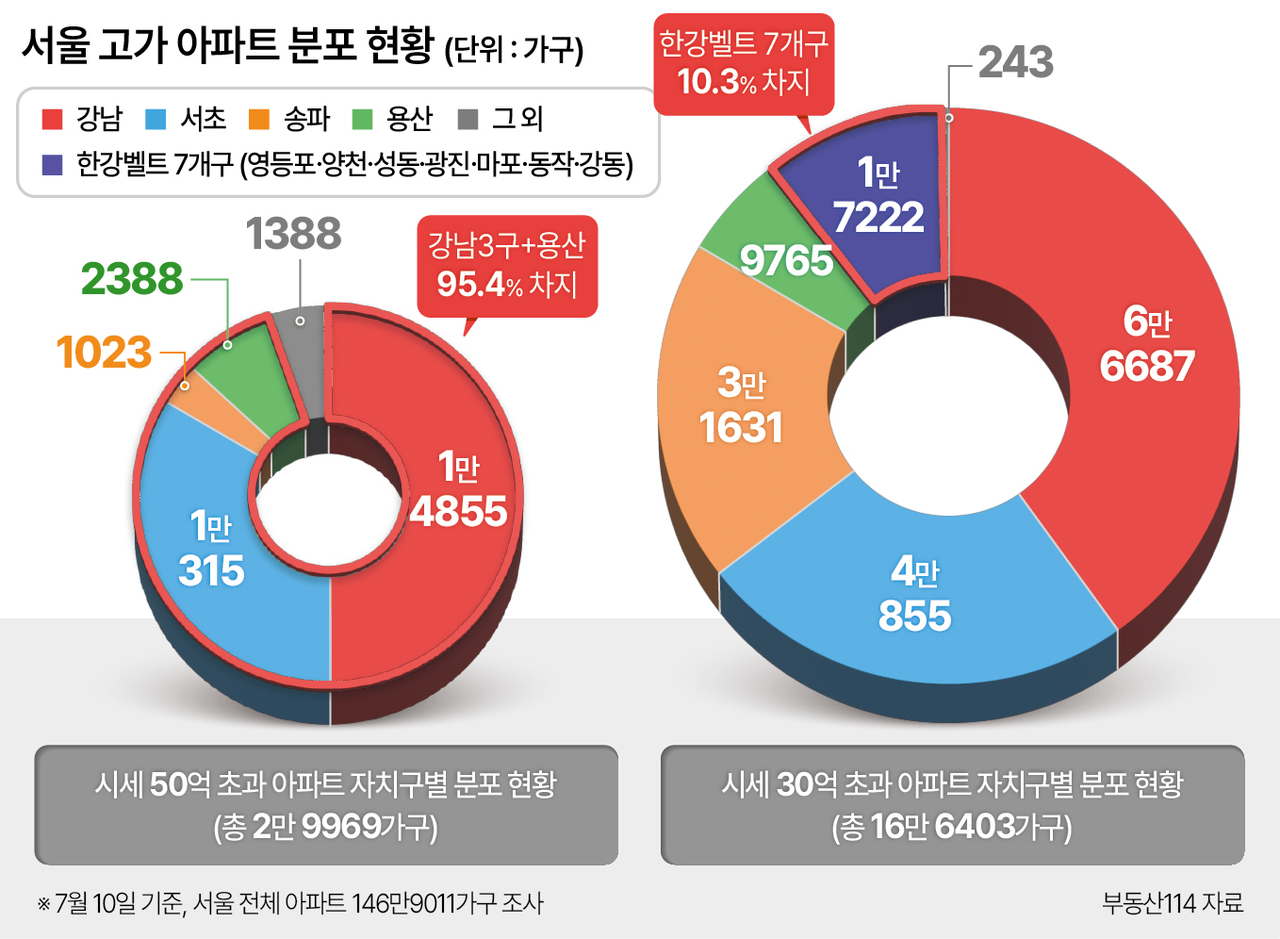
Outside the three Gangnam districts and Yongsan-gu, 17,465 units exceeded 3 billion won — more than 10 percent of all such apartments citywide. Should the ultra-high-priced threshold be set at 3 billion won, a significant number of Han River belt households could find themselves subject to the tax.
Transactions above 3 billion won have in fact been occurring with increasing frequency in major Han River belt complexes. According to the Ministry of Land, Infrastructure and Transport's actual transaction price disclosure system, a total of 1,918 apartment deals worth 3 billion won or more were recorded in Seoul this year as of Wednesday. Of those, only 10 transactions — nine in Jongno-gu and one in Jung-gu — took place outside the three Gangnam districts, Yongsan-gu and the Han River belt.
By district, the breakdown was: Gangnam-gu (625 transactions), Seocho-gu (485), Songpa-gu (482), Yongsan-gu (153), Yeongdeungpo-gu (68), Yangcheon-gu (44), Seongdong-gu (21), Gwangjin-gu (11), Gangdong-gu (11), Jongno-gu (9), Mapo-gu (4), Dongjak-gu (4) and Jung-gu (1).
The head of a real estate agency in Jayang-dong, Gwangjin-gu, said apartments in the district had never previously crossed the 3 billion won mark, but that newly built large-unit complexes and those approaching reconstruction had begun recording such transactions this year, with asking prices above 3 billion won now common in a number of complexes. "These are neighborhoods that never even worried about the existing comprehensive real estate tax, and now there's sudden anxiety about being hit by an ultra-high-priced property levy all at once," he said.
Experts warn that setting the threshold too low could impose an excessive tax burden on long-term single-home owners whose actual income or cash flow has not increased.
Park Hap-su, an adjunct professor at Konkuk University's Graduate School of Real Estate, said not every owner of a high-priced home in Gangnam or along the Han River has realized speculative gains. "A home purchased for 500 million to 1 billion won long ago may now be appraised at 7 billion to 8 billion won, but if it has not been sold, no actual cash has come in — it is nothing more than a paper gain," he said. He added that imposing excessive holding taxes on such owners would only increase the burden on long-term single-home owners who do not have high incomes.
Park said some overseas jurisdictions, such as the state of California, cap the rate at which assessed values can rise by anchoring them to the original purchase price. "When discussing taxes on single-home owners, we need to broadly consider not just the current market price but also the purchase price, the length of ownership and income levels," he said.
quq@heraldcorp.com