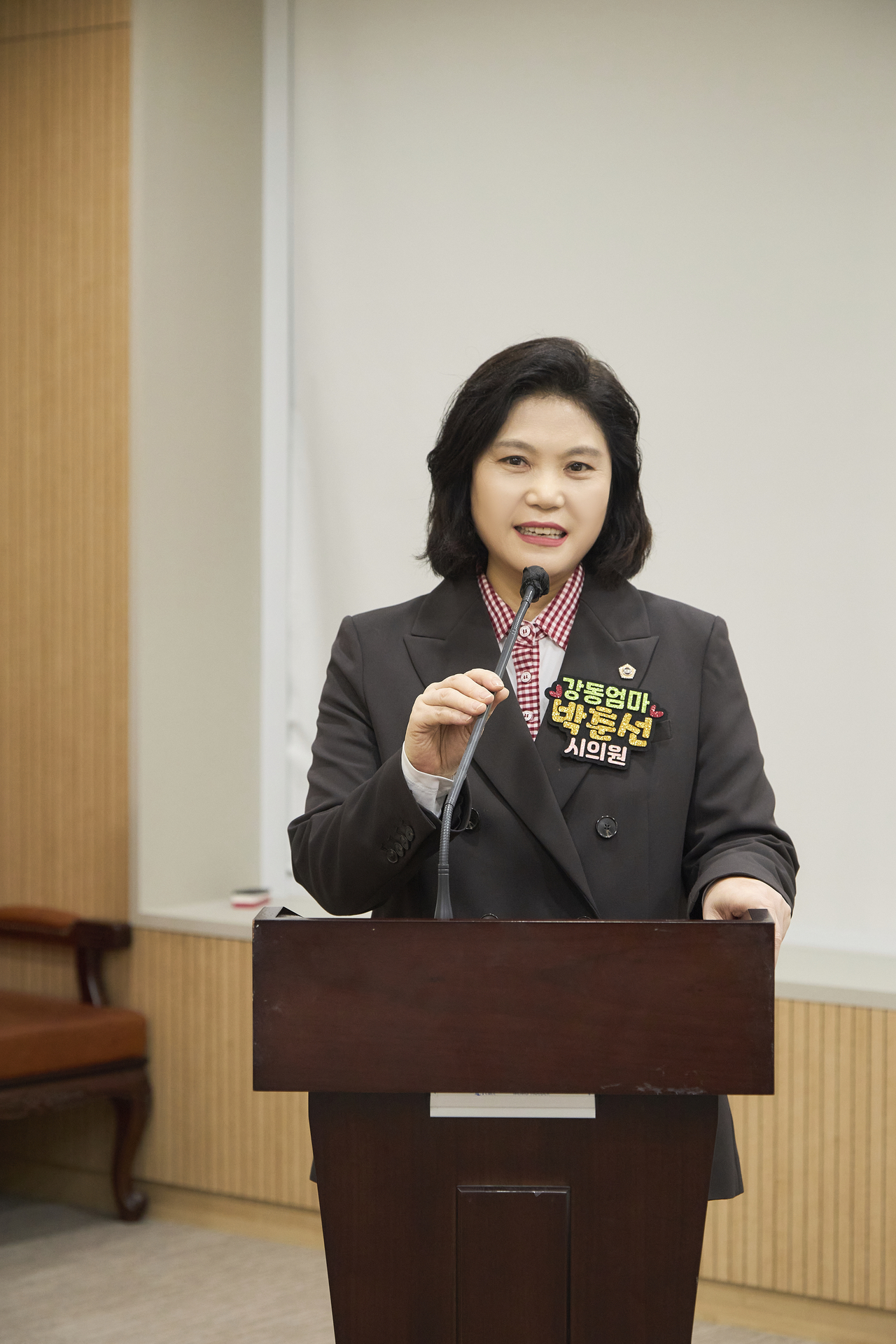
"I want residents to feel that their neighborhood has a council member they can truly trust."
Park Chun-sun, a Seoul Metropolitan Council member representing Gangdong District 2 for the People Power Party, said she will focus her next four years on education, reconstruction and redevelopment, the low birth rate, and expanding everyday infrastructure. Her goal is to deliver changes that residents can feel in their daily lives amid Gangdong-gu's rapidly shifting urban landscape, while building a sustainable foundation for the district's future.
In an interview Tuesday, Park said she would not lose sight of her original commitment. "Since residents have chosen me again, I will continue grassroots politics that finds answers on the ground," she said. "I will build on the achievements of the 11th council term and carefully address what fell short, to improve residents' quality of life."
During the 11th Seoul Metropolitan Council term, Park worked to translate long-standing community priorities into policy and budget — including environmental improvements along Godeokcheon stream, Han River waterfront upgrades, expanded sports facilities at Gwangnaru Han River Park, and improvements to local parks.
In education, she pushed to introduce Seoul-style urban campuses and modular classrooms to address overcrowded schools driven by rapid population growth. She focused on identifying residents' everyday inconveniences firsthand and working with the Seoul Metropolitan Government, the Seoul Metropolitan Office of Education, and other agencies to turn those findings into policy.
Reconstruction and education: 'We must also raise the city's quality'
Park said she plans to place greater emphasis on education and urban development in the 12th council term. A redistricting change that brought Myeongil-dong into her constituency has made improving aging residential environments and expanding education infrastructure her top priorities.
She said both Myeongil-dong and Sangil-dong urgently need urban infrastructure upgrades to keep pace with redevelopment, reconstruction and population growth. Myeongil-dong requires a stable push for aging housing redevelopment and reconstruction, she said, while Sangil-dong needs expanded transportation networks and education facilities to handle its rapid population increase.
Park said the focus must shift away from housing supply alone toward balanced urban planning that pairs new development with transportation, education, green space, welfare and everyday amenities.
"Redevelopment and reconstruction are not simply about building new homes — they are a process of redesigning the city to improve residents' quality of life," she said. "A city's quality rises only when transportation, education, green space and everyday amenities are all in place together."
Improving the educational environment is also a key legislative priority, she said. Beyond tackling overcrowded classrooms, commuting safety and aging school facilities, she plans to work on building a long-term education foundation that accounts for student population growth accompanying urban development.
The low birth rate is the issue Park has followed most closely over her career. Drawing on her experience working in the fertility treatment field, she has connected infertility support and childbirth policies to Seoul Metropolitan Government programs, and has contributed to infant and toddler care policy discussions within the party's low birth rate working groups.
She said the low birth rate must not be approached through birth statistics alone. Infertility support, housing, childcare, caregiving and work-life balance policies must be organically linked, she said, before young people can feel secure enough to choose to have and raise children.
While Seoul's low birth rate policies have produced some results, she said, the city must keep a close watch on blind spots — people who miss out on benefits because they are unaware of available programs, or who fall outside eligibility criteria.
"The process of a person being conceived and born cannot be explained by policy numbers alone," Park said. "Low birth rate policy must ultimately begin with genuine care and attention toward people."

'Turning small everyday inconveniences into policy'
Another defining thread of Park's legislative work is grassroots politics. Whether drafting ordinances or advancing local projects, she consistently starts by listening to residents and then channels their input into administrative action and budget allocations.
She said an equally important part of the job is working through feasibility together with residents, and when something cannot be done, explaining clearly why and how the process unfolded.
Park also takes part in plogging events, park clean-ups and community gatherings to stay in natural contact with residents and bring their voices into policy.
She gets around by bicycle and public transit for the same reason — personally checking conditions on side streets, roads, parks and public transportation to spot residents' inconveniences and identify new policy needs.
Park describes herself as the "Gangdong mom" — a way of saying she looks after everyone in the community, from children and young people to parents and the elderly, as if they were family.
"I will not lose my original commitment or my fundamentals, so that residents can feel proud that their neighborhood has a council member they can trust," she said. "I will do my best to deliver changes residents can feel through education, urban competitiveness and low birth rate policy, and to prepare Gangdong's future."

7toy7@heraldcorp.com