'Mapo should be a place families stay for education, not leave' — lawmaker returns to district politics after four-year absence, with focus on redevelopment costs, education and youth housing
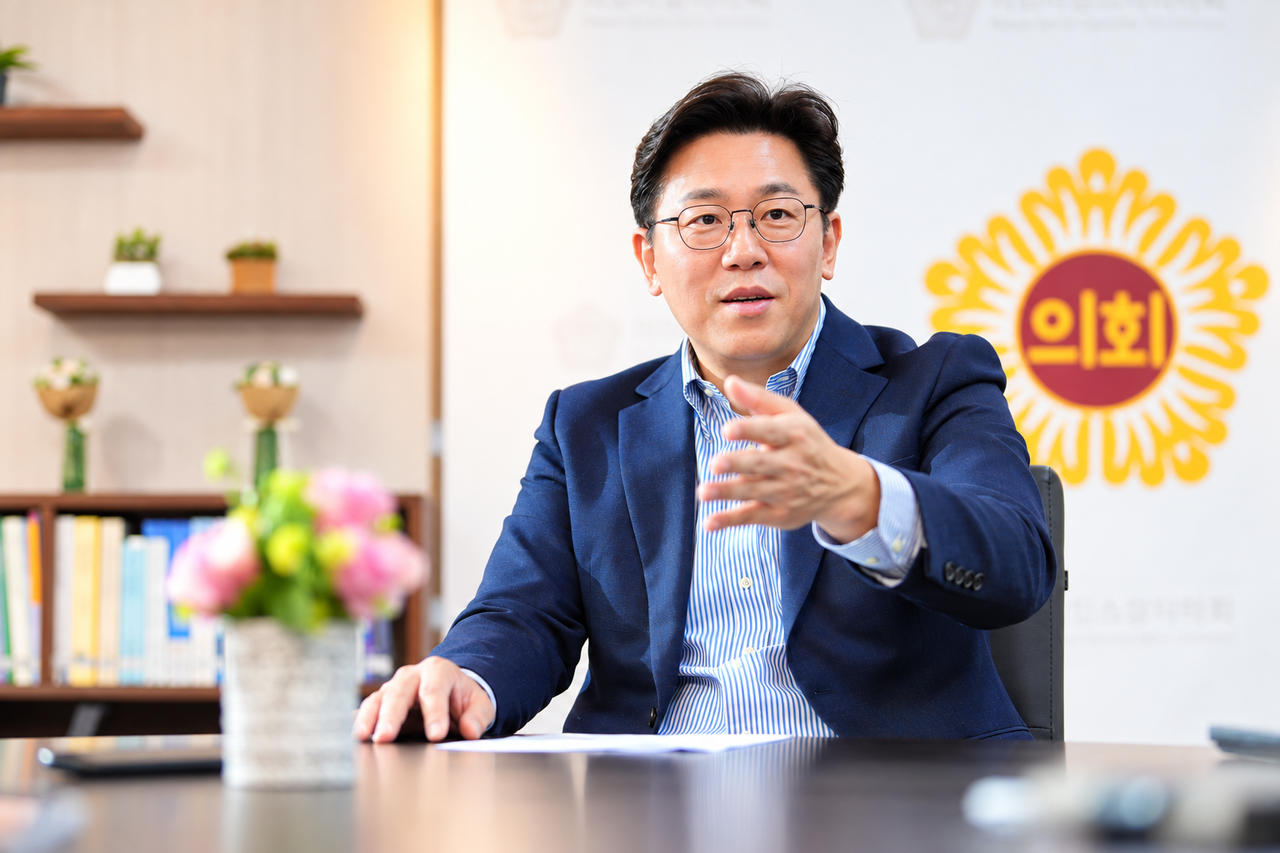
Han Ki-young, a Seoul Metropolitan Council member representing Mapo-gu for the Democratic Party of Korea, has returned to the council as a constituency lawmaker after a four-year absence — a different role from the one he held before. When he first entered the council as a proportional-representation member for young people, he served as vice chairman of the Administrative Affairs Committee and as council spokesperson, surveying Seoul city governance from a broad vantage point. Now his gaze has shifted closer to the ground: to the alleyways of Daeheung-dong, Yeomni-dong, Sinsu-dong and Yonggang-dong, to redevelopment sites, schools and childcare facilities.
The view from a proportional seat and the view from a constituency seat are different things. What was once a citywide perspective has narrowed — deliberately — to the block level. The four-year gap between his two terms, Han said, gave him the distance to reassess Seoul's governance before stepping back into the field.
Mapo-gu's urban map is changing fast. Redevelopment projects are accelerating in Yeomni-dong and Sinsu-dong, and multiple schemes at various stages are under way across the Sinchon corridor in Daeheung-dong and Nogo-san-dong. But new apartment construction and expanded housing supply alone do not make a neighborhood competitive.
Families leave because the local education environment falls short. Young people defer independence because housing costs are too high. At redevelopment sites, complicated administrative procedures and rising construction costs pile pressure on residents. The central question — how to connect physical redevelopment with policies that change people's daily lives — is precisely the challenge Han has returned to the council to address.
Now serving on the council's Housing and Space Committee, he is looking for answers at the neighborhood level. Rather than bundling all of Mapo into one sweeping development plan, his vision is to fill each neighborhood with the education, childcare, cultural and sports infrastructure it specifically needs, so residents can see change happening right outside their front doors.
The two areas Han is watching most closely in Seoul city governance are redevelopment policy and the shift to digital administration. He intends to monitor how regulations tied to the designation of speculative overheating zones — including restrictions on transferring union membership and limits on relocation loans — affect project timelines, and to verify whether policy-reform discussions between the city and the central government are actually producing results on the ground.
On digital administration, he said AI governance models and smart-city pilot projects should be evaluated not by budget growth alone but by whether the services citizens actually use are getting better.
"It is not enough for Seoul City and the central government to say they discussed institutional reform. We need to confirm how many cases were actually resolved and by how much project timelines were shortened. The same applies to AI administration. As the budget grows, I will be checking whether the services citizens experience are improving."
Mapo's redevelopment surge: the next challenge is construction costs and on-site expertise
Multiple redevelopment projects are moving simultaneously across Mapo-gu.
The area around 488-14 Yeomni-dong is working through the union establishment approval process, and the former Yeomni District 5 site around 81 Yeomni-dong is also pursuing redevelopment. In Sinsu-dong, the Sinsu 250 area is going through the fast-track integrated planning consultation process. Across the Sinchon corridor in Nogo-san-dong, adjacent to Daeheung-dong, several districts are at different stages ranging from public notice to approval. In Yonggang-dong, the Useok apartment complex has completed its relocation notice, establishing itself as a small-scale reconstruction case.
The methods and stages differ, but the problems encountered on the ground look similar. Shortening the permitting period matters, but what ultimately determines a project's stability is how transparently construction costs and feasibility are verified from the outset — and how clearly that information is explained to residents.
Seoul City has adjusted its rules to accelerate redevelopment, including moving up the timing of contractor selection to after union establishment approval, which opens the door to earlier collaboration with contractors. But managing the rise in construction costs driven by higher raw material prices and labor costs — and handling disputes between unions and contractors — has become a separate challenge.
Han's assessment is that even well-designed regulations lose much of their effect if there are not enough trained professionals on the ground to apply them and explain them to residents.
He has put forward a campaign pledge to assign specialists to each redevelopment zone in Mapo-gu, expanding the pool of field support professionals — including dedicated redevelopment site support officers — so that unions and residents are not left to navigate complex procedures and construction cost disputes on their own.
"No matter how good the regulations are, they are useless to residents if there is no one on the ground to filter and explain them properly. I will keep checking through the council that the specialist support staff for redevelopment sites are actually being expanded and functioning as they should."
His intent is to bring into the scope of his legislative work not just housing supply figures and permitting outcomes, but the burdens and conflicts that arise for residents throughout the redevelopment process.
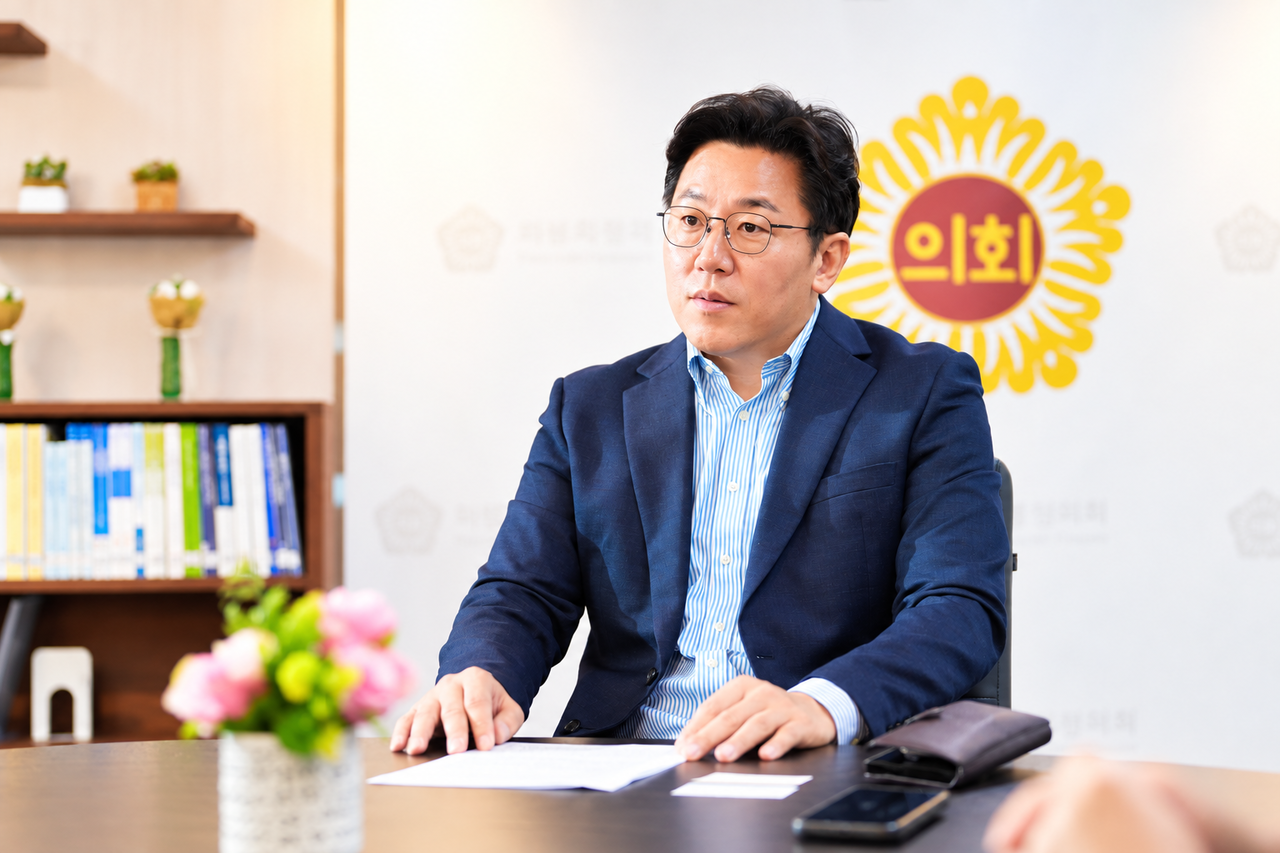
Keeping families in Mapo: stopping education-driven departures, starting with youth housing
When Han talks about Mapo's future competitiveness, education ranks alongside redevelopment as a top priority.
He has previously raised the issue of elementary school student outflows from Mapo in a media column. An analysis of data from the Korean Educational Development Institute and the School Information service showed that departing students have consistently outnumbered arrivals, with the outflow ratio rising from 1.42 times in 2022 to 1.51 times in 2023. According to Statistics Korea data, Gangnam-gu and Yangcheon-gu ranked among the top destinations for those leaving.
His diagnosis: even though Mapo has strong transport links, housing options and cultural amenities, parents' perception that the area lags on education is undermining residents' attachment to the neighborhood.
His proposed solution is a Mapo-style education support center.
The idea is not simply a facility that runs educational programs, but a hub that provides parents with accessible information on local schools, curricula and university admissions, and connects the educational resources already available in the area. He has also proposed placing infant and toddler childcare hubs at transit-oriented areas throughout the district, creating an environment where families can continue living in Mapo through and after the child-rearing years.
"It should not keep happening that families leave Mapo — a neighborhood with excellent transport and plenty of cultural facilities — just because of their children's education. The goal is to make Mapo a place where there is simply no reason to move to another neighborhood to raise a child, and ultimately a place that parents from other areas seek out for its education."
On youth issues, Han sees housing as the first step toward independence.
His thinking is grounded in experience: while serving as youth committee chair for the Seoul chapter of his party, he built a ten-division structure spanning youth entrepreneurship, housing and welfare, and spent time listening directly to young people in the field.
According to his figures, single-person households make up 48.7 percent of all households in Mapo-gu, well above the Seoul average of 36.1 percent, with people in their 20s and 30s accounting for a large share of that group. Because young people form a major part of the district's resident population, he argues, youth policy cannot be separated from Mapo's broader urban policy.
He sees it as particularly important to bring into the policy framework groups that existing support systems tend to miss — platform workers such as delivery riders and designated drivers who find work through apps, and socially isolated young people who have lost their community ties.
Rather than short-term cash transfers, his position is that supply-side policies such as youth safe housing should be strategically placed in areas with high concentrations of young single-person households, and that young people themselves should have a greater role in shaping the policies that affect them.
The shift he is calling for is to treat young people not merely as recipients of support, but as co-creators of policy.
Built on data, tested in the field: neighborhood-by-neighborhood politics
Another distinctive feature of Han's legislative approach is his commitment to examining data and institutional frameworks together.
In 2023, working with the Seongdong-gu Council as lead researcher, he analyzed 379 municipal ordinances in Seongdong-gu. The review turned up ordinances that still cited provisions from superseded laws, as well as regulations that had seen little practical use since their enactment.
He believes Seoul city policy is susceptible to the same problems.
His view is that it is not enough to rely on official statistics when launching a project — after a set period, the ordinances and rules underpinning a policy, along with its actual results, should be subject to a regular, structured review.
He argues that publishing the relevant statistics from the policy design stage, and accumulating data in a form that allows comparisons across districts and across years, is what makes it possible to objectively assess a project's impact after it concludes. He plans to draw on his background in political science and his experience as a legislative researcher at the National Election Commission to bring this data-and-institutions lens to his council work.
He also sees a need to change how information is disclosed. During his time as council spokesperson in the previous term, when he briefed the press directly on legislative matters, he came to realize that the reason citizens often fail to access information is not a shortage of material but the complexity of how it is delivered.
He plans to pursue an administrative transparency initiative that would reorganize legislative materials by issue and by area, and establish a standing channel through which residents can submit input on policy decisions as they are being made.
All of these ideas ultimately converge on the concept of neighborhood-level politics.
His plans by neighborhood include: in Daeheung-dong, a community living-support center and a Mapo-style education support center; in Yeomni-dong, a youth cultural center and a safe school commute route; in Sinsu-dong, a children's park swimming pool and a pet-themed park; and in Yonggang-dong, a multipurpose cultural and sports center at the Mapo retention basin and a tourism landmark development at Mapo-naru.
Even within the single name of Mapo, he said, each neighborhood has a different demographic profile, a different residential environment and different facilities its residents want — so the prescription must differ by neighborhood as well.
If his first term on the Seoul Metropolitan Council, as a proportional-representation member, was a time for surveying the city as a whole, his second — as a constituency lawmaker after a four-year absence — is about verifying the results of policy within the radius of residents' daily lives.
Reshaping the city's bones through redevelopment, building an environment where families can raise children through education and childcare, providing young people with stable housing — and adding cultural and sports facilities to complete a walkable neighborhood where residents can enjoy everything close to home. That is the Mapo he is working to build.
Han said the results of politics, in the end, must be felt not in grand slogans but in the streets residents walk every day and the facilities they use.
"A single sweeping campaign pledge for all of Mapo makes it hard for residents to feel that their lives have actually changed. I will complete the specific projects each neighborhood needs, so that change can be confirmed in a single path you walk or a single facility that opens its doors. I will repay residents with action over words, and results over promises."
7toy7@heraldcorp.com