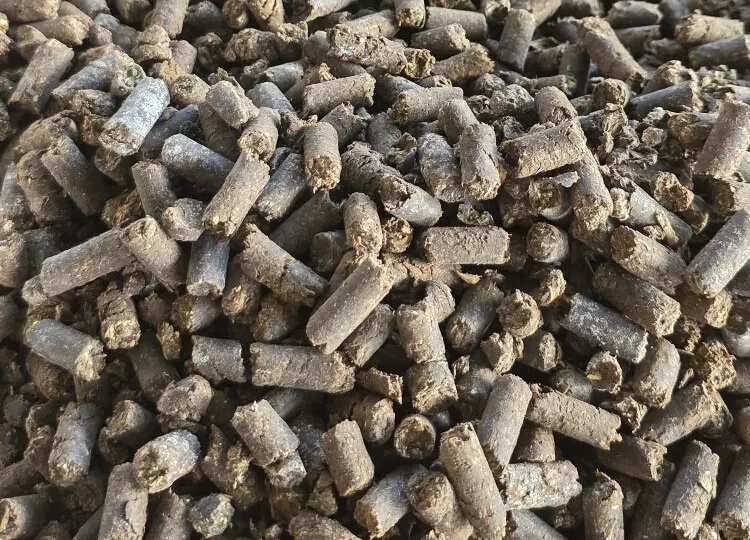
South Korea will significantly ease auxiliary fuel content and calorific value standards to expand the use of livestock waste as fuel. To prevent environmental pollution during production, operators will be required to retain production management records for three years.
The Ministry of Climate, Environment and Energy said Tuesday that the Cabinet approved amendments to the enforcement decree and enforcement rules of the Act on the Management and Use of Livestock Excreta, which will take effect immediately upon promulgation on July 30.
The revised enforcement rules rationalize the component standards for solid fuel derived from livestock waste to better reflect on-site conditions.
Previously, solid fuel was required to be produced only in a formed, pelletized shape. Under the new rules, unformed production will be permitted provided that safety measures — such as those addressing fire risks from dust generation — are in place.
The rules also allow auxiliary materials to be blended at less than 40 percent when the purpose is to supplement calorific value, whereas previously only pure livestock waste could be used. For solid fuel produced solely from livestock waste, the minimum calorific value requirement has been lowered from 3,000 kilocalories per kilogram to 2,000 kilocalories per kilogram, broadening options in the solid fuel market.
Alongside the eased component standards, the revised rules specify in detail the permit documents and review requirements that livestock farmers and livestock waste processors must submit when installing solid fuel production facilities, improving administrative predictability for local governments.
Those seeking to install solid fuel production facilities must submit a facility installation and operation plan and a plan for securing solid fuel end-use facilities when applying for a permit. The permitting authority will then review in advance whether the applicant can produce solid fuel that meets component standards and whether end-use facilities can be secured.
If the total blending ratio of auxiliary materials used in solid fuel production changes, both livestock farmers and livestock waste processors must obtain a permit for the change, ensuring solid fuel quality can be managed.
To prevent environmental pollution from solid fuel facilities, the rules also clarify installation standards for livestock waste treatment facilities and management standards for discharge and treatment facilities. Operators must record the treatment method and volume of materials used in production management ledgers and retain those records for three years.
Kim Eun-gyeong, director general for water environment policy at the Ministry of Climate, Environment and Energy, said the amendments would contribute to carbon neutrality in the livestock sector by using livestock waste as a renewable energy source, while also helping to improve water quality in public waterways through an expanded solid fuel market and more diversified livestock waste treatment options.
thlee@heraldcorp.com