Targeting operation by 2029 ... Andong's Imha Dam and Hapcheon Dam offer precedents for eco-friendly power generation
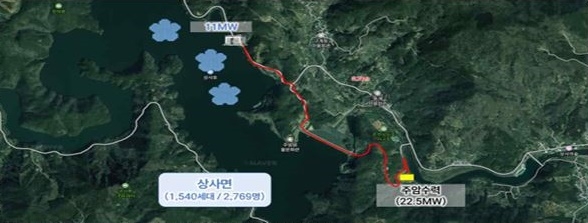
An 11-megawatt floating solar power plant is expected to be built on Sangsa Dam — a regulating dam connected to Juam Dam in Suncheon via a water conveyance tunnel — which would rank third among floating solar projects operated or pursued by Korea Water Resources Corporation.
The planned capacity trails only the 47 MW facility at Imha Dam in Andong, North Gyeongsang Province, and the 42 MW plant at Hapcheon Dam in South Gyeongsang Province.
The details come from a progress and implementation plan for floating solar development at Juam Dam and Sangsa Dam that Korea Water Resources Corporation submitted to Assembly member Kim Moon-su of the Democratic Party of Korea, who represents the Suncheon-Gwangyang A constituency. According to the document, the Sangsa Dam facility would be built on the water's surface.
The project aims to complete a basic design, community consultations and power business licensing this year, put construction out to tender in early 2027, and begin commercial operation in the second half of 2029.
The Honam region, which includes Suncheon, currently faces difficulty building new power plants due to electricity grid saturation. A development plan for floating solar at Juam Dam is expected to be drawn up in line with future transmission network upgrades.
Sangsa Dam has a clearer path to early development because it can use a "cross-transmission" method that leverages the existing transmission lines of the Juam hydroelectric power station.
Under cross-transmission, solar power generated during daylight hours and hydroelectric power generated when solar output is unavailable are alternately fed into the grid through the same lines.
The project will be structured as a community-participation model in which local residents can take part in the venture and share in revenue from power generation.
Concerns raised in some quarters about algae blooms and water quality are contradicted by long-term monitoring results from Hapcheon Dam.
A study by the Korea Environment Institute covering the floating solar facility at Hapcheon Dam from 2012 to 2019 found no unusual changes in water quality, phytoplankton or fish populations attributable to the installation.
"I will make the Sangsa Dam floating solar project an eco-friendly energy source for Suncheon and a community benefit initiative that raises residents' incomes," Kim said.
parkds@heraldcorp.com