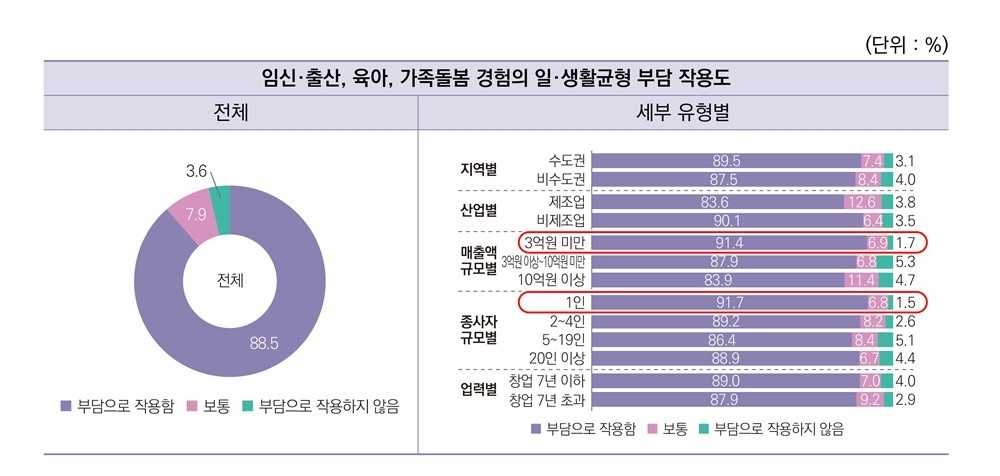
More than eight in 10 women entrepreneurs say pregnancy, childbirth, childcare and family caregiving weigh on their work-life balance. Experts say the current support system must be overhauled to reflect the realities of women-owned businesses, where the owner's absence immediately creates a management gap.
The Women's Economic Research Institute, affiliated with the Korea Women's Business Center, said Tuesday it had published a report titled "Work-Life Balance Among Women Entrepreneurs: Current Status and Policy Implications." The survey was conducted in June and covered 645 companies that had received official women-owned business certification.
The survey found that 88.5 percent of women entrepreneurs feel burdened by pregnancy, childbirth, childcare or family caregiving when it comes to work-life balance. The strain was sharpest among sole proprietors, at 91.7 percent, and among businesses with annual sales below 300 million won ($202,000), at 91.4 percent — indicating that the smaller the business, the heavier the caregiving burden. On a more positive note, 55.8 percent said caregiving experiences had led them to new business ideas.
Asked why women entrepreneurs face greater work-life balance difficulties than their male counterparts, 65.3 percent cited the social expectation that family caregiving falls primarily on women. Childcare responsibilities came second, at 54.6 percent.
Support needs varied by type of caregiving. During pregnancy and childbirth, the top concern was disruption to business operations due to the owner's absence, cited by 24.3 percent of respondents. The most-requested form of support was short-term substitute staffing to cover management gaps, at 23.6 percent.
During the childcare phase, sudden caregiving gaps caused by a child's illness or the temporary closure of a daycare or school were the biggest difficulty, cited by 36.5 percent. Demand was high for subsidies to cover childcare and daycare service costs, at 19.3 percent. For those caring for elderly parents or other family members, accompanying them to hospital appointments, tests, and inpatient or rehabilitation treatment was the heaviest burden, at 38.0 percent, and support for a helper to assist with such medical visits was the most-requested policy, at 26.0 percent.
Demand for expanded policy support was also strong: 97.1 percent of respondents said work-life balance support policies specifically for women entrepreneurs are needed. The report recommended building a medium- to long-term support framework, providing tailored assistance based on business size, and diversifying policies by caregiving type to reduce the caregiving burden on women entrepreneurs and minimize management disruptions.
The findings highlight that, unlike salaried employees, women entrepreneurs are personally responsible for running their businesses, meaning caregiving burdens can directly disrupt operations. For sole proprietors and micro-businesses with no employees, there is no one to fill the owner's role during an absence — making pregnancy, childbirth and childcare a direct risk to both livelihood and business continuity.
"The current work-life balance support system is designed around wage workers, which means women entrepreneurs can in effect fall into a blind spot when they face pregnancy, childbirth, childcare or family caregiving situations," the Women's Economic Research Institute said. "It is urgent to establish an effective support framework so that women entrepreneurs can continue to grow and run their businesses with stability."
boo@heraldcorp.com