![Kumho Complex 1 in Yangji Village, Bundang-gu, Seongnam, sold by President Lee Jae-myung and his wife for 2.9 billion won on July 14. [Naver Road View]](https://wimg.heraldcorp.com/news/cms/2026/07/21/news-p.v1.20260716.10d6e32da8fa4cbd9249ae78e2a7a075_P1.jpg)
A regulation restricting the transfer of association membership rights has been identified as a key obstacle slowing reconstruction and redevelopment projects across Seoul. Analysts say the rule also influenced President Lee Jae-myung's decision to register a 1.77 billion won ($1.19 million) maximum mortgage against the co-buyers when he sold his home.
According to Supreme Court registry records released Tuesday, the apartment at Kumho Complex 1 in Yangji Village, Bundang-gu, Seongnam, Gyeonggi Province — jointly owned by President Lee and his wife Kim Hye-kyung — was sold for 2.9 billion won on July 14, with the ownership transfer registered July 16. Title passed to two buyers identified by their surnames Kim and Jo.
The couple also registered a maximum mortgage of 1.77 billion won against the buyers. Financial institutions typically set a maximum mortgage at around 120 percent of the actual loan amount, which puts the sum Lee and his wife lent the buyers at an estimated 1.4 billion won. Industry observers believe the sellers transferred ownership first — before the complex receives its project implementation designation — to secure the buyers' association membership rights, with the unpaid balance covered by the mortgage. Once the designation is issued, any buyer who acquires ownership afterward would not receive a move-in right and could instead be subject to cash settlement.
A significant number of Seoul redevelopment sites are already subject to the membership transfer restriction. According to the quarterly "Seoul Urban Renewal Project Progress Report" published by the Seoul Metropolitan Government's Real Estate Policy Development Center, as of March, 128 sites in Seoul — 79 reconstruction projects and 49 redevelopment projects — had membership transfers restricted.
The list includes a large share of units in the Mokdong Shinsigaji district, Yeouido Hanyang Apartments and Banpo Mido 1st Complex, among other major Seoul renewal sites. Many projects currently remain at the district-designation stage, and the number of sites subject to transfer restrictions is expected to grow substantially as association formation accelerates in those areas.
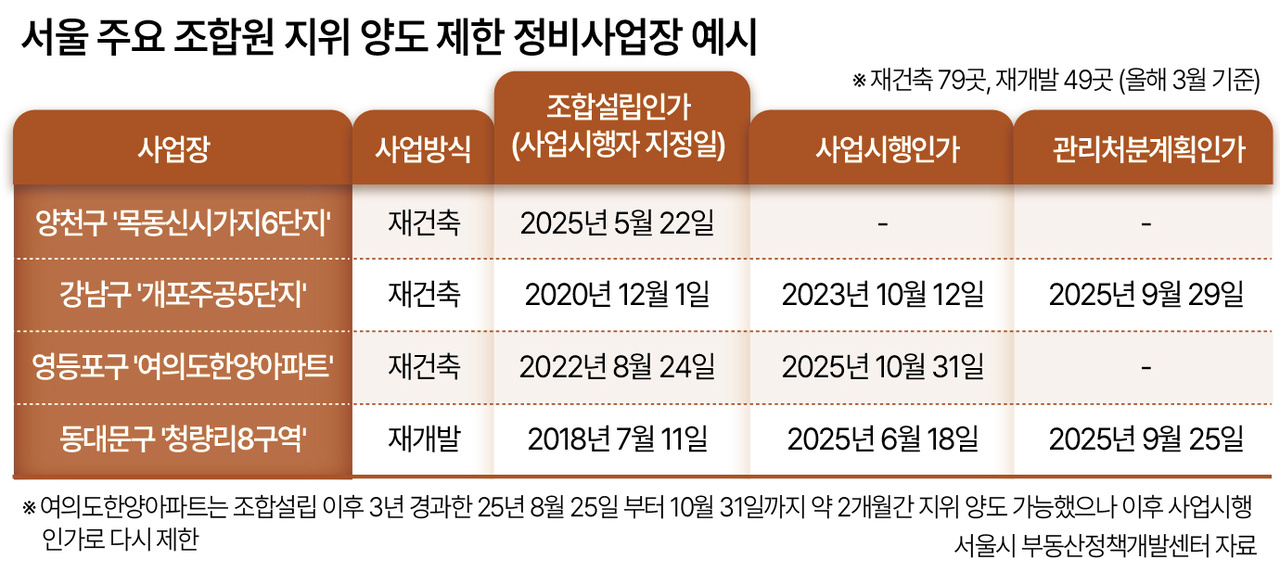
Under the current Act on the Improvement of Urban Areas and Residential Environments, anyone who acquires housing or land in a speculation-overheated district after a reconstruction association receives its establishment approval — or after a redevelopment project receives its management and disposal plan approval — is barred from inheriting association membership rights. Buyers who acquire property after those thresholds cannot receive move-in rights and may be subject to cash settlement; the same principle applies to ownership changes through gifts and other transfers.
However, the law provides exceptions for cases such as medical treatment, job relocation or livelihood-related moves, disposal of inherited housing, long-term ownership and residence by single-household owners, and prolonged project delays. For reconstruction projects, exceptions may also apply to association members who have held their units for a qualifying period if no application for project implementation approval is filed within three years of association establishment, or if ground-breaking does not occur within three years of implementation approval.
A prominent example is the reconstruction of Banpo Jugong Complex 1, Districts 1, 2 and 4 in Seocho-gu — slated for pre-sale in the second half of this year under the planned name Banpo Dieh Classt. After receiving association establishment approval on Sept. 11, 2013, the complex was subject to a three-year membership transfer restriction. Because no application for project implementation approval was filed within that period, the restriction was lifted from Sept. 12, 2016, until project implementation approval was granted on Sept. 17, 2017 — a window of roughly one year.
The restriction was reimposed after implementation approval, but because ground-breaking did not occur within three years, the exception conditions were again met and transfers were permitted for about three and a half years from September 2020. The restriction was reinstated when construction began on March 29, 2024. The cycle of restrictions being applied and lifted depending on project progress and delays repeated itself throughout the process.
![Jamsil Jugong Complex 5 in Songpa-gu, where a project implementation approval issued July 1 reimposed association membership transfer restrictions for the first time in about 10 years. [Herald Business DB]](https://wimg.heraldcorp.com/news/cms/2026/07/21/ams.V01.photo.HDN.P.20210615.202106150000000587478394_P1.jpg)
Jamsil Jugong Complex 5 in Songpa-gu presents a similar case. After receiving association establishment approval on Dec. 29, 2013, the project stalled for years, allowing membership transfers for roughly a decade from late 2016. When the complex received project implementation approval on July 1, the transfer restriction was reimposed. Going forward, sales will in effect be off-limits unless a legally recognized exception applies.
The deeper problem is that rising construction costs and prolonged timelines are inflating members' share of project expenses even as they lose the ability to exit. Members who cannot absorb the financial burden but are unable to sell may oppose cost increases or revisions to the management and disposal plan, fueling internal conflict within associations.
Members who need to relocate for job changes, their children's education or retirement funding also find themselves effectively trapped. Restricting transactions makes it harder for new buyers — those willing and financially able to shoulder project costs — to enter.
The problem is especially acute at sites where project viability has deteriorated. Members who cannot dispose of their assets face a high risk of falling behind on assessments, delaying relocation and becoming embroiled in disputes over general meeting votes. Critics argue that a regulation designed to curb speculative demand is instead blocking long-term holders and genuine end-users from making normal property disposals, ultimately sapping the momentum of urban renewal projects.
"A significant portion of delays in urban renewal projects occur at the relocation stage," said Lee Jin-ho, secretary-general of the Seoul Urban Renewal Project Association. "If members cannot secure relocation funds, they need to sell and move out — but once a project reaches a certain stage, the membership transfer restriction makes even that impossible. They end up with nowhere to go."
quq@heraldcorp.com