![The headquarters of South Korea's four major financial holding companies. [Each company]](https://wimg.heraldcorp.com/news/cms/2026/07/21/news-p.v1.20260721.ef0069115c204abda6167fad057d1f5a_P1.png)
After roughly eight months of deliberation, the government has decided to legally ban financial company CEOs from serving a third consecutive term. The move reflects President Lee Jae Myung's view that the current tenure rules have caused serious harm — he has argued that financial sector CEOs form a "corrupt inner circle" and wield unchecked power.
The financial industry is pushing back hard, warning the measure will "undermine the managerial autonomy of private companies." The backlash is expected to carry significant weight: foreign investors hold stakes of up to 79 percent in some domestic financial firms, and Institutional Shareholder Services (ISS), the world's largest proxy advisory firm, has also come out against the government's plan to enshrine the term limit in law.
Financial Services Commission (FSC) Chairman Lee Eok-won plans to hold a meeting with the heads of the eight major financial holding companies this month to announce the governance reform package, according to industry sources Tuesday. Authorities are currently coordinating schedules with each holding company. The announcement comes about eight months after President Lee criticized the long-running practice of financial CEOs repeatedly extending their tenures, calling it a "corrupt inner circle" late last year. Shortly after the president's remarks, financial authorities formed a governance reform task force to develop the plan.
The FSC had initially considered requiring a special shareholder vote — rather than an explicit statutory ban — for a CEO seeking a third term. That approach reflected internal concerns about the legal risks of arbitrarily capping the tenure of private company executives, as well as worries that such a restriction would not align with global standards.
Cheong Wa Dae then signaled strong policy resolve during consultations with financial authorities, and calls to address the side effects of prolonged CEO tenure at financial holding companies continued to mount — ultimately pushing the authorities to pivot toward full legislative codification of the three-term ban.
The shift gained further momentum when Financial Supervisory Service (FSS) Governor Lee Chan-jin recently emphasized at a press briefing that the three-term limit must be written into law. Democratic Party lawmaker Jeon Hyeon-hui of the National Assembly's Political Affairs Committee added her voice in a broadcast interview, saying the president had ordered a governance overhaul but the FSC and FSS had yet to produce a proper report or proposal. The ruling party's expected chairmanship of the Political Affairs Committee in the second half of the Assembly session is also seen as lowering the legislative hurdle for the related bills.
The financial industry has reacted sharply to the authorities' decision, arguing that legally capping the tenure of private financial company CEOs infringes on managerial autonomy. "The government and the National Assembly pushed through the Commercial Act amendment to boost shareholder value — but the direction they're now pursuing seems to run somewhat counter to that stance," a senior industry official said. "The principle of a joint-stock company is that shareholders decide whether to renew a CEO's term based on performance."
Another official expressed concern about the precedent being set. "Couldn't they have first introduced various checks on the board and then decided?" the official said. "Now that they've gone as far as legally capping CEO tenure, I worry about what even stricter regulations might follow."
The reaction of foreign shareholders is also worth watching. As of Monday, foreign ownership stakes in the four major financial holding companies — KB, Shinhan, Hana and Woori — ranged from 45.82 percent to 79.34 percent.
ISS, the world's largest proxy advisory firm and a major influence on foreign shareholders' voting decisions, has also taken a negative stance on the government's plan to legislate the term limit.
In a written response to The Herald Business in May, ISS said the issue should be addressed through board independence requirements, regular director re-election procedures, and clear shareholder accountability through voting — rather than fixed regulatory limits on executive tenure. "A rigid cap applied without regard to performance or circumstances has the side effect of removing the important element of board discretion," ISS said.
At the same time, voices within the industry are calling for the financial sector to reflect on its own practices. Critics argue that despite the public-interest obligations of financial companies, CEOs have dominated their boards and reduced voting procedures to a formality. "There is legitimate room for debate over whether candidates who have challenged financial holding company CEOs have received fair evaluations," a former FSC chairman said. "Some cite global firms like JPMorgan as examples of companies without term limits, but the reality in Korea is entirely different from overseas."
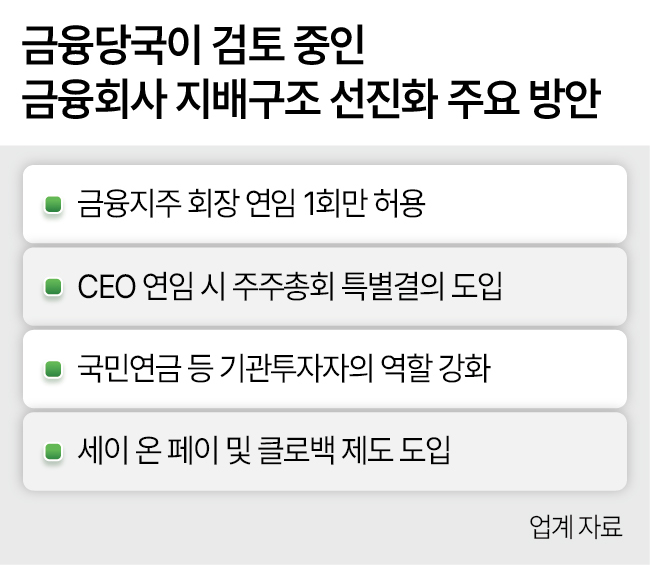
Beyond the three-term ban, financial authorities also plan to tighten shareholder voting requirements for a CEO's second term. The governance reform package is also said to include an overhaul of executive compensation — introducing clawback and say-on-pay mechanisms — as well as measures to strengthen the role of institutional investors such as the national pension fund.
hyuk@heraldcorp.com
ehkim@heraldcorp.com