![The Bank of Korea's Monetary Policy Board voted Wednesday to raise the benchmark interest rate by 0.25 percentage point, signaling the start of a full-fledged tightening cycle. Key monetary policy indicators — growth, inflation and the exchange rate — all point toward further rate increases. [Lim Se-jun]](https://wimg.heraldcorp.com/news/cms/2026/07/16/news-p.v1.20260716.d19be98b52a340b7bb9c7e3e514adcb4_P1.jpg)
BOK raises benchmark rate to 2.75%, adding to loan burden for small businesses
Minimum wage for 2027 set at 10,700 won; oil and raw material costs also rising
Nearly 60% of small business owners expect conditions to worsen in second half; 96.6% have no investment plans
Small business owners already struggling with weak domestic demand are bracing for a perfect storm in the second half of the year — simultaneous increases in interest rates, labor costs, raw material prices and energy bills. The Bank of Korea raised its benchmark interest rate for the first time in three and a half years and left the door open to further hikes. On top of that, the minimum wage has risen 3.7 percent, and the conflict between the United States and Iran is escalating again.
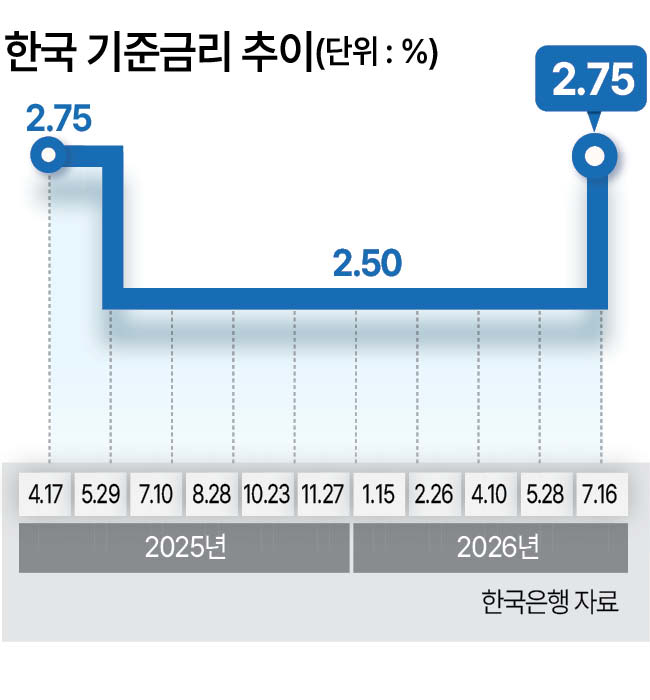
The Bank of Korea's Monetary Policy Board raised the benchmark interest rate by 0.25 percentage point on Wednesday, lifting it from 2.50 percent to 2.75 percent, according to industry sources. It was the first increase since January 2023. The central bank had cut the rate four times between October 2024 and May last year, lowering it by a total of 1.00 percentage point, before holding it steady for eight consecutive meetings. Crucially, the BOK signaled that this hike may not be the last.
Announcing the rate increase, BOK Governor Shin Hyun-song said the central bank sees a need to continue raising rates. "Inflation is expected to remain above the target level for a considerable period, and we also need to remain attentive to financial stability risks," he said. "The timing and pace of any additional increases will be determined by monitoring the degree of inflationary pressure, the trajectory of economic improvement and financial stability conditions, based on incoming data."
For small business owners, the rate hike translates directly into heavier loan repayment burdens. The COFIX rate — the benchmark for mortgage lending rates — has already surpassed 3 percent. With the policy rate now rising as well, banks facing higher funding costs will pass those increases on to borrowers. Rates on new loans and variable-rate loans are likely to rise with a lag.
A survey released Thursday by the Korea Federation of SMEs on business conditions in neighborhood commercial districts found that 59.8 percent of respondents expect overall business conditions in the second half of this year to worsen compared with the first half. Some 58.4 percent said their financial situation would deteriorate in the second half. Those expecting a drop in sales reached 59.4 percent, while 59.8 percent forecast a decline in operating profit. A striking 96.6 percent said they had no investment plans for the second half — a sign that nearly all small business owners are focused on keeping their existing shops afloat rather than expanding or upgrading equipment.
By sector, 72.7 percent of laundry and hair salon operators expected sales to fall in the second half. The figure was 70.0 percent for real estate agencies, 68.0 percent for hagwon operators and 63.3 percent for beer halls, bars and pojangmacha. Cafes and bakeries were comparatively less pessimistic, with 41.2 percent forecasting a sales decline — but only 11.8 percent expected any improvement.
The biggest reason small business owners are pessimistic about the second half is shrinking consumer spending power. Among those who expect conditions to worsen, 60.9 percent cited reduced consumer spending caused by high prices and falling real incomes. Another 23.5 percent pointed to rising operating costs, including raw materials, rent and labor. With consumer purchasing power already weakened, the added pressure of higher interest rates is likely to deepen the spending slump further.
![Members of the Korea Federation of Small and Medium Business Owners hold a press conference Tuesday in front of the Minimum Wage Commission at Government Complex Sejong to oppose a minimum wage increase for next year. Participants called for freezing next year's minimum wage at this year's level of 10,320 won per hour and urged the government to establish a legal basis for applying differentiated rates by industry. [Yonhap]](https://wimg.heraldcorp.com/news/cms/2026/07/16/news-p.v1.20260713.1509220b7da3429080e2578443e4bd20_P1.jpg)
The minimum wage — a direct cost burden for small business owners with employees — has also gone up. The Minimum Wage Commission voted Tuesday to set the 2027 minimum wage at 10,700 won per hour, an increase of 380 won, or 3.7 percent, from this year's level. The monthly equivalent, based on a 40-hour workweek and 209 working hours per month, comes to 2.24 million won. While the higher minimum wage takes effect next year, sectors with a high proportion of part-time workers — including restaurants, accommodation businesses and convenience stores — may begin adjusting hiring levels, operating hours and staffing plans as early as the second half of this year.
Small business groups say that when labor costs rise, small operators typically respond by cutting staff numbers or working hours and relying more heavily on family labor.
Prolonged conflict in the Middle East is another variable, pushing up global oil prices. Clashes involving the United States, Israel and Iran have unsettled the Strait of Hormuz — a critical chokepoint for crude oil shipments — sending international oil prices sharply higher again. According to Korea National Oil Corporation's Petronet, Dubai crude stood at $79.29 per barrel as of Wednesday, while Brent crude reached $84.95 per barrel, approaching the $100 mark once more.
Rising oil prices feed through sequentially into food ingredients, packaging materials, delivery and logistics costs, and gas bills. Restaurants and cafes face higher raw material and delivery costs, while laundry businesses and accommodation operators are hit by rising heating, cooling and washing expenses. The consumer price inflation rate climbed from 2.0 percent in January and February to 2.2 percent in March and 2.6 percent in April, before reaching 3.1 percent in May and 3.2 percent in June. The everyday living cost index rose to 3.4 percent in June. When prices rise, shop operators face a double burden: higher running costs and weaker real purchasing power among consumers.
Electricity tariffs are another potential cost pressure. The government and Korea Electric Power Corporation have been cautious about adjusting residential and commercial rates out of concern for household finances. But if rising international oil prices push up fuel costs for power generation, KEPCO will initially absorb those costs — and when its financial burden and the need for grid investment are factored in, pressure for a rate increase could build again in the second half and beyond.
Small business owners say they want fixed-cost relief more than direct cash handouts. In the Korea Federation of SMEs survey, 65.7 percent of respondents named expanded tax benefits for small businesses as the most needed policy for revitalizing neighborhood commercial districts. Some 52.1 percent called for reduced energy costs such as electricity and gas bills, 43.6 percent sought expanded financial support including policy loans and credit guarantees, and 31.7 percent wanted loan maturity extensions and reduced principal and interest repayment burdens.
"When interest rates, labor costs and raw material prices all rise at the same time while sales are not growing, there is a limit to how much cost-cutting individual shops can absorb," a small business industry official said. "What is needed are tax, financial and energy support measures that reflect the cost structures of each sector."
hong@heraldcorp.com