7 standout cases selected, with top prize going to initiative that diversified crude oil supply chain through Canadian FTA certificate-of-origin exemption
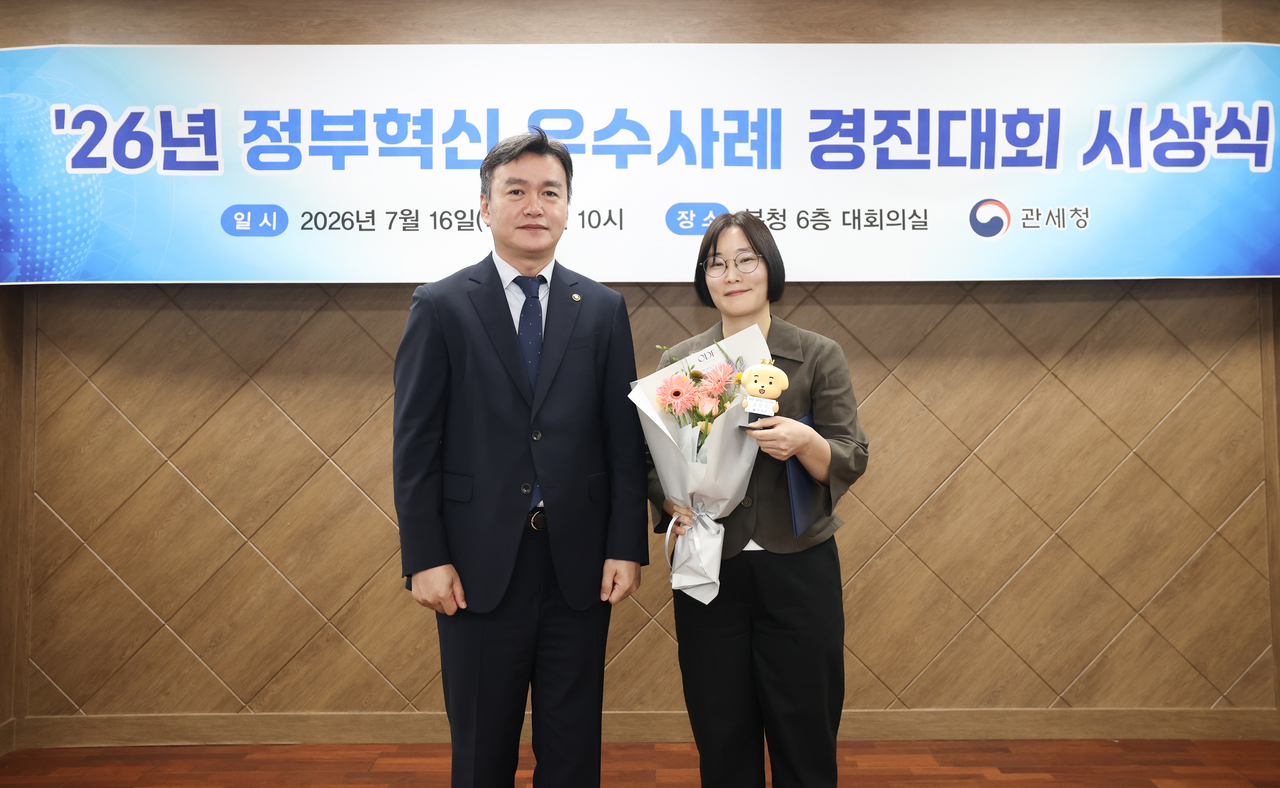
The Korea Customs Service has announced its "Government Innovation Best Practices" awards, an initiative aimed at identifying outstanding examples of customs administration reform and sharing them with the public.
The agency held its 2026 Government Innovation Best Practices Competition Thursday at the Government Daejeon Complex, selecting and honoring seven cases.
The competition focused on identifying exemplary cases in three categories: participatory and communicative innovation, foundational social innovation, and administrative innovation.
A total of 17 submissions were received. Judges evaluated entries on public impact, creativity and proactiveness to determine one grand prize winner, two excellence award recipients and four encouragement award recipients. The selection process incorporated assessments by an internal employee panel as well as results from a public online review platform.
The grand prize went to Ko Hyeon-ju, an administrative officer in the Korea Customs Service's Origin Verification Division, for establishing a special FTA certificate-of-origin exemption for Canadian crude oil that secured an import base of up to 33 million barrels annually, supporting supply chain diversification.
The excellence awards went to Choi Gyeong-sik, an official at the Seoul Customs Office's Foreign Exchange Investigation Division, for developing an AI-based integrated automated analysis system for trade and foreign exchange data that significantly cut the time needed to analyze illegal trading companies; and Lee Jae-ran, an official at the Busan Customs Office's Sinhang Import Clearance Division 1, for building a new drug risk management framework by combining public data with AI to calculate a consumption-area-based drug risk index.
The encouragement awards went to Do Ye-hui of the Seoul Customs Office's FTA Division 1, for developing a generative AI chatbot for analyzing FTA certificate-of-origin information; Lee Yu-na of the Busan Customs Office's Clearance General Division, for building a generative AI-based model to analyze origin circumvention exports; Nam So-yeong of the Korea Customs Service's Data Division, for creating an industrial complex code within the trade statistics coding system to help companies in industrial complexes verify their export performance; and Kim Seon-bi, also of the Korea Customs Service's Data Division, for simplifying the small and medium-sized enterprise verification process by linking systems between the Korea Customs Service and the Ministry of SMEs and Startups.
Lee Byeong-jin, the Korea Customs Service's administrative management officer, said the competition had surfaced a wide range of government innovation cases, "from improvements in customs administration that citizens can feel directly, to AI-driven innovations in the way we work." He added that the agency would "actively embed these innovation values on the ground to deliver citizen-centered customs administration services."
kwonhl@heraldcorp.com