Agency to focus on state-led forest disaster response, expanded support for forestry workers, stronger global cooperation
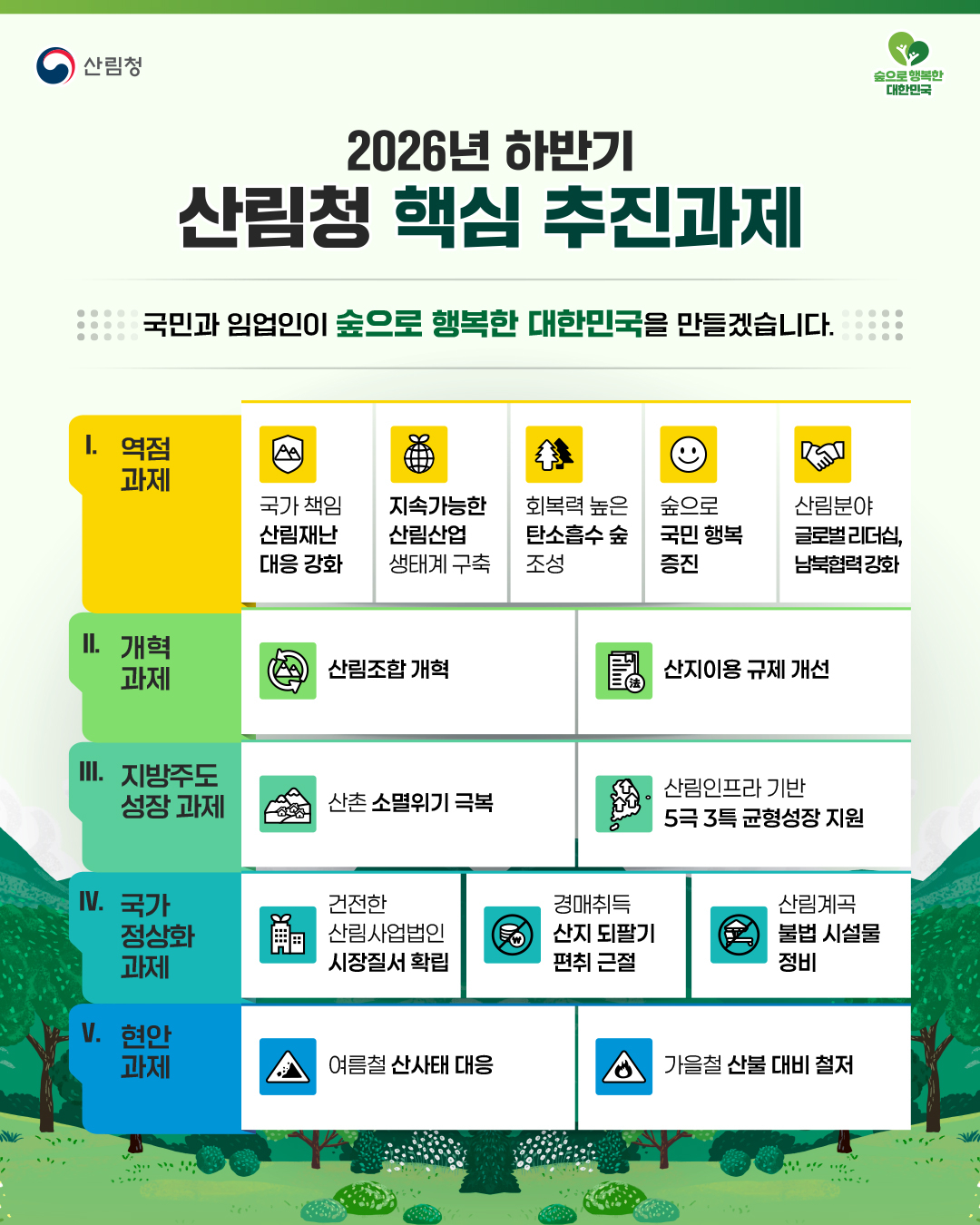
The Korea Forest Service announced its key second-half priorities Thursday through a government work report, outlining its agenda for building a "Happy Korea Through Forests."
The agency said it will pursue five priority tasks, a locally led growth initiative and a national normalization agenda to protect lives and property from forest disasters and to develop forests as a core asset for improving the quality of life of citizens and forestry workers.
The five priority tasks are: strengthening state-led forest disaster response, building a sustainable forestry industry ecosystem, creating resilient carbon-absorbing forests, promoting public well-being through forests, and strengthening international forest cooperation.
To prevent casualties from landslides, local governments will be required to establish resident evacuation plans, and the Korea Forest Service will support their situational assessments so they can issue preemptive evacuation orders. Forest road projects, previously carried out on a single-year basis from design through construction, will be converted to multi-year projects to build a road network capable of withstanding extreme rainfall.
To halt the spread of pine wilt disease, the agency will overhaul its control strategy. A national control belt at least 4 kilometers wide will be established to prevent the disease from spreading from heavily affected areas to other regions, with control efforts concentrated on species conversion and the removal of hazardous trees near residential areas. The entire national forest will be divided into 1-hectare grid units, and a precision monitoring system using LiDAR and AI will be introduced.
The agency will also strengthen its all-out wildfire response system. To improve prevention, it will create 120 wildfire safety zones around buildings adjacent to forests — four times more than last year. During the wildfire-watch period, pan-government firefighting helicopters will be forward-deployed to bolster initial response.
② Building a sustainable forestry industry ecosystem
The direct payment rate for forestry workers will be raised by up to 36 percent, in line with last year's increase in the farmland direct payment rate for field crops, to improve conditions in the forestry sector and enhance equity between forestry and agriculture.
Safety manager deployment standards at logging sites will be tightened so that one safety manager oversees only one worksite. Specialized industrial accident agencies will conduct on-site inspections of forest project sites to address hazards, and the use of forestry machinery will be made mandatory starting with national forests to prevent accidents.
The agency also plans to enact a timber construction law within the year, covering administrative and fiscal support for the spread of wood-frame construction and the training of specialists, to boost the production and consumption of domestically grown timber. Public engagement with wood culture will be broadened through a lifestyle wood-use competition and the expansion of timber culture experience centers.
③ Creating resilient carbon-absorbing forests
Tailored species — broadleaf trees resilient to disasters and conifers in high demand by industry — will be planted in the right locations to build forests that are both climate-resilient and economically valuable.
Well-established forests will be managed scientifically. An agricultural and forestry satellite launched July 7 will be used to strengthen forest monitoring and support systematic forest management. Carbon absorption from forest management will also be automatically linked to national greenhouse gas reduction target calculations.
Forests requiring active management will be managed systematically, while those requiring conservation will be strictly protected. Core ecological corridors such as the Demilitarized Zone and the Baekdudaegan mountain range will be managed in an organized manner, and conservation of endangered conifer species will be strengthened to promote ecosystem health.
④ Promoting public well-being through forests
The agency will partner with medical and public health institutions — including the Central Dementia Center and the National Cancer Center — to provide tailored forest therapy services for dementia prevention and cancer patient recovery. A specialized forest therapy program for people at high risk of suicide will be offered to 10,000 people within the year to build a mental health safety net for the public.
If you're thinking about self-harm or suicide, contact the Ministry of Health and Welfare's helpline 1393, available 24/7. Please request a translator for English-language services.
Forest education content for infants and children, which has been uniform and ecology-focused, will be diversified to cover timber, forest disasters and carbon neutrality. Lifelong education courses on forest income and forest therapy for middle-aged and older adults will be offered to expand the reach of forest education.
⑤ Strengthening international forest cooperation
Leveraging summit diplomacy with Central Asian countries including Mongolia, the agency will expand international cooperation on forest restoration and climate response. With European countries such as Greece and France, it will strengthen cooperation in forest disaster response to build a global forest disaster management framework.
The REDD+ program — which earns carbon reduction credits by preventing deforestation in developing countries — will be expanded to Honduras, Vietnam and Guatemala. Through this, the agency aims to secure a stable supply of overseas carbon reduction credits toward meeting the national greenhouse gas reduction target.
The agency will also operate a Korean Peninsula Forest Forum with participation from academia, international organizations and NGOs. It will review ways to implement existing inter-Korean forest cooperation agreements and, working with international organizations, seek to draw North Korea into international events on forest disaster response and forest restoration — areas likely to attract Pyongyang's interest — as a potential breakthrough for reviving stalled inter-Korean relations.
▶ Locally led growth initiative: pan-government cooperation with local governments to develop the East-West Trail and expand garden infrastructure
The East-West Trail — an 849-kilometer long-distance national forest trail crossing the Korean Peninsula from Taean to Uljin — will be completed on schedule this year and developed into core infrastructure for revitalizing rural and mountain communities through pan-government and public-private collaboration.
To that end, the agency is working with central government bodies — including the Ministry of SMEs and Startups, the Ministry of Health and Welfare and the Ministry of Agriculture, Food and Rural Affairs — to develop policies for rural revitalization and youth job creation.
The agency plans to meet regularly with local governments and residents along the trail to match region-specific projects and to encourage voluntary contributions from local communities, organizations and businesses, with the aim of fostering a culture in which the East-West Trail becomes a source of local pride and affection.
The Korea Forest Service will also expand garden infrastructure evenly across regions. It will conduct evaluations and consulting to designate outstanding local gardens in each of the five major and three special zones as national gardens, and will expand garden cities in areas including Yeongwol, Jecheon and Sinan to 12 sites within the year. Garden expos promoting local forestry and farming communities are planned in Geochang (garden therapy, October), Yeongwol (garden industry, October) and Jeju (garden culture, November).
▶ National normalization agenda: restoring market order among forestry business operators, restoring illegally built commercial facilities in forests
A joint investigation with the Office for Government Policy Coordination and local governments is underway to restore order in the forestry business operator market, and violations uncovered will be dealt with strictly. The agency also plans to work swiftly with related ministries — including the Ministry of Economy and Finance and the Ministry of Interior and Safety — to develop institutional reforms to prevent recurrence, including a deposit forfeiture system for shell companies and ongoing verification of corporate registration standards.
The agency has also conducted a comprehensive survey of illegal structures in forest valleys together with local governments and established restoration standards in June on the principle that commercial facilities must be returned to their original state. It will first encourage voluntary demolition of commercial facilities and pursue administrative enforcement against those that do not comply, taking a firm stance against illegal activity in forest valleys.
"The Korea Forest Service bears a heavy responsibility for protecting public safety, revitalizing the forestry economy and enhancing public well-being," Korea Forest Service Commissioner Park Eun-sik said. "We will listen closely to voices from the field and devote all our efforts to fulfilling national policy tasks, delivering visible results in the second year of the people's sovereignty government."
kwonhl@heraldcorp.com