
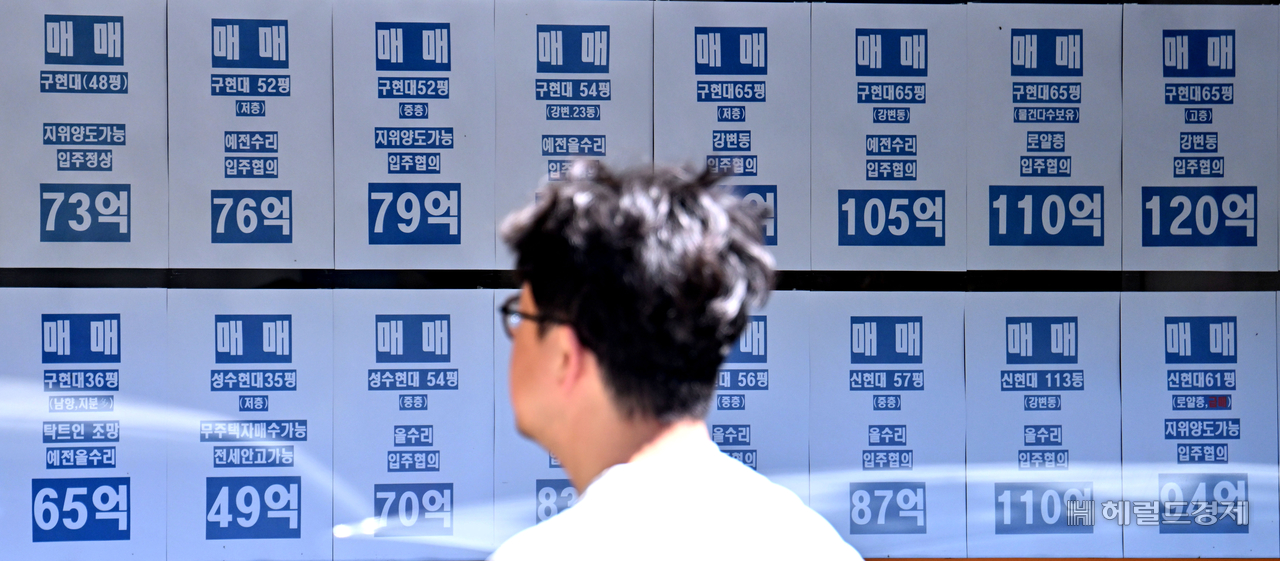
The government has in effect formalized plans to raise property holding taxes on ultra-expensive single homes, signaling that a price threshold will be set. At a Cabinet meeting on Tuesday, President Lee Jae Myung questioned where the line should be drawn and said that 3 billion won ($2.01 million) would be "too harsh" as a cutoff. The remark was widely read as an indirect signal that the threshold would be set higher — a market value of 3 billion won corresponds to a publicly assessed price in the late 1 billion won range, which would sweep in a large number of properties. The market now expects the threshold for an ultra-expensive single home to land somewhere between 4 billion and 5 billion won. In effect, most apartments of 84 square meters or larger (exclusive use area) in the Gangnam area are expected to fall within the scope of the strengthened holding tax.
Lee says 3 billion won 'too harsh' — if threshold is set at 4 billion won, Heukseok-dong would also be affected
According to the Ministry of Land, Infrastructure and Transport's actual transaction price disclosure system, 1,398 apartments (including corporate purchases) changed hands at prices above 4 billion won in the year through June 1 — accounting for 1.6 percent of all transactions (83,554 deals) during the period.
While the share of total transactions remains small, the sheer number of such deals has surged as home prices have climbed sharply for years. Five years ago — from June 2, 2020 to June 1, 2021 — apartments sold above 4 billion won were limited to 396 transactions a year, representing just 0.5 percent of all deals.
The number of apartments changing hands above 4 billion won has grown 3.5 times over the past five years.
The geographic spread of ultra-expensive homes has also widened. Five years ago, transactions above 4 billion won were concentrated almost entirely in Apgujeong-dong and Cheongdam-dong in Gangnam-gu, Banpo-dong in Seocho-gu, Seongsu-dong in Seongdong-gu, and Hannam-dong in Yongsan-gu. Over the past year, however, flagship apartment complexes along the Han River belt have joined the list — among them Hyundai Hi-Perrion in Mok-dong, Yangcheon-gu; Jangmi Apartments in Sincheon-dong and Jamsil Els in Jamsil-dong, Songpa-gu; Shindonga in Seobinggo-dong, Yongsan-gu; and large-unit apartments at Acro River Haim in Heukseok-dong, Dongjak-gu.
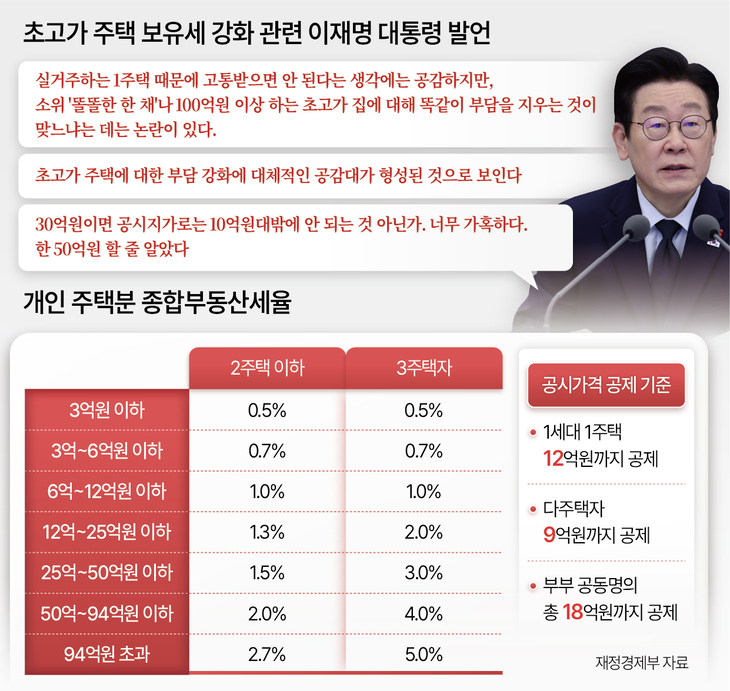
The prospect of a strengthened holding tax has prompted predictions that most apartments in the Gangnam area could fall within its scope. At the Cabinet meeting he chaired at Cheong Wa Dae on Tuesday, President Lee raised the issue of holding taxes on owner-occupied single homes publicly while receiving a ministry briefing on plans to gather public opinion on real estate policy. "There is debate over whether it is right to impose the same burden on so-called 'prime single homes' and ultra-expensive properties worth 10 billion won or more," he said.
Lee then proposed a surprise live vote via YouTube, asking viewers to press "1" if they thought ultra-expensive homes should bear a heavier tax burden, or "2" if they disagreed. When Office for Government Policy Coordination Minister Lim Gi-geun reported that "about 90 percent of comments chose option 1," Lee said, "Doesn't this suggest broad public agreement that even an owner-occupied single home, if it is ultra-expensive, should face a heavier burden?" — effectively arguing that public support had formed for raising the holding tax on ultra-expensive single homes.
A specific threshold for "ultra-expensive homes" also came up. When Minister Lim said "many people wrote in 3 billion won as the benchmark," Lee replied, "Isn't that too harsh? At a market value of 3 billion won, the publicly assessed price is only in the low-to-mid 1 billion won range. I had expected something like 5 billion won — that's surprising."
Comprehensive real estate tax brackets may be subdivided — and annual tax-burden cap could rise too
The market interprets Lee's remarks as indicating that he has a figure above 3 billion won — somewhere in the 4 billion to 5 billion won range — in mind as the threshold for ultra-expensive homes. Within and around the government, proposals have been circulating to classify ultra-expensive homes as a separate category and further subdivide the tax brackets for the comprehensive real estate tax. The intent is in effect to bring even owner-occupied "prime single homes" within the scope of tighter regulation.
Since Lee's remarks, observers expect growing momentum behind a plan to apply a separate tax bracket to homes with a market value above 4 billion won. Under the current comprehensive real estate tax structure, a single-home household (owning two or fewer properties) calculates its tax base by deducting 1.2 billion won from the publicly assessed price and then applying a fair market value ratio of 60 percent. Even homes worth more than 4 billion won on the market therefore do not face an extreme tax burden.
However, if a separate tax bracket were created for single-home owners within the existing tax-base and rate structure — with a higher rate applied — even someone who owns just one home they live in could face a tax bill comparable to that of a multi-home owner with three or more properties.
![A notice related to real estate taxes is posted outside a real estate agency in Seocho-gu, Seoul. [Yonhap]](https://wimg.heraldcorp.com/news/cms/2026/07/15/rcv.YNA.20260714.PYH2026071416070001300_P1.jpg)
Lee Jeom-ok, deputy head of Shinhan Premier Pathfinder, said the current law raises tax rates only for multi-home owners once the publicly assessed value exceeds 1.2 billion won, but that the brackets are likely to be further subdivided so that single-home owners with a high tax base also face a higher rate. "A market value of 4 billion won corresponds to roughly 2.4 billion won in publicly assessed terms, so anyone in that range could see their holding tax rise sharply," she said.
Experts also suggest the government may raise the annual tax-burden cap. Even if tax brackets are subdivided and rates increased, the actual increase felt by taxpayers may remain limited as long as the cap stays at the current 150 percent. Under the Moon Jae-in administration in 2021, the cap was raised from 150 percent to 300 percent for owners of two homes in designated adjustment areas and owners of three or more homes.
Lee said that if the 150 percent cap is maintained, "those holding a prime single home will have some degree of protection." She added, however, that "if the annual tax-burden cap is also raised for single-home owners, the additional burden could be substantial."
hss@heraldcorp.com




