
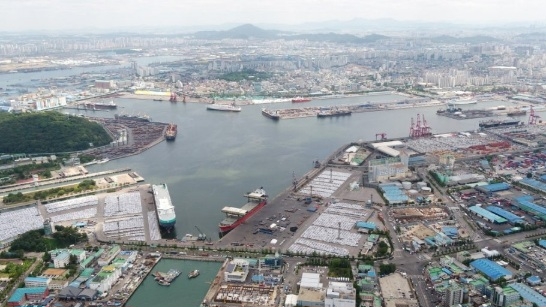
Concerns are growing that Incheon Port's functions and competitiveness could deteriorate further as the government is reportedly reviewing a plan to merge the port authorities of Busan, Incheon, Ulsan and Yeosu-Gwangyang.
Critics warn that merging the operational structure on top of an already skewed investment landscape — where government fiscal spending has been concentrated on Busan while Incheon's share has sharply declined — would severely undermine regional ports' autonomy and competitiveness.
According to data submitted by the Ministry of Oceans and Fisheries to Jung Il-young, a Democratic Party lawmaker representing Incheon's Yeonsu-eul district and a member of the National Assembly's Land, Infrastructure and Transport Committee, government fiscal investment in ports over the past five years has been heavily concentrated on Busan while Incheon has seen a steep decline.
Government fiscal investment in Busan Port rose from 251.4 billion won ($167 million) in 2021 to 461.6 billion won in 2025, an increase of 210.2 billion won, or 83.6 percent.
Incheon Port, by contrast, saw investment fall from 177.2 billion won to 61.4 billion won over the same period — a drop of 115.8 billion won, or 65.4 percent.
As a result, the investment gap between the two ports widened from 74.2 billion won to 400.2 billion won, and the ratio of Busan's investment to Incheon's ballooned from 1.4 times to 7.5 times.
Incheon Port also fell five places in the national fiscal investment rankings, dropping from third in 2021 to eighth in 2025, while Busan Port has held the top spot for three consecutive years since 2023.
Cargo volumes, however, have not declined. Vehicle and parts throughput at Busan Port rose from 23.83 million tons to 26.51 million tons.
Incheon Port also saw throughput grow, from 7.81 million tons to 8.95 million tons, underscoring its expanding role as the Greater Seoul area's key import-export logistics hub.
With cargo volumes rising even as government investment shrinks, critics say a merger of the port authorities would weaken Incheon Port's ability to set its own investment strategy and make independent operational decisions.
"Incheon Port is a nationally critical port responsible for Greater Seoul's import-export cargo and logistics to and from China," Jung said. "The government has sharply expanded investment in Busan while cutting it significantly in Incheon. If the port authorities are merged on top of that, Incheon Port's competitiveness will inevitably weaken further."
He added that major ports around the world build their competitiveness on regional expertise and autonomy, and that consolidating Korea's port authorities could make region-specific investment and swift decision-making more difficult.
Jung urged the government to focus on strengthening Incheon Port's competitiveness rather than pursuing a merger of the port authorities.
Citing the recently passed legislation establishing the Incheon Maritime Court, he stressed that construction of the court building, expansion of port infrastructure and increased government fiscal investment should come first.
He went on to say that if the relocation of the Ministry of Oceans and Fisheries to Busan is followed by a merger of the port authorities, the blow to Incheon Port's functions, standing and the local economy would be severe. He urged the government to maintain an independent port management structure that reflects each region's distinct characteristics and to increase investment in Incheon Port.
Jung added that consolidating port authorities — which were established to operate in line with each region's characteristics and industrial conditions — into a single entity would amount to voluntarily undermining regional ports' competitiveness. "If the government submits legislation to merge the port authorities to the National Assembly, I will oppose it to the end to protect Incheon Port's competitiveness," he said.
gilbert@heraldcorp.com




