Parents who struggle to find childcare during school vacations — beyond shuttling their children between hagwon — may soon have less to worry about. The government is launching a new initiative to extend operating hours at after-school community care facilities during vacation periods.
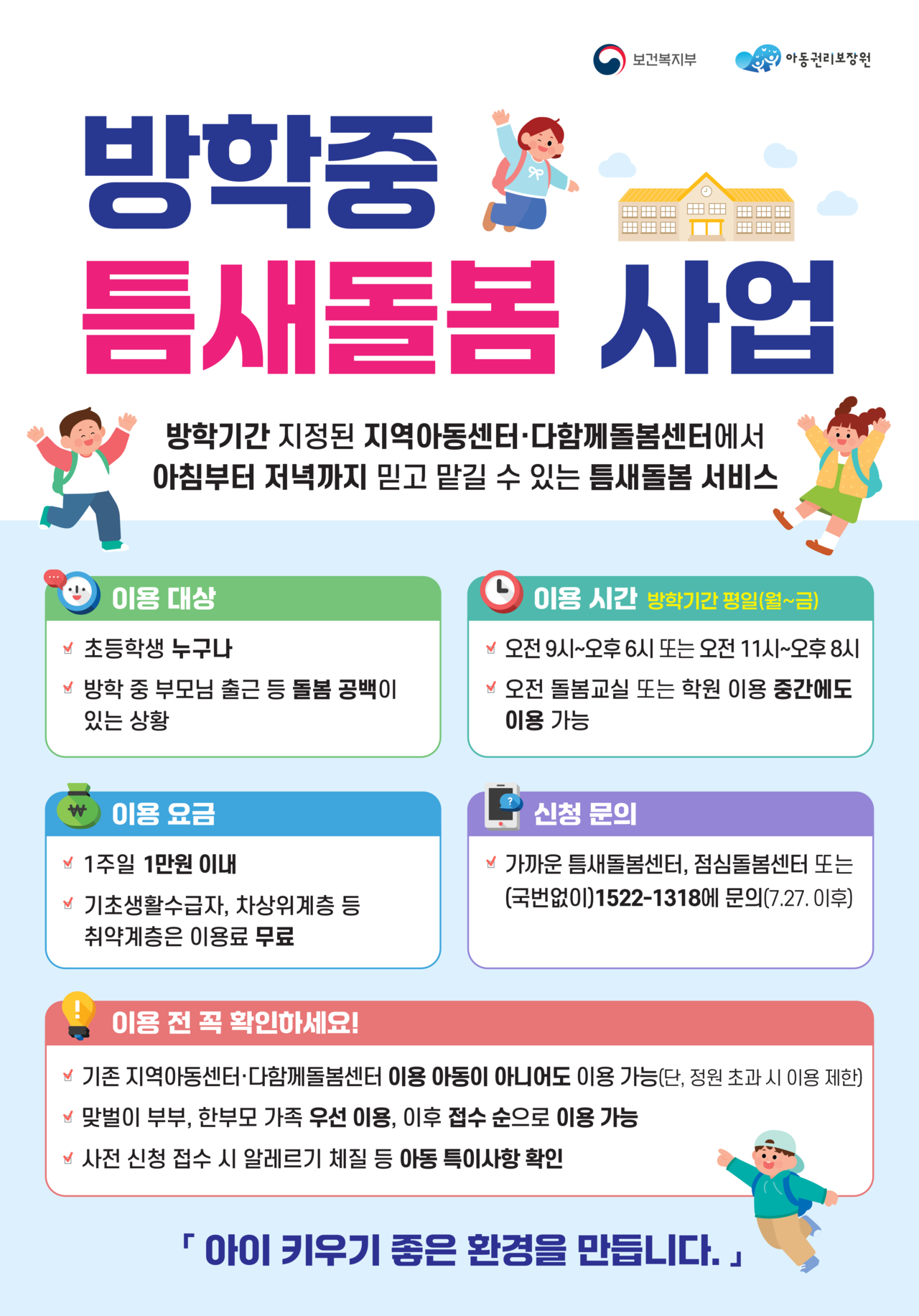
The Ministry of Health and Welfare announced Monday that it will roll out the gap-care project starting July 27, expanding operating hours at after-school care facilities for the duration of school vacations.
While schools currently run in-school care programs during breaks, gaps in coverage can arise depending on the region and individual school conditions.
The new initiative aims to address those gaps by extending hours at community-based after-school care facilities during vacation periods and ensuring children receive lunch and dinner.
Targeting participation from 2,500 of the roughly 5,600 community after-school care facilities nationwide, 1,500 centers during the vacation period will operate from 9 a.m. to 6 p.m., providing a morning snack, lunch and dinner, while another 1,000 centers will run from 11:30 a.m. to 8 p.m., offering lunch and dinner.
As a vacation-only program, children who do not normally use community care facilities during the school term may also participate by registering in advance.
However, to prevent excessive meal registrations, each center may charge a weekly fee of up to 10,000 won ($7) per child — 2,000 won per day.
The program is set to run from July 27 through the third week of August for this summer vacation, with ready centers launching first.
Following the summer break, the program is also planned for the winter vacation period — from Dec. 21 through January 2027 — and is intended to continue every vacation season thereafter.
Starting July 27, families can inquire directly at designated centers or call the nationwide after-hours care support hotline to find available centers nearby.
A list of designated centers will also be available on the National Child Rights Guarantee Agency website from July 27.
The ministry expects that once participation reaches the target of 2,500 centers, more than 200,000 elementary school students and their parents nationwide will benefit each vacation period.
The ministry also plans to coordinate with the Ministry of Education's pilot program on outstanding school-break elementary care and education models, with the aim of building diverse school-community cooperation frameworks suited to local conditions.
Additional national subsidy funding required for the new gap-care project will be finalized through a Cabinet meeting.
"I hope this vacation gap-care project will go a long way toward easing the worries of parents with elementary school-age children across the country," said Hyeon Su-yeop, first vice minister of health and welfare. "We will work with relevant ministries to continuously strengthen school-based care and actively identify and address care blind spots — including evenings, weekends and school vacations."
thlee@heraldcorp.com