Quantitative evacuation criteria, stronger prevention projects, expanded public data access and community participation — response personnel also increased
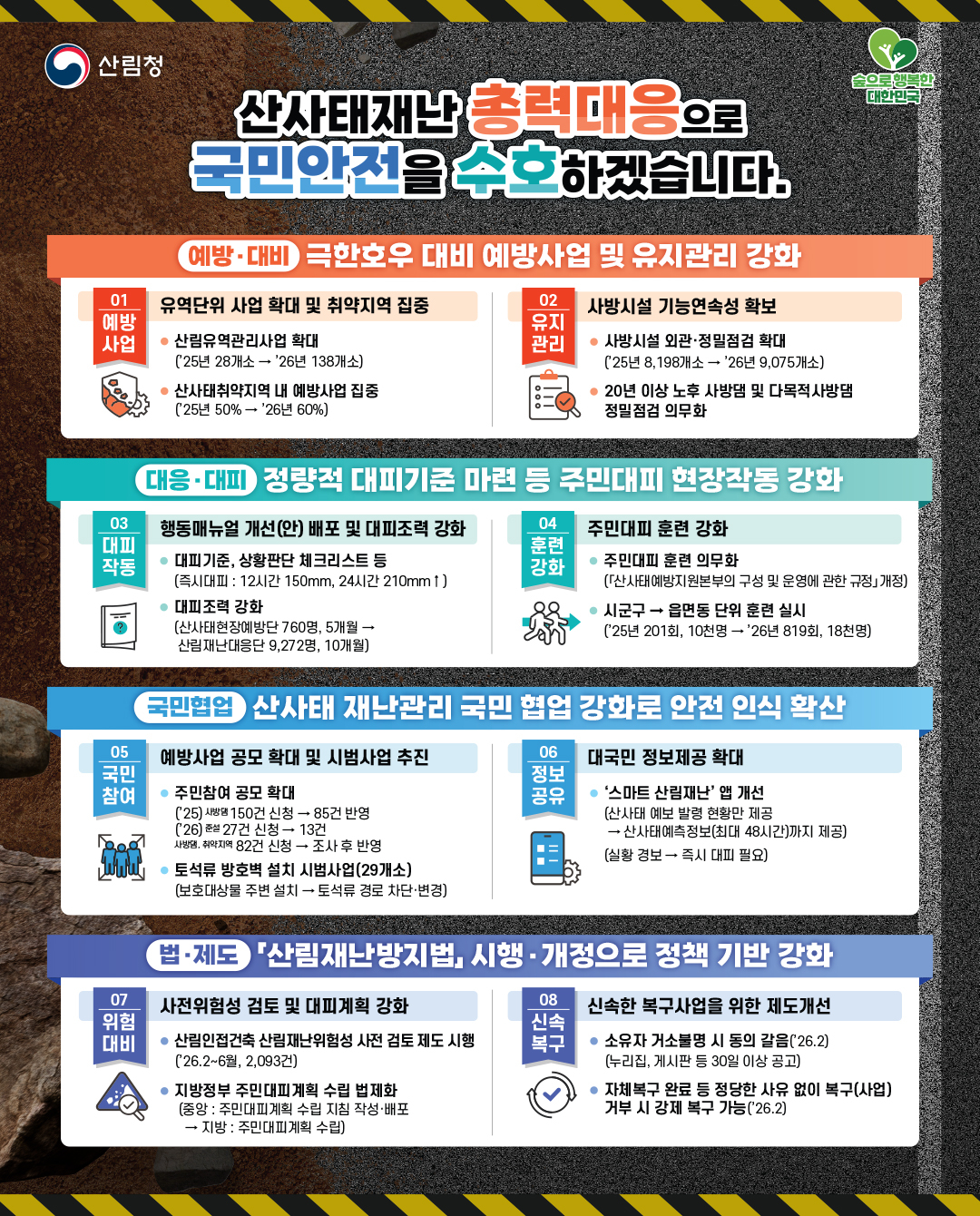
A strengthened, smarter landslide response system has been put in place to protect lives and property even in the event of extreme rainfall on the scale seen last year.
The Korea Forest Service, led by Commissioner Park Eun-sik, outlined the major policy changes made since last year's landslide damage and the agency's response framework for this summer at the Government Daejeon Complex on Thursday.
Last year's landslide incidents totaled 2,637 cases — about 1.6 times the 10-year average of 1,640. Of those, 2,599 cases, or 98.5 percent of the total, were concentrated in a five-day window from July 16 to July 20 last year.
In Sancheong, South Gyeongsang Province, 793 millimeters of rain fell over four days, surpassing the area's average summer rainfall of 710 mm — an extreme deluge amounting to roughly half the region's annual average of about 1,400 mm. In Gapyeong, Gyeonggi Province, 226 mm fell within five hours, exceeding 80 percent of the area's normal July rainfall.
Drawing on the results of a joint public-private disaster cause investigation led by the Ministry of Interior and Safety, the Korea Forest Service has since focused less on pinpointing specific causes and more on broadly reinforcing resident evacuation systems, prevention infrastructure, public participation and institutional foundations to prevent casualties.
▶ Evacuation drills and decision-making criteria strengthened to ensure rapid on-the-ground response
Drills previously conducted at the city, county and district level have been broken down to the township and neighborhood level starting this year, raising the number of drills from 201 to 819 and the number of participants from 10,000 to 18,000.
The agency also distributed to local governments a set of recommended quantitative criteria and a situational checklist for deciding when to issue evacuation preparation orders, evacuation orders and immediate evacuation orders — the last triggered when cumulative rainfall reaches 150 mm over 12 hours or 210 mm over 24 hours, among other conditions. Local governments make the final call on resident evacuations by weighing local terrain, rainfall conditions and on-site warning signs.
▶ Field response personnel sharply expanded
Personnel previously assigned separately to forest fires, landslides and forest pest control have been consolidated into a single Forest Disaster Response Corps, which has been operating for 10 months. Tasks previously handled by 760 members of the Landslide Field Prevention Unit — including inspections of landslide-prone areas and assistance with resident evacuations — are now carried out by 9,272 members of the Forest Disaster Response Corps.
▶ Public access to hazard information expanded so residents can check risks directly
Starting this year, the Smart Forest Disaster app provides landslide forecast information in three alert levels — advisory, preliminary warning and warning — down to the township and neighborhood level. Anyone can register an area of interest in the app and receive updates for that location.
▶ Scope of erosion-control dam dredging applications expanded
Until last year, residents could only apply to have new erosion-control dams installed in their areas. Starting this year, the public can also directly propose sites in need of erosion-control dam dredging — the removal of sediment accumulated in existing dams — as well as areas they believe should be designated as landslide-prone zones, broadening the scope of the public application process.
Applications for erosion-control dam dredging were accepted earlier this year, and 13 projects have already been carried out. A total of 82 applications received through the end of May — covering erosion-control dam installation and landslide-prone zone designation — will undergo field surveys, and those found to have a genuine need will be incorporated into future prevention projects.
The Korea Forest Service is currently operating a 24-hour emergency response system centered on its Landslide Prevention Support Headquarters, continuously monitoring warning signs including landslide forecasts and weather alerts.
"Due to the rainfall that has been falling since Wednesday, damage can occur with less rain than usual," said Lim Ha-su, deputy commissioner of the Korea Forest Service. "We urge the public to refrain from outdoor activities near forests, pay close attention to evacuation guidance through emergency alert messages and village broadcasts, and move quickly to designated shelters such as community centers if an evacuation order is issued."
kwonhl@heraldcorp.com