
![Consumer prices rose at their fastest pace in two and a half years in June, driven by a sharp increase in oil prices following the Middle East war and a rebound in agricultural prices due to poor harvests. Lifestyle prices also posted their biggest gain in two years and two months, with prices for farm, livestock and fishery products rising 3.2 percent, pushing overall inflation up by 0.24 percentage points.
A shopper browses the vegetable section of a hypermarket in Seoul on Thursday. [Yonhap]](https://wimg.heraldcorp.com/news/cms/2026/07/09/rcv.YNA.20260702.PYH2026070210910001300_P1.jpg)
South Korea's food prices rank among the highest in the OECD even after adjusting for purchasing power, data showed Thursday.
While the country's overall consumer price level remains below the OECD average, grocery prices have stayed near the top of the rankings for three consecutive years, placing a heavy burden on household budgets.
According to OECD purchasing power parity (PPP)-based price statistics, South Korea's 2024 price index for food and non-alcoholic beverages stood at 146 — 46 percent above the OECD average of 100.
The PPP index measures real price levels by accounting for each country's prices and purchasing power. Among the OECD's 38 member states, South Korea ranked second, trailing only Switzerland at 147.
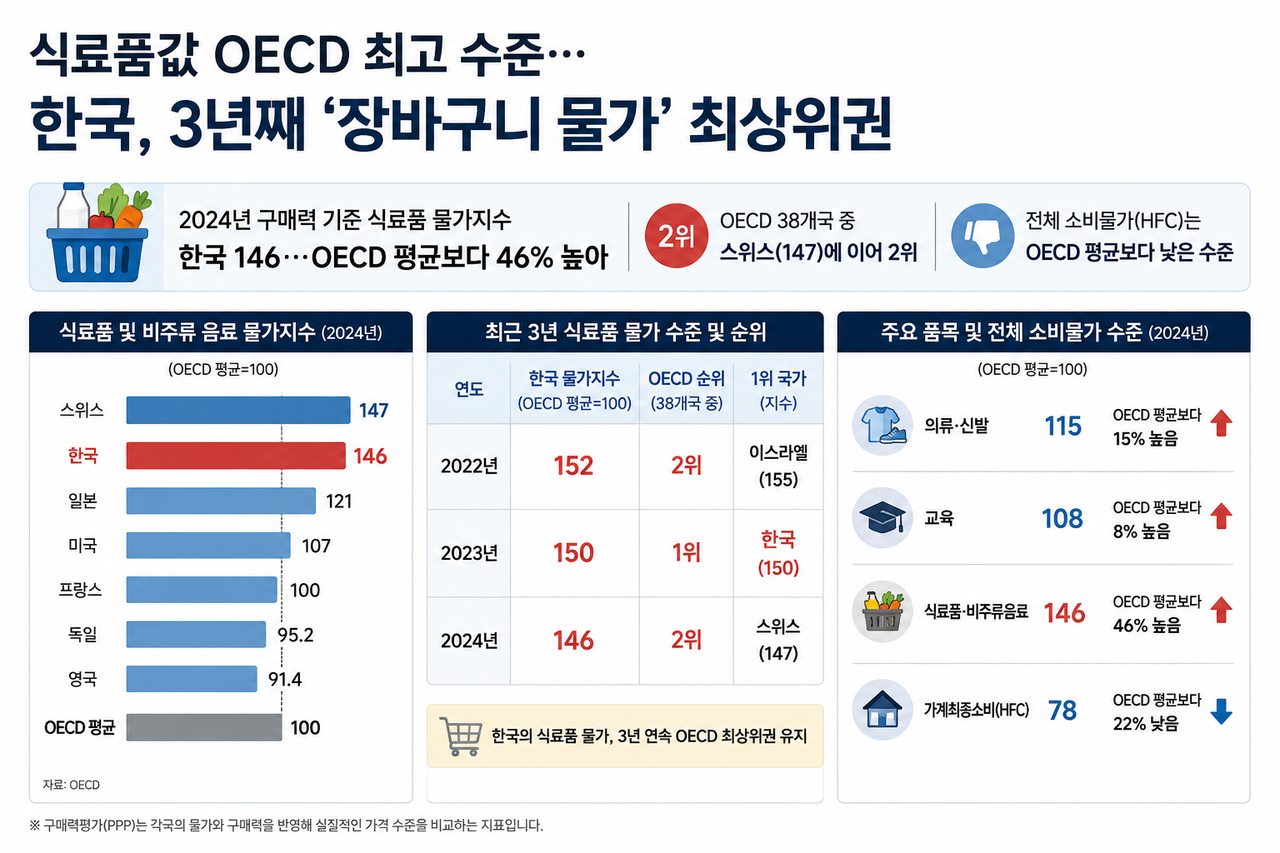
South Korea's food prices are high even by the standards of major advanced economies. Japan recorded an index of 121 and the United States 107, while major European countries — France at 100, Germany at 95.2 and the United Kingdom at 91.4 — came in at or below the OECD average.
South Korea has ranked near the top of the OECD for food prices for three consecutive years. In 2022, it posted an index of 152, tying for second place behind Israel at 155. In 2023, its index of 150 was the highest among all OECD members. Last year the index edged down to 146, but South Korea still claimed second place behind Switzerland.
Beyond food, South Korea's price index for clothing and footwear stood at 115, and education at 108, both above the OECD average.
By contrast, the household final consumption (HFC) price index — which covers all consumer spending — came in at 78, below the OECD average, placing South Korea 23rd among the 38 member states.
Analysts attributed this to persistently below-average prices in key service categories, including residential costs at 54.7, transportation at 75.3, leisure and culture at 80.7, and food services and accommodation at 93.6.
fact0514@heraldcorp.com




