![President Lee Jae Myung speaks at a senior secretaries meeting at Cheong Wa Dae on Wednesday. [Yonhap]](https://wimg.heraldcorp.com/news/cms/2026/07/07/rcv.YNA.20260702.PYH2026070211550001300_P1.jpg)
Spending on maternity protection programs funded by the employment insurance fund — including parental leave benefits and maternity leave benefits — grew 2.6 times between 2021 and 2025, worsening the fiscal health of the unemployment benefit account, a new report shows. With President Lee Jae Myung ordering a reform of unemployment benefits and a plan to stabilize employment insurance finances, discussions on separating the maternity protection account and expanding general budget support are expected to gain momentum.
According to a report titled "2026 Social Insurance of the Republic of Korea," published Tuesday by the National Assembly Budget Office, spending on maternity protection and child-rearing support programs — classified as mandatory outlays under employment insurance — rose from 1.69 trillion won ($1.09 billion) in 2021 to 4.31 trillion won in 2025, a 2.6-fold increase with an average annual growth rate of 26.5 percent. Parental leave benefits drove much of that growth, rising from 1.3 trillion won to 3.63 trillion won over the same period — a 2.8-fold increase. By contrast, unemployment benefit spending grew just 2.9 percent over the same period, from 12.52 trillion won to 12.87 trillion won, far outpaced by the rise in maternity protection outlays.
The budget office said fiscal concerns over the unemployment benefit account have deepened as mandatory outlays funded by the employment insurance fund — including job-seeker benefits, maternity leave benefits and parental leave benefits — have broadly expanded. However, it projected that reserves would resume an upward trend from 2026 onward, factoring in deposit support from the Public Fund Management Fund and the stable fiscal conditions of the employment stability and vocational skills development account. By 2029, employment insurance fund revenue is expected to reach 24.7 trillion won against outlays of 21.3 trillion won.
The employment insurance fund currently covers not only unemployment benefits but also maternity protection programs aimed at addressing the low birth rate, including parental leave benefits, maternity leave benefits and paternity leave benefits. Analysts say the fiscal burden is growing rapidly as employment insurance takes on responsibility for both unemployment protection and childbirth and child-rearing support.
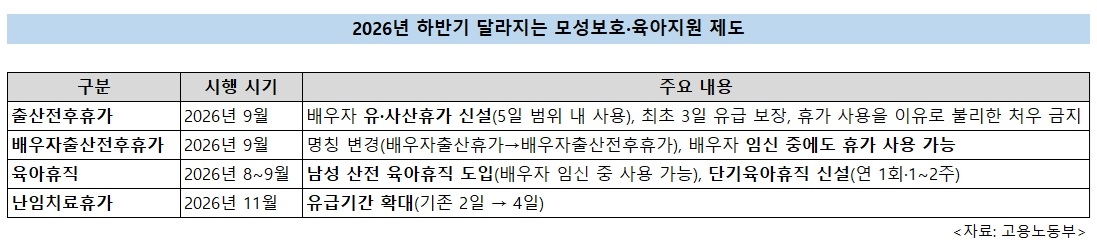
Maternity-related spending is likely to increase further. According to the Ministry of Employment and Labor, the second half of this year will bring new spousal miscarriage and stillbirth leave, and spouses will be allowed to use maternity leave during pregnancy. New paternal prenatal parental leave and short-term parental leave will also be introduced, and the paid period for infertility treatment leave will be extended from two days to four. The expansion of these programs is expected to drive a sustained rise in mandatory maternity-related outlays through employment insurance.
Against this backdrop, discussions inside and outside the National Assembly and the government have centered on separating the maternity protection program from the unemployment benefit account or expanding general budget support as alternatives. The general budget already provides some fiscal support for maternity protection programs, but critics argue that employment insurance funds alone cannot absorb the spending increases driven by the expansion of low birth rate policy.
These fiscal conditions are closely tied to the government's push to reform unemployment benefits. Labor, management and government representatives have already held National Assembly discussions on separating maternity protection programs from the unemployment benefit account, on the grounds that rapid growth in maternity protection spending is straining employment insurance finances. Alongside this, calls have grown for stable funding to be secured before advancing an income-based universal employment insurance system and improvements to the job-seeker benefit regime for independent workers.
President Lee received a briefing on a "plan to reform unemployment benefits and stabilize employment insurance finances" at a senior secretaries meeting at Cheong Wa Dae on Wednesday, and directed officials to gather sufficient public input before finalizing any measures. "It is desirable for policy to be established through a process of opinion gathering and public deliberation," he said. The government is now expected to accelerate work on an employment insurance stabilization plan ahead of next year's budget drafting. Key issues will include whether to create a separate account for maternity protection programs, whether to expand general budget support, and how to secure funding for the rollout of income-based universal employment insurance.
fact0514@heraldcorp.com