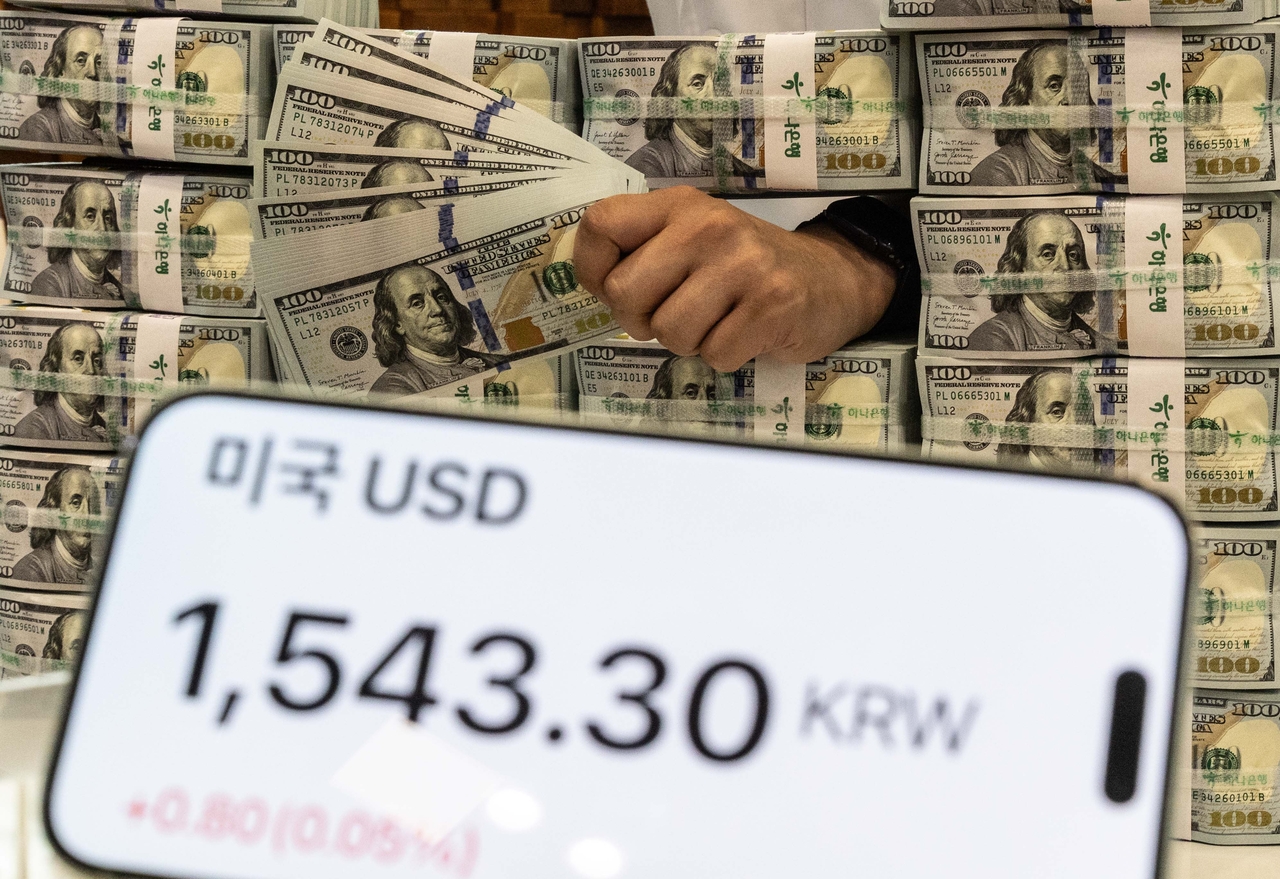
The premium rate attached to the dollar in Korea's foreign-currency funding market has been falling consistently since last year and has recently turned negative.
Dollar deposits — led by small and medium-sized enterprises — have surged, and foreign investors have expanded their domestic bond holdings through foreign-exchange swaps, flooding the funding market with dollars.
In the spot market, however, the dollar is growing scarcer. Expectations of a further rise in the won-dollar exchange rate have dampened demand to convert dollars into won, while foreign investors selling Korean equities and converting the proceeds into dollars have pushed the dollar's value higher on the spot market.
Attention is now turning to whether major semiconductor companies will convert dollars into won for domestic investment and tax payments — potentially releasing dollar liquidity from the funding market into the spot market and pulling the exchange rate lower.
Dollar liquidity overflows in FX funding market; premium rate hits -0.3%
According to the Bank of Korea, the dollar premium rate in the foreign-currency funding market — based on three-month instruments — stood at -0.3% on Tuesday. The dollar premium rate, also known as the arbitrage incentive, is calculated by subtracting the swap rate from the interest-rate differential between domestic and foreign markets. It represents the additional premium charged when financial institutions borrow dollars in foreign-exchange swap transactions, in which they exchange dollars and won. Because the dollar, as the world's reserve currency, commands greater demand than the won, lenders have traditionally charged extra interest when lending dollars in exchange for won.
A negative reading means the market has reached a point where lenders are willing to cut rates just to place their dollars — while borrowing won has become more expensive. As foreign-currency liquidity has grown abundant, more institutions are seeking to borrow won than dollars, producing a reversal in which won now carries a premium in the interbank funding market.
The dollar premium rate has been shrinking consistently since last year. From 0.41% at end-June 2025, it fell to 0.22% by end-December and to 0.04% in January before turning negative — a decline of more than 0.7 percentage points in a single year.
The rise in dollar liquidity has been driven largely by a surge in dollar deposits, particularly among small and medium-sized enterprises. Corporate dollar deposit balances reached $83 billion at end-May, up $2.95 billion from the previous month and a record high, according to the Bank of Korea.
Small and medium-sized enterprises' share of corporate dollar deposits has grown steadily, rising from 54% at end-January last year to 60% by end-December and to 66% by end-June this year.
The trend reflects a broader current-account surplus that has brought more dollars into the country, combined with expectations of further won-dollar rate increases that have led many companies to hold onto their dollars rather than convert them into won.
Last month, foreign reserves actually rose by $370 million even as authorities intervened to defend the won — a direct result of the increase in dollar deposits. When banks have surplus foreign-currency funds, they deposit them in the Bank of Korea's foreign-currency reserve accounts, and the recent buildup in dollar deposits has lifted reserves along with it.
Expanded foreign investment in domestic bonds has also added dollars to the funding market. Bond-related capital recorded a net inflow of $5.68 billion in May, extending a net inflow for a second consecutive month after $550 million in April. Because foreign investors typically fund more than half of their domestic bond purchases with won obtained by lending dollars through foreign-exchange swaps, the process has channeled a large volume of dollars into the market.
Expectations of further rate rise dampen won demand on spot market
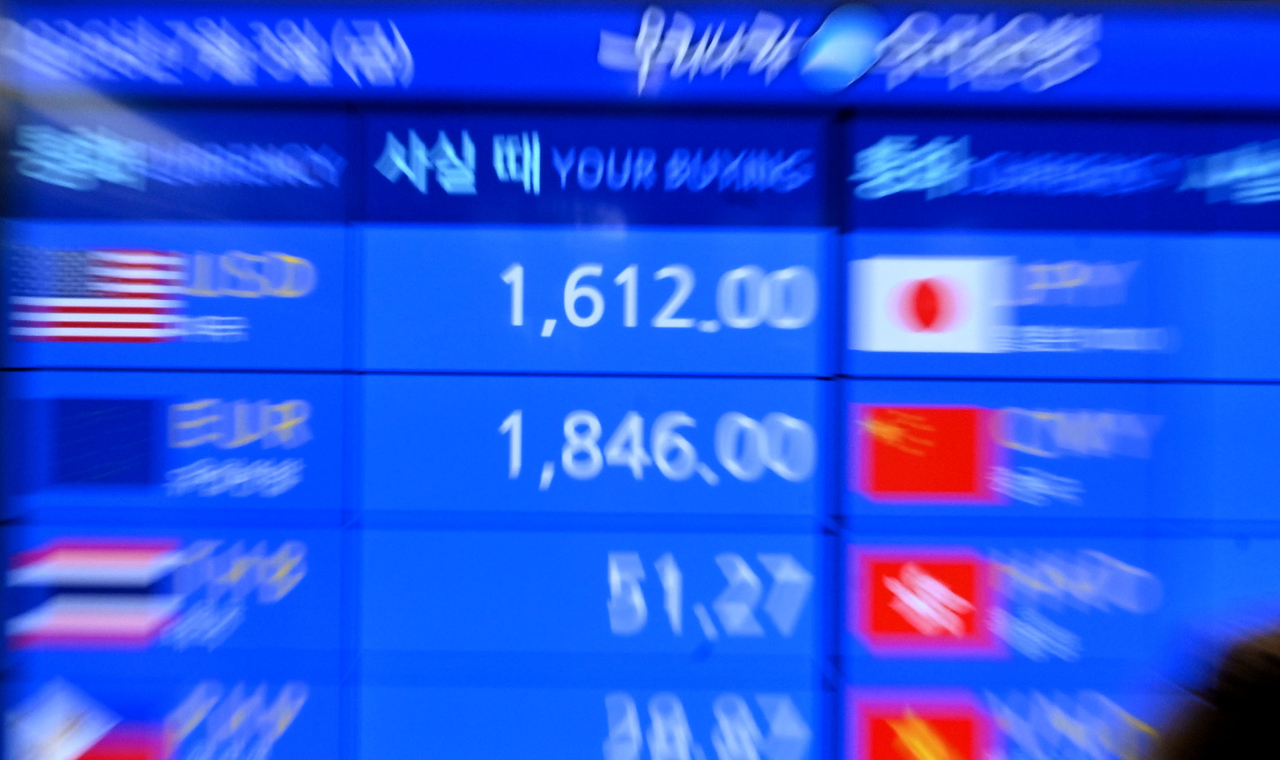
Paradoxically, while dollars are overflowing in the foreign-currency funding market, a shortage on the spot market is keeping the exchange rate elevated. The average won-dollar rate in the first half of this year — based on weekly closing prices — came to 1,484.6 won, the highest since the first half of 1998 during the Asian financial crisis (1,493.1 won) and 133.5 won above the level recorded during the global financial crisis (1,351.1 won).
The divergence stems from the fact that the foreign-currency funding market, where currencies are lent and borrowed, and the spot market, where they are bought and sold, operate independently. No matter how plentiful dollars are in the funding market, if those dollars are lent out rather than converted into won, the won's value on the foreign-exchange market will inevitably fall.
Growing numbers of companies and investors are holding dollars in deposits rather than converting them into won, betting the rate will rise further. At the same time, foreign investors who have been consistently selling Korean equities are converting their won proceeds into dollars, pushing the dollar higher and the won lower on the spot market.
Minutes from the Monetary Policy Board meeting held June 11 noted the same dynamic: "Unlike some past episodes — such as crises — in which a rise in the won-dollar spot rate and a tightening of foreign-currency funding market liquidity occurred simultaneously, current foreign-currency funding market liquidity is very abundant."
If demand to convert dollars from the funding market into won on the spot market increases, the exchange rate is expected to come under natural downward pressure.
Last month the government urged major export companies — including Samsung Electronics, SK hynix and Hyundai and Kia — to convert export proceeds into won more quickly and repatriate overseas retained earnings, while financial regulators asked commercial banks to scale back marketing of dollar deposit products, both measures aimed at accelerating that conversion.
Some market participants predict that a surge in won-conversion demand from major semiconductor companies — for domestic investment and tax payments — will gradually push the exchange rate lower. Because domestic investment and taxes must be paid in won, companies must convert the dollars they earn from exports, and that process is expected to exert downward pressure on the rate.
Samsung Electronics and SK hynix have already announced plans to invest a combined 800 trillion won in four memory fabrication plants in the southwestern region as part of the government's three mega-project national development initiative. On top of that, analysts project the companies will need to convert roughly $40 billion into won to pay interim corporate taxes in mid-August.
kimstar@heraldcorp.com