
In conversation with IMF Asia-Pacific director
Inflation to stay above target for considerable time
Prices, exchange rate, financial stability all point same way
Won should appreciate further, aiding financial stability
Taming inflation is the best way to help the vulnerable
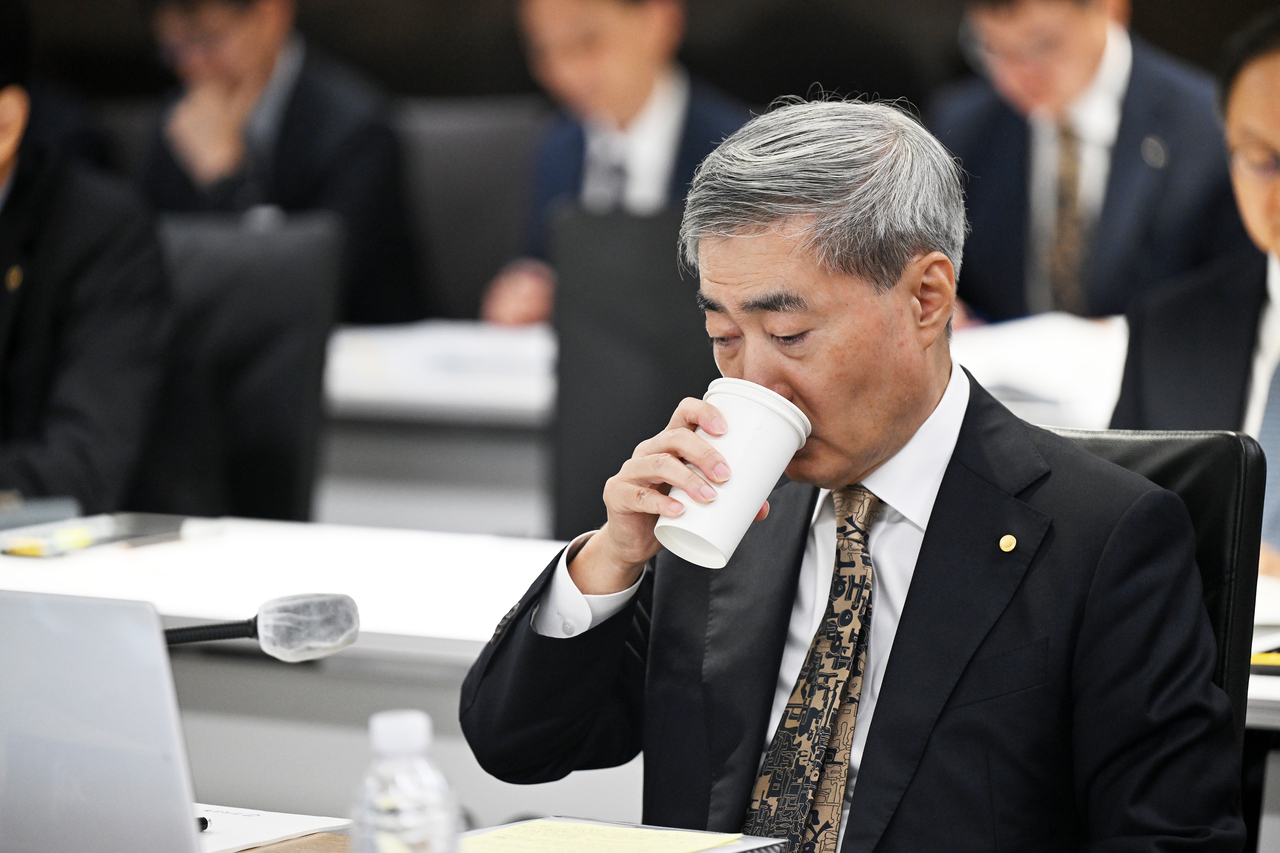
Bank of Korea Governor Shin Hyun-song said he would maintain a restrictive monetary policy stance "until I am convinced that inflation will converge on its target in a timely manner," signaling that the tightening cycle could be prolonged given expectations that price growth will remain above target for a considerable period.
Shin made the remarks during a "Governor Talk" session at the International Monetary Fund–World Bank Group Annual Meetings in Bangkok, Thailand, on Tuesday (local time), in conversation with Krishna Srinivasan, director of the IMF's Asia and Pacific Department.
"The AI cycle is overwhelming the negative impact of the Middle East war, but on the inflation side the two factors are combining," Shin said. "Cost-push and demand-pull pressures are overlapping, making inflation worse."
He noted that the IMF had revised its growth forecast for South Korea this year to 3.3 percent, matching the Bank of Korea's own projection, and said the strong momentum was feeding price pressures. "Both headline consumer prices and core inflation will remain above target for a considerable time," he said.
Shin likened the current monetary policy environment to chasing rabbits. "When two rabbits run in different directions it is hard to know which one to chase, but when they run in the same direction it becomes easy," he said. "Right now in Korea, inflation is too high, the won has room to strengthen further, and there are financial stability demands as well — all three point in the same direction." He added that trade-offs were "less difficult" in Korea at present and that, while rare, "the direction is fairly clear." Shin had used the same analogy at his first post-appointment monetary policy press conference in May.
On the won-dollar exchange rate, Shin said the won had been "very weak in the first half of this year" but had appreciated considerably since the Bank of Korea shifted to a tightening stance. "I see room for further appreciation, and I think some additional strengthening would be desirable," he said.
A stronger won would raise household purchasing power and shift the economy's center of gravity from exports toward domestic demand, he added, producing a positive effect on economic polarization — the so-called "K-shaped economy." "The exchange rate is not just a relative price; it is a measure of confidence in the currency and the economy as a whole," Shin said. "Converging back toward the levels we were accustomed to for years will also help financial stability."
On addressing the K-shaped economy, Shin said price stability was itself the most direct way to ease the burden on vulnerable households. "Inflation hits low-income households hardest," he said. "The bottom 20 percent of Korean households by income spend 32 percent of their income on food and energy. Getting inflation under control is a very effective way to help those who are struggling the most." On borrowers strained by high interest rates, he said the central bank "cannot do everything" and stressed the role of fiscal policy, adding that "while a balance with moral hazard is needed, there may be room for debt restructuring if necessary."
On financial stability, Shin cited the Financial Vulnerability Index. He said the FVI — benchmarked at 100 for the second quarter of 1997, just before the Asian financial crisis — was currently rising from around its long-term average of 46. "I expect monetary tightening to slow the pace of the rise, and I anticipate it will peak at a level that does not cause concern," he said. He warned that responding after imbalances have grown large "is as dangerous as popping a balloon with a needle" and stressed the need to act while vulnerabilities are still building.
Shin added that in a restrictive monetary policy environment, macroprudential tools become more powerful. "We must not fall into the temptation of loosening macroprudential tools and leaving everything to the central bank," he said. "The central bank can be very lonely."
On the impact of AI on the neutral interest rate — the rate that neither overheats nor slows the economy — Shin said annual AI infrastructure investment by hyperscalers, the large cloud companies, was estimated to exceed $1 trillion through 2030. "The ultra-long-term corporate bonds they issue are drawing money out of the funding pool and becoming one factor pushing up long-term interest rates," he said.
On the "K-dot plot" introduced before Shin took office earlier this year, he said the Bank of Korea would review it "after operating it for at least a year," with any reassessment coming next year at the earliest. He also said the August rate-setting meeting had allowed the bank to signal the trajectory of future policy responses alongside the rate increase, which he said had "a considerably positive effect on long-term interest rates."
kimstar@heraldcorp.com




