Han Byung-do says People Power Party is holding people's livelihoods hostage, vows to wrap up key legislation by year-end
Jeong Jeom-sik says Democratic Party is dismantling the judicial system, reducing judiciary committee to a rubber stamp
Ruling party pushes mega special economic zone bill, eyes fast-track reform
Committee chair dispute surfaces, with Lee Eon-ju alleging political retaliation
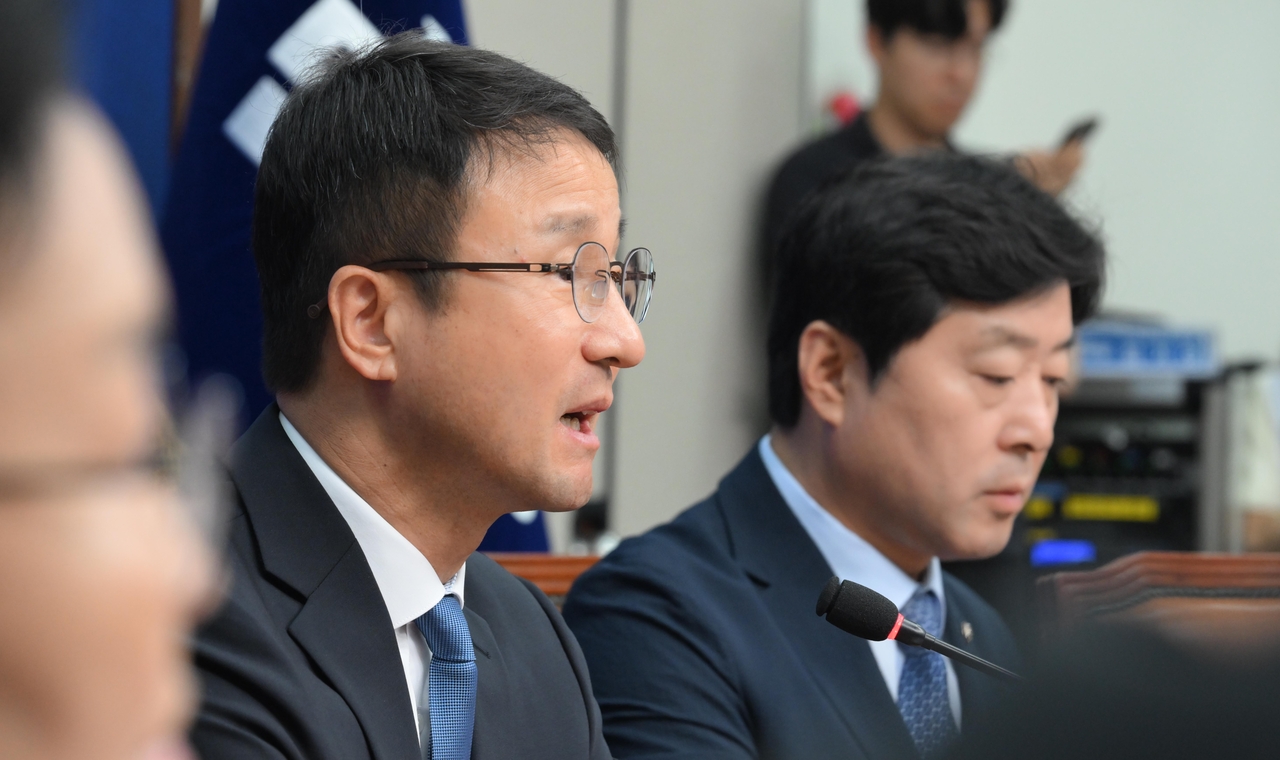
A bitter blame game between South Korea's two major parties shows no sign of easing amid a prolonged standoff over the composition of the National Assembly — including the chairmanship of the judiciary committee — with growing warnings that the breakdown in cross-party cooperation on livelihood issues will ultimately hurt ordinary citizens.
Han Byung-do, acting leader and floor leader of the Democratic Party of Korea, said Thursday at a supreme council meeting at the Assembly that the People Power Party had caused a month-long legislative vacuum and was now resorting to inflammatory rhetoric — labeling the Assembly a "bulletproof parliament" and an "assembly dictatorship" — to justify its own irresponsibility.
Han said the PPP had effectively declared a boycott of livelihood legislation and announced it would escalate its confrontation further, holding the public's welfare hostage to pointless political infighting. In response, he said the Democratic Party would reform fast-track procedures to ensure livelihood bills move quickly and would block what he called sham filibusters.
"We hope the People Power Party will stop its petty obstruction driven by narrow partisan interests and cooperate in normalizing the Assembly," Han said. He added that the Democratic Party would immediately convene a July extraordinary session to accelerate passage of a backlog of livelihood and reform legislation, with plans to complete all major legislative priorities of the Lee Jae Myung administration by year-end.
Han also outlined plans tied to the government's three flagship "Great Leap Forward" mega-projects, saying the party would enact a special law on mega special economic zones — covering regulatory exemptions and comprehensive policy support — through a dedicated task force. He said the party would also review related legislation, including amendments to the Framework Act on Water Management and the Waterworks Act to secure large-scale power capacity and industrial water supply, and would push to secure the budget needed to lay the groundwork for infrastructure development.
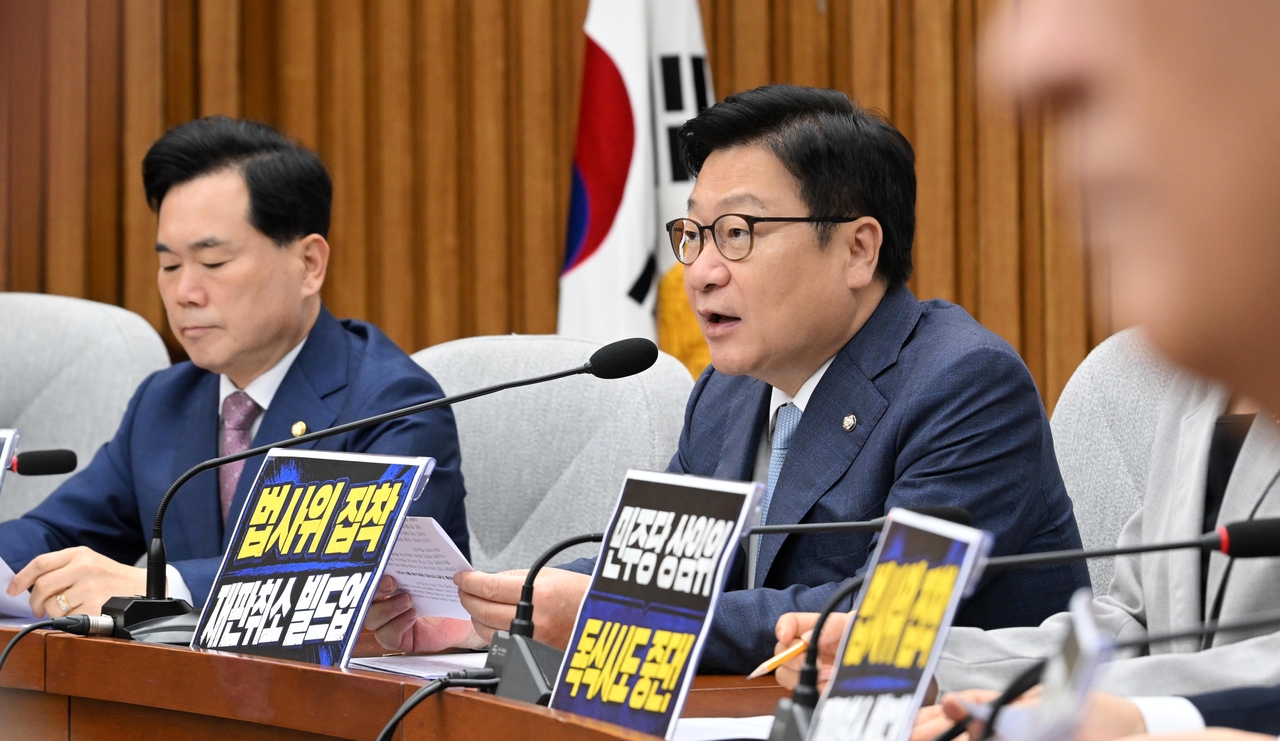
The People Power Party kept up its attack on Democratic Party judiciary committee chair Seo Yeong-gyo for a second consecutive day. PPP floor leader Jeong Jeom-sik said at a floor strategy meeting Thursday that the judiciary committee, now under Democratic Party control, had become a place where the rule of law had died, and that Seo and other Democratic Party members on the panel — intoxicated by the cheers of their hard-line base — would use the power of the state to shred the rule of law.
"What concerns me most is that the Assembly's judiciary committee is leading the charge in dismantling the country's judicial system," Jeong said. He warned that if the Democratic Party accelerated what he called judicial chaos after its party convention, all responsibility would fall squarely on the government and the ruling party.
Jeong also criticized the Democratic Party's decision Wednesday to convene the judiciary committee unilaterally and form a task force on amendments to the Code of Criminal Procedure that would determine whether prosecutors retain supplementary investigative powers. He said completely separating investigation from indictment and stripping prosecutors of even supplementary investigative powers would create endless jurisdictional disputes between investigative agencies, and that the resulting harm would fall entirely on victims.
On shareholder and union opposition to Samsung Electronics and SK hynix's planned semiconductor investments in the Honam region, Jeong said demands for transparency were reasonable. "The argument that President Lee and the corporate chiefs should not be making decisions behind closed doors — that they should openly disclose the rationale for investment decisions to shareholders and seek their verification and consent — sounds quite reasonable," he said. He added that the so-called Yellow Envelope Act and the strengthened commercial law that the Lee government and the Democratic Party had pushed through would end up hobbling the Gwangju-South Jeolla semiconductor cluster.
Discontent within the Democratic Party over its selection of chairs for 11 standing committees on June 30 also surfaced publicly.
Lawmaker Lee Eon-ju criticized the party on her Facebook page Thursday, writing that she suspected political retaliation after being left off the list of committee chairs despite never having held such a post. Lee had sought to chair an economy- or industry-related standing committee in the second half of the Assembly term, but the bid fell through.
"The floor leadership said they would consult me, but there was no real consultation, and I was left off the final list. They didn't even answer my calls," she wrote. "Where in today's world is there an organization this irrational? I thought that at the very least, as a public party, they should divide up the committee posts with a sense of public accountability."
bigroot@heraldcorp.com
mp1256@heraldcorp.com
sunpine@heraldcorp.com