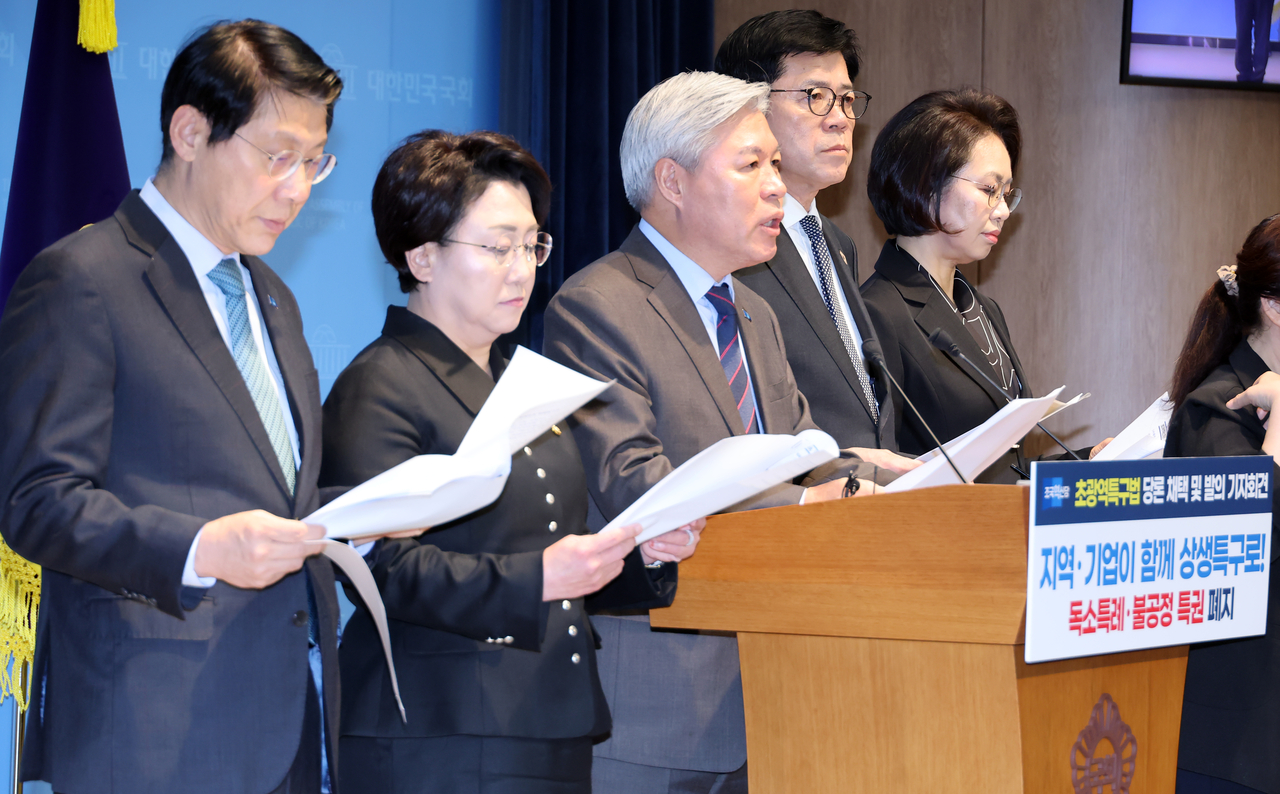
The Rebuilding Korea Party announced Wednesday it had introduced what it calls the "Better Super-Regional Zone Act" — a rival version of a bill filed by the Democratic Party of Korea that strips out labor exemptions, including an exception to the 52-hour workweek cap.
Seo Wang-jin, the Rebuilding Korea Party lawmaker who introduced the bill, said at a National Assembly press conference Wednesday that the legislation would "provide corporate support on par with the Democratic Party's bill, while drawing a clear legal line that must not be crossed."
Earlier, Democratic Party lawmaker Park Sang-hyeok, who leads his party's side on the National Assembly's Political Affairs Committee, introduced the original "Super-Regional Zone Act" on Oct. 20. The bill, tied to the semiconductor industry in the Honam region, was designed to foster regional strategic industries and provide government-level corporate support — but it also included a range of labor-related exemptions.
The Rebuilding Korea Party's version removes the provision exempting high-income and research workers from the 52-hour weekly limit, and deletes clauses that would have allowed foreign-invested companies to impose unpaid holidays and expand the use of dispatched workers.
The bill also limits each zone to no more than one designated area per region to concentrate corporate investment, and establishes a "labor-management-civil society-government cooperative council" to jointly deliberate on zone plans, working conditions and environmental impact.
Speaking with reporters after the press conference, Seo said many lawmakers within the Democratic Party itself have "serious concerns" about the labor exemption provisions, adding that he expects them "to be adjusted through the deliberation process in the Assembly."
Meanwhile, the Democratic Party had already filed a separate super-regional zone bill — introduced by Choe Gi-sang, who leads the ruling party's side on the National Assembly's Climate, Energy, Environment and Labor Committee — that likewise excludes the 52-hour workweek exemption, in addition to Park's original bill.
bigroot@heraldcorp.com