Asking prices climb in neighborhoods next to newly regulated zones
Dasan and Byeollae areas already topping 1 billion won for standard units
'If Namyangju gets regulated, the ripple could reach Uijeongbu'
![A view of apartments in the transit-oriented area of Guri [The Herald Business DB]](https://wimg.heraldcorp.com/news/cms/2026/07/02/news-p.v1.20260630.1dda91ca57d84392969782d9178d9155_P1.jpg)
On Tuesday, a real estate agent surnamed A, who handles transactions at Xi IVY Place — a transit-oriented mixed-use complex widely regarded as the top-tier development in Dasan-dong, Namyangju, Gyeonggi Province — received a call from a seller who had listed a unit at 1.25 billion won ($804,000), asking to raise the asking price by 50 million won. The complex's standard 84-square-meter unit set a record high in February at 1.2 billion won, a transaction that came as apartment prices in the outer metropolitan area rose ahead of the reimposition of the capital gains tax surcharge on multi-home owners. "Most listings currently posted online are already around 1.3 billion won," the agent said. "Sellers are raising their prices for now and watching how the market moves."
After the government placed Guri, Hwaseong's Dongtan district and Yongin's Giheung district — areas that had seen sharp price gains but were left out of earlier rounds of controls — under regulated-zone and land transaction permit zone designations, asking prices in nearby areas began climbing almost immediately. Concerns are growing that a balloon effect could spread in a chain reaction, particularly in unregulated areas such as Namyangju that were already under upward price pressure.
Those concerns are grounded in price trends already visible in the area. According to the Ministry of Land, Infrastructure and Transport's actual transaction price disclosure system, an 84-square-meter unit at Dasan e-Pyeonhansesang Xi in Dasan-dong, Namyangju set a record high on June 5, changing hands at 1.09 billion won on the eighth floor. A 59-square-meter unit sold for 920 million won on the 27th floor on June 13, and a 74-square-meter unit traded at 1.07 billion won on the 18th floor on May 16 — meaning every unit size in the complex has recently set a new record high.
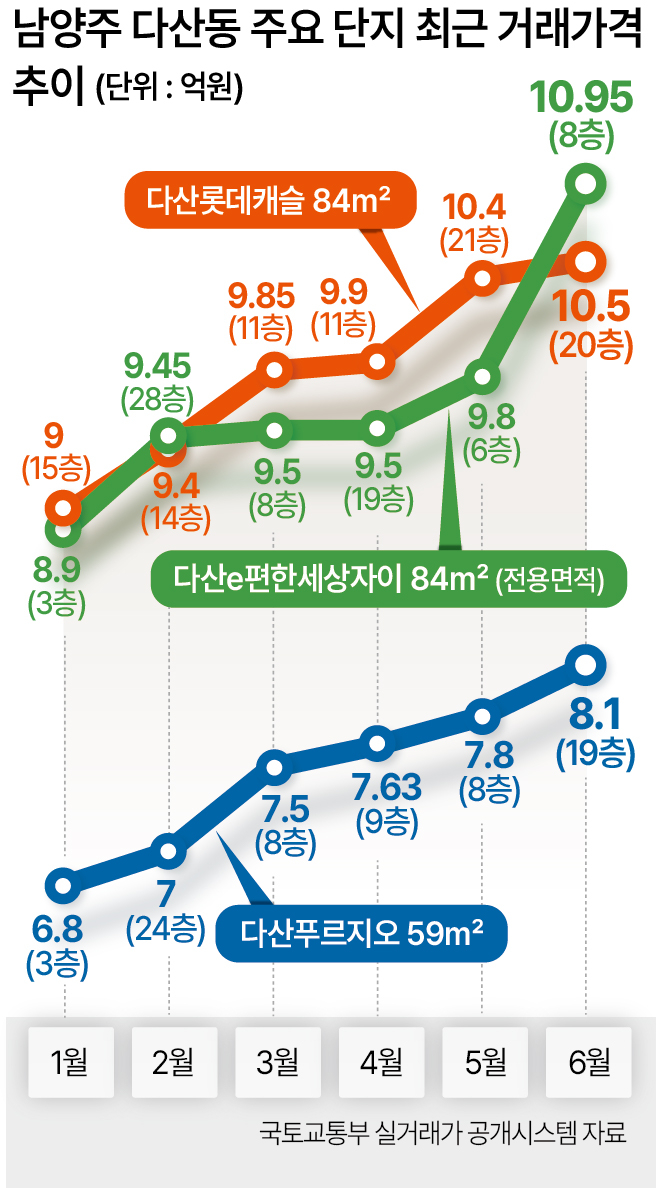
Namyangju has in fact stood out this year as one of the fastest-rising unregulated markets in the metropolitan area. According to the Korea Real Estate Board's weekly apartment price survey for the fourth week of June, Namyangju's cumulative apartment sale price increase this year reached 2.95 percent. That ranks third among areas outside Seoul and the 15 regulated zones in Gyeonggi Province, trailing only Suwon's Gwonseon district at 3.86 percent and Anyang's Manan district at 3.53 percent.
Weekly gains have also been accelerating since June. Namyangju apartment prices rose 0.11 percent in the first week of June, then 0.13 percent in the second week, 0.14 percent in the third and 0.19 percent in the fourth. Given that Namyangju covers a large area with significant variation by neighborhood, analysts say the felt rate of increase in well-connected areas such as Dasan-dong is likely higher than the headline figures suggest.
"Areas close to Seoul, like Dasan and Byeollae, have already been under upward price pressure," said the head of a real estate agency in Dasan-dong, identified only as B. "Among ordinary buyers, there was already a widespread expectation that Dongtan and Guri would be placed under land transaction permit zone designations in the second half of the year." The agent added that speculation is now circulating about Namyangju being next, with many people wondering how any designation would be structured given that the city has no general-gu administrative subdivisions.
With regulations now applying to Hwaseong's Dongtan district, nearby Byeongjeom district in Hwaseong and Osan in Gyeonggi Province are also being mentioned as likely candidates for a balloon effect. Most complexes in those areas have yet to recover to their 2021 peak prices, but record-high transactions have already appeared in some complexes and unit sizes.
"We haven't yet seen a flood of calls from sellers asking to raise asking prices," said the head of a real estate agency in Sucheong-dong, Osan, identified only as C. "But there is a sense of anticipation, particularly near Osandae Station on Line 1, that the area could benefit as a spillover from the Dongtan restrictions."
Experts say the balloon effect is likely to spread first to areas adjacent to the newly regulated zones and to neighborhoods with good regional transit access. "The balloon effect will inevitably spread in sequence, centered on areas connected to the wider transit network," said Kim In-man, head of Kim In-man Real Estate Economic Research Institute. "Byeongjeom and Osan next to Dongtan, Namyangju next to Guri, Cheoin district and Gwangju in Gyeonggi Province near Giheung — all of these will be affected, and ultimately the ripple will reach as far as Uijeongbu."
Kim said the intensity would vary by area, but singled out Namyangju as facing particularly strong upward pressure. "Namyangju borders Seoul and is connected by Metro Line 8, so it moves in tandem with Guri, and it also shares the upside of third-generation new town projects such as the Wangsuk district — that combination could amplify the pressure further," he said.
As Dongtan, Guri and Giheung come under land transaction permit zone designations starting Sunday, fears are growing that the jeonse and monthly rent shortages already visible in Seoul and key parts of Gyeonggi Province could spill over into neighboring areas.
quq@heraldcorp.com
hwshin@heraldcorp.com