Forum takes comprehensive look at achievements and limits of the two-decade-old bus semi-public management regime
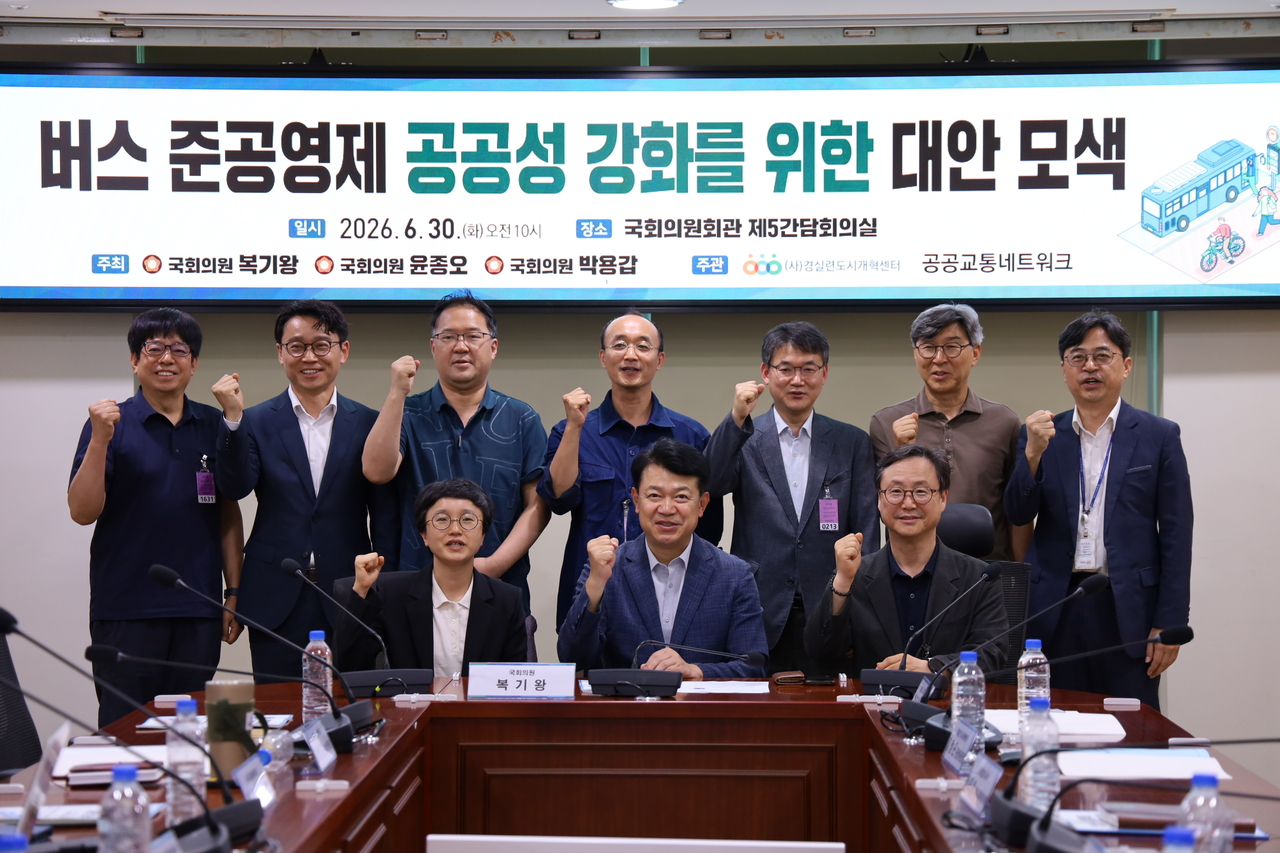
Democratic Party of Korea lawmakers Bok Ki-wang and Park Yong-gap, along with Progressive Party lawmaker Yoon Jong-o, announced Wednesday that they held a policy forum titled "Seeking Alternatives to Strengthen the Public Interest of the Bus Semi-Public Management System" on Monday at the National Assembly Members' Office Building.
The forum was organized to take a comprehensive look at the achievements and limitations of the bus semi-public management regime, which has been in place for more than 20 years. Discussions centered on diagnosing the system's structural shortcomings — particularly the criticism that fiscal support has expanded while actual service mileage and the quality of service felt by citizens have stagnated — and on finding fundamental reforms to improve financial and operational transparency.
Bok said urban bus routes are the "capillaries" that determine whether local communities survive, adding that despite massive public funding to guarantee citizens' transportation welfare, the system suffers from a contradiction in which operational transparency is not ensured.
He called for the system to go beyond merely improving the existing semi-public management framework, urging that it be transformed into an alternative public transit system encompassing new technology systems such as wide-area transport networks, in anticipation of the coming shift to autonomous driving buses. He added that overall transportation welfare must be improved so that the benefits of public transit reach not only major cities but also transportation-underserved areas.
Minister of Land, Infrastructure and Transport Kim Yun-deok sent a written congratulatory message, saying the forum was "very timely" as the semi-public management system has been in operation for more than 20 years and efforts are needed to strengthen operational accountability and improve safety and service quality. Kim added that the ministry would pool its wisdom to build a sustainable public transit system and better guarantee citizens' right to mobility.
Hwang Ji-uk, chairman of the Citizens' Coalition for Economic Justice's Urban Reform Center, stressed the need to establish a clear legal foundation to cut off the inflection point at which public tax money is shifting from a "snowball budget" to an "avalanche bomb budget."
Park and Yoon, who co-hosted the forum, agreed that even amid fiscal burdens, operational transparency and public accountability must be raised to deliver services that satisfy citizens.
The forum, moderated by Hwang, featured in-depth presentations and discussions. The first presenter, Kim Sang-cheol, policy director of the Public Transportation Network Policy Center, argued that reforming the semi-public management system cannot be achieved through amendments to the existing Passenger Transport Service Act alone, given the many stakeholders involved. He proposed enacting a standalone "Bus Act" or separating bus-related provisions into independent legislation that would also cover integrated management of infrastructure such as bus stops and terminals.
The second presenter, Kim Jeong-gon, a steering committee member of the CCEJ Urban Reform Center, urged swift legislative amendments incorporating seven reform directions — including full disclosure of transport cost subsidies and a restructuring of service evaluation from a citizen's perspective — to strengthen transparency, civic participation and public accountability.
The designated discussion session that followed produced sharp, field-driven reform proposals. Lee Yeong-su, a research fellow at the Public Transportation Network, highlighted polarization in the greater Seoul metropolitan area and population decline, urging the adoption of minimum transportation welfare standards modeled on overseas practices for underserved regions. Park Jun-hwan, head of the land, transport and maritime affairs division at the National Assembly Research Service, proposed diversifying the traditional semi-public management model by analyzing the changed environment — including differences between Seoul and regional areas and the expansion of daily living zones — by type.
Na Jin-hang, director of the transport service policy division at the Ministry of Land, Infrastructure and Transport, acknowledged problems with the current system. He said the government is considering a direction in which private operators bear responsibilities commensurate with the risks assumed by the public sector — including on safety and transparency — while the government retains a degree of route authority to make adjustments.
Na added that route adjustments are unavoidable to provide better service to citizens, but that the government would take into comprehensive consideration not only bus operators but also passengers on existing routes. "The government shares a clear sense of direction on issues raised today — including the discussion of the autonomous driving transition that Rep. Bok pointed out — and we will actively reflect the on-the-ground opinions raised today in policy," he said.
bigroot@heraldcorp.com