Gallup Korea's first November poll puts positive rating at 41%
'Rise in economy-related criticism not unrelated to Kospi decline'
Ruling party mobilizes all policy tools to stabilize markets
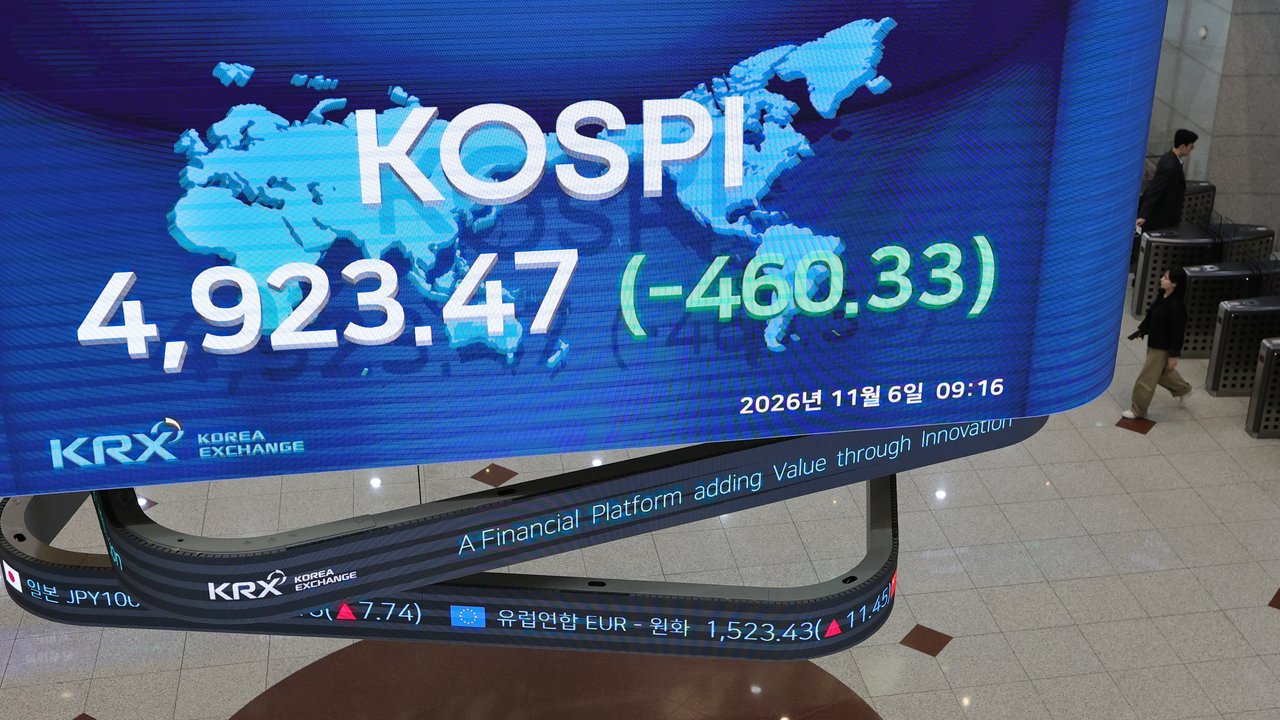
Recent polls suggest President Lee Jae Myung's approval rating has bottomed out and is settling back into the 40 percent range — but a sharp stock market selloff triggered by the US midterm elections could complicate that recovery.
According to political circles Saturday, a Gallup Korea survey conducted Tuesday through Thursday among 1,001 registered voters aged 18 and older nationwide found that 41 percent gave Lee a positive job performance rating, up 2 percentage points from the previous poll's 39 percent. The negative rating edged up 1 percentage point to 50 percent, while 9 percent withheld judgment.
Among those who rated Lee positively, "diplomacy" was cited most often at 18 percent, followed by "economy and livelihoods" at 15 percent, "communication" at 10 percent, "policies for ordinary people and welfare" at 8 percent, and "doing well overall" at 5 percent.
Those with a negative view pointed to "real estate policy" (19 percent), "economy and livelihoods" (13 percent), "national defense, security and North Korea policy" and "ethical issues and avoiding trial" (8 percent each), "diplomacy" and "authoritarian or unilateral governance" (4 percent each), and "doing poorly overall" and "dishonesty or lying" (3 percent each).
A Gallup Korea survey of 1,000 voters conducted Oct. 6-8 recorded a positive rating of 37 percent — the lowest since Lee took office. Since then, his approval has staged a modest rebound, hovering between the high 30s and low 40s throughout October.
However, with "real estate policy" and "economy and livelihoods" ranking first and second among reasons for negative assessments, analysts say resolving those issues will be the single biggest factor in any sustained approval recovery.
Gallup Korea noted that real estate has topped the list of negative-rating reasons every week since late July. "The increase in economy-related criticism, including responses to the stock market, does not appear unrelated to the Kospi's decline," the polling firm said.
Meanwhile, the government and ruling party's response to the market plunge, the market's subsequent movements, and the People Power Party's political offensive are all seen as pivotal variables for Lee's approval trajectory going forward.
The Democratic Party of Korea held an emergency meeting on financial market stability and investor protection at the National Assembly on Friday afternoon. Party leader Kim Min-seok and floor leader Han Byung-do attended, along with Supreme Council member Park Seon-won, Assembly Policy Committee Chairman Yoo Dong-su, Assembly Finance and Economy Planning Committee Chairman Cho Seung-rae, and party chief of staff Kim Tae-seon. From the government side, Deputy Prime Minister and Minister of Finance and Economy Lee Hyeong-il, Financial Services Commission Chairman Lee Eok-won and Financial Supervisory Service Director Lee Chan-jin were present. The ruling party said it would prepare additional measures as needed and commit all available resources to stabilizing markets.
Kim said experts attributed the sharp stock decline primarily to growing concerns about a pullback in AI data center investment following the US midterm elections. "A plunge in share prices is a matter directly tied to the safety of people's assets," Kim said. "Please work to protect retail investors and restore market confidence."
Han said the ruling party and government were taking the situation in domestic and international financial markets with the utmost seriousness. "We will deploy every available policy tool to stabilize markets and ease investor anxiety," Han said.
Deputy Prime Minister Lee said external uncertainty and the underlying strength of the domestic economy should be assessed separately. "South Korea's economic fundamentals are more solid than ever — we are on track for growth in the mid-3 percent range this year, exports of $1 trillion and corporate operating profit surpassing 900 trillion won ($671 billion)," Lee said.
The conservative opposition, led by the People Power Party, has been escalating its attacks, accusing the government of artificially inflating share prices in ways that ultimately triggered the crash. "The people are in tears as the market collapses under forced price-boosting," the party said, calling on the government to scrap a future-response fund financed by surplus tax revenue.
The survey conducted Tuesday through Thursday used telephone interviewer interviews. The margin of error is plus or minus 3.1 percentage points at the 95 percent confidence level, with a response rate of 9.7 percent. Full details are available on the website of the National Election Survey Deliberation Commission.
bigroot@heraldcorp.com