Key forest policy and system changes for second half of 2026 — reforms shaped by public input
South Korea is rolling out a set of forest policy reforms drawn from the voices of forestry workers and the public — toughening penalties and liability for those who cause wildfires while easing the administrative burden on forestry workers.
The Korea Forest Service, led by Commissioner Park Eun-sik, announced Tuesday a new policy vision centered on these changes under the banner "Happy Korea Through Forests."
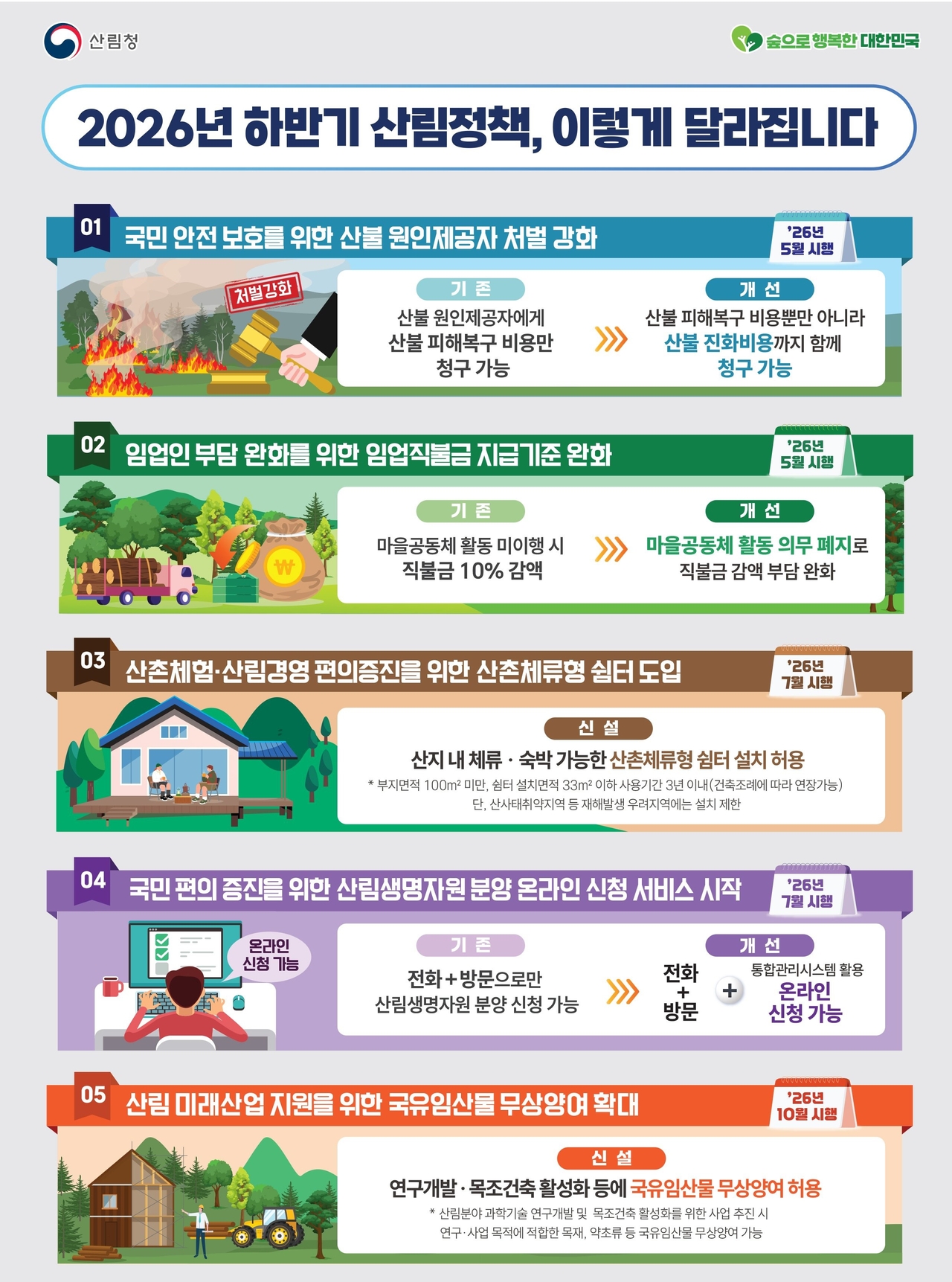
Among the key changes taking effect in the second half of 2026, the agency has significantly strengthened penalties for those who cause wildfires, reflecting growing public concern. Amended regulations now allow authorities to bill offenders not only for firefighting costs but also for damage restoration expenses. When arson or negligent fire-setting results in a fatality, courts may impose sentences up to 50 percent heavier than the standard penalty.
To ease the burden on forestry workers, the agency is also scrapping a mandatory community-activity requirement tied to forestry direct payments. Under the previous system, payments were reduced if recipients failed to participate in village community activities or forestry-related associations. Eliminating that obligation is intended to reduce hardship for forestry workers and improve the practical effectiveness of the payment system.
Alongside this, the agency is introducing temporary forest-stay shelters to promote mountain-village tourism and forest management. Allowing the installation of short-term lodging facilities on forested land is meant to draw more residents to mountain villages and make it easier for forestry workers to manage their land.
In addition, the Korea Forest Service is launching an online application service for forest genetic resources, replacing a system that required applicants to call or visit in person. The new platform covers the entire process — from submitting an application to checking results — in a single online session.
Finally, the agency is expanding eligibility for the free transfer of state-owned forest products. When national agencies or forest-sector public institutions pursue research and development, carbon sink enhancement, or timber construction projects, they will be able to receive state-owned forest products — including timber and medicinal herbs — free of charge, supporting both forest-sector research and carbon neutrality goals.
Full details on the forest policy and system changes taking effect in the second half of 2026 are available on the Korea Forest Service website.
"We will communicate at the level of the field and reflect the public's voice in our policies, building a 'Happy Korea Through Forests' that every citizen can feel," Commissioner Park said.
kwonhl@heraldcorp.com