Domestic beauty platform market shifts toward a multi-player landscape
Daiso, Musinsa and others challenge Olive Young's dominant position
Ultra-low pricing and niche targeting emerge as key rival strategies
'Warehouse pharmacies are becoming yet another competitor,' analyst says
![A CJ Olive Young store near Myeong-dong Station. [Herald DB]](https://wimg.heraldcorp.com/news/cms/2026/07/01/news-p.v1.20260507.cb4f47e1133b4aadb3dba86023d758ab_P1.png)
South Korea's beauty platform market is reshaping itself into a multi-player arena. Even as CJ Olive Young maintains an overwhelming lead, rivals are carving out niches by riding the K-beauty wave.
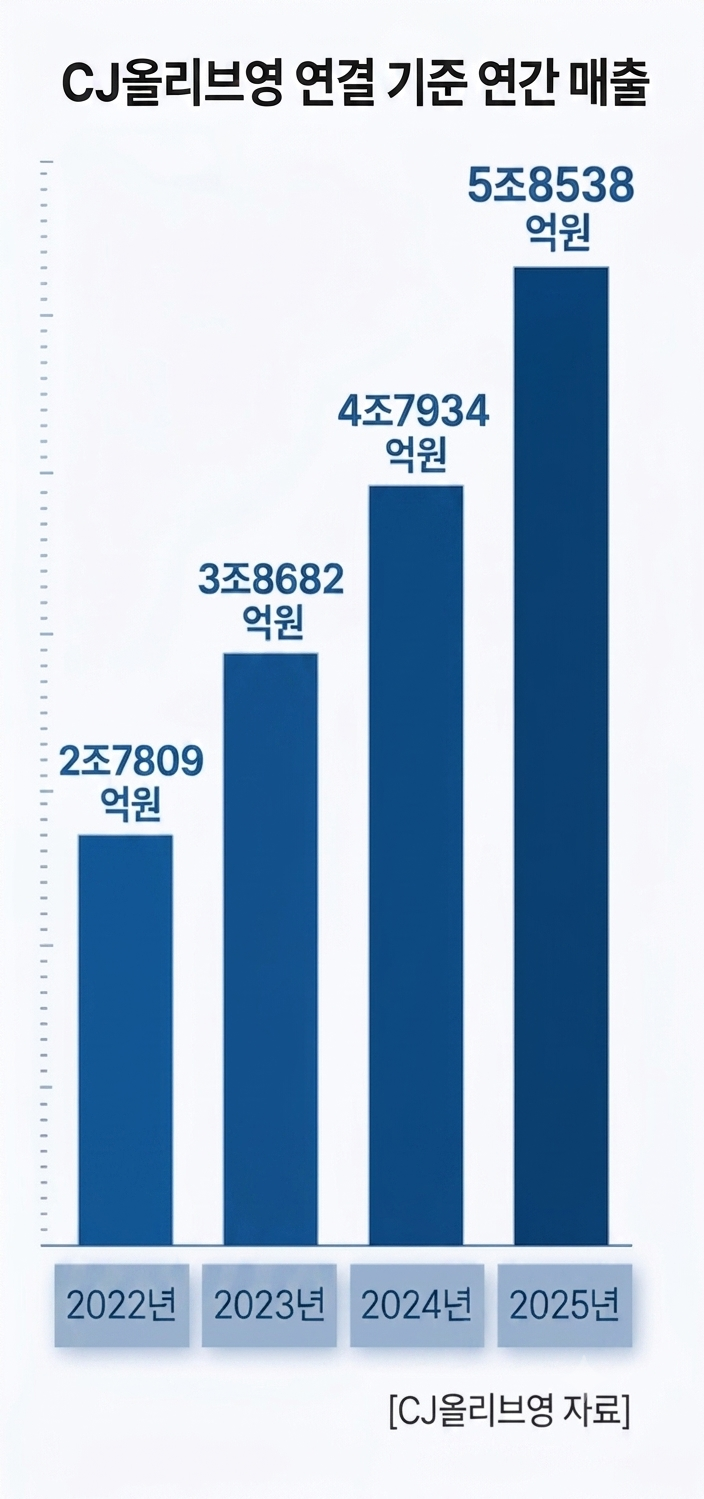
CJ Olive Young is on track to post annual consolidated sales of 6 trillion won ($3.87 billion) this year, according to industry sources. The company has added a new leading digit to its annual revenue every year since crossing the 1 trillion won mark in 2020. Last year, it recorded sales of 5.85 trillion won and an operating profit of 732.8 billion won. This year, it expanded further through a direct entry into the US market and a push into the health supplement sector via its wellness platform Olive Better.
Olive Young has dominated the health-and-beauty store market since GS Retail's Lalavla and Lotte Shopping's Lohbs both shuttered their operations. According to data analytics firm Sensor Tower, Olive Young captured 66 percent of domestic beauty e-commerce mobile app downloads and 78 percent of website visits between May 2025 and April this year, cementing its commanding market share.
The chain now operates 1,367 stores nationwide, running multiple locations in major commercial districts — eight in Myeong-dong and six in Seongsu — to absorb surging demand from domestic and foreign shoppers alike. It has also moved beyond simple product sales, debuting large experiential flagship stores. Its Beauty Mansion Seongsu, near Exit 2 of Seongsu Station, occupies an entire four-story building spanning roughly 1,650 square meters.
For K-beauty brands, securing a spot in Olive Young is a chance to build recognition and drive sales at the same time. "You have to hit a certain sales threshold on Olive Young's online mall before you even get a shot at its physical stores," said one beauty brand operator. "Getting into Olive Young is every brand's dream." The retailer currently carries more than 3,000 brands.
Competitors are making their presence felt. Daiso, which sells ultra-low-priced beauty products ranging from 1,000 to 5,000 won across more than 1,600 stores nationwide, stands out as the most prominent challenger. Its beauty sales jumped 70 percent last year from the year before. Convenience store chains, sensing an opportunity in the Daiso beauty craze, have also begun adding budget beauty sections.
Off Beauty, operated by Q&B International — a subsidiary of Daemyung Chemical — has built a following through discounts of up to 90 percent off the regular price. About a year after opening its first store at Gwangjang Market in May last year, it has grown to 40 offline locations and plans to open its 100th store and a location in Mongolia before the end of the year.
Musinsa is also expanding its Musinsa Beauty offering. Beauty transaction volume on the Musinsa Global Store from Jan. 1 through July 24 this year surged 360 percent compared with the same period a year earlier. The number of brands on the platform has grown to around 2,000. The company plans to open large flagship stores of roughly 1,320 square meters each in Hongdae and Seongsu in September and November.
Hyundai Home Shopping Network is expanding Coasis, an offline beauty select shop targeting women in their 40s and 50s. Since its debut at Hyundai Premium Outlet Space One in Namyangju, Gyeonggi Province, late last year, the concept has grown to four locations this year. Warehouse-style pharmacies catering primarily to foreign tourists are also being cited as emerging competitors to Olive Young.
"The touchpoints for K-beauty consumption are expanding beyond Olive Young, duty-free shops and brand flagship stores — all the way to pharmacies," said Oh Rin-a, an analyst at LS Securities. "As more channels challenge Olive Young and Daiso, competition will only intensify."
![Daiso's beauty section. [Herald DB]](https://wimg.heraldcorp.com/news/cms/2026/07/01/news-p.v1.20260701.f5574228b51d429fbefc6cee94458df8_P1.jpeg)

Homeplus has paid roughly 73 percent of this month's wages to employees at Homeplus Express, which NS Home Shopping under the Harim Group acquired on June 22, but workers at the main Homeplus entity have yet to receive their pay, according to sources familiar with the matter. Homeplus is currently undergoing corporate rehabilitation proceedings.
soho0902@heraldcorp.com