
Samsung, SK to pour massive funds into semiconductors, data centers
Plans unveiled at national briefing; AI supremacy in focus
Yongin semiconductor cluster completion moved up
Yeongnam region emerges as hub for physical AI
![Employees arrive at Samsung Electronics' Seocho office building in Seoul on Monday, where the government's "Korea's Great Leap: Three Mega-Projects National Briefing" is being held. Samsung Electronics Chairman Lee Jae-yong and SK Group Chairman Chey Tae-won are scheduled to attend and personally announce their companies' investment plans. [Yonhap]](https://wimg.heraldcorp.com/news/cms/2026/06/29/rcv.YNA.20260629.PYH2026062904130001300_P1.jpg)
Samsung Electronics and SK hynix are set to announce Monday a massive investment plan that includes building a second semiconductor cluster in the Honam region. Estimated at a combined 2,000 trillion won ($1.3 trillion) over the next decade, the investment is aimed at securing South Korea's lead in the intensifying global race for AI dominance.
The plan spans the full breadth of AI-era infrastructure — semiconductors and data centers at its core, backed by investment in materials and components including batteries, displays, multilayer ceramic capacitors and substrates — with the goal of strengthening the country's overall AI competitiveness.
According to political and business circles, Samsung Electronics Chairman Lee Jae-yong and SK Group Chairman Chey Tae-won will attend an afternoon session at Cheong Wa Dae's banquet hall, presided over by President Lee Jae Myung, to personally present the two companies' combined investment plans at the "Korea's Great Leap: Three Mega-Projects National Briefing."
Analysts say the investment reflects both companies' determination not to cede ground in the global semiconductor race while seizing the current boom as an opportunity to expand the semiconductor value chain and upgrade the broader manufacturing sector.
If the Honam semiconductor cluster reaches up to 10 fabs — including those of Samsung Electronics and SK hynix — it would rival the scale of the Yongin semiconductor cluster in Gyeonggi Province. The strategy is to build a second large-scale cluster in Honam, following Yongin, to ease a prolonged memory chip shortage driven by surging AI semiconductor demand.
Earlier speculation had pointed to a back-end packaging facility, but both companies have decided to build front-end fabs, which generate greater employment and economic impact. The move is expected to anchor a vast semiconductor industry ecosystem where design, equipment and materials suppliers cluster together. Samsung Electronics and SK hynix are each expected to build four to six fabs. Construction costs for a single fab are generally estimated at a minimum of 60 trillion won.
The cluster is also expected to draw in semiconductor research and development personnel and master's and doctoral-level specialists, while expanding the foundation for industry-academia cooperation and professional talent development.
![Samsung Electronics Chairman Lee Jae-yong and SK Group Chairman Chey Tae-won are scheduled to attend the government's "Korea's Great Leap: Three Mega-Projects National Briefing" on Monday and personally announce their investment plans. Pictured is SK's Seorin Building in Jongno-gu, Seoul. [SK]](https://wimg.heraldcorp.com/news/cms/2026/06/29/news-p.v1.20260619.61e20800bbde4d61bdac42213a51f8aa_P1.jpg)
With Samsung Electronics' operating profit projected at around 1,500 trillion won over the next three years and the semiconductor boom expected to continue through 2030, the large-scale industrial ecosystem is expected to serve as a powerful foundation for maintaining South Korea's global edge in semiconductors.
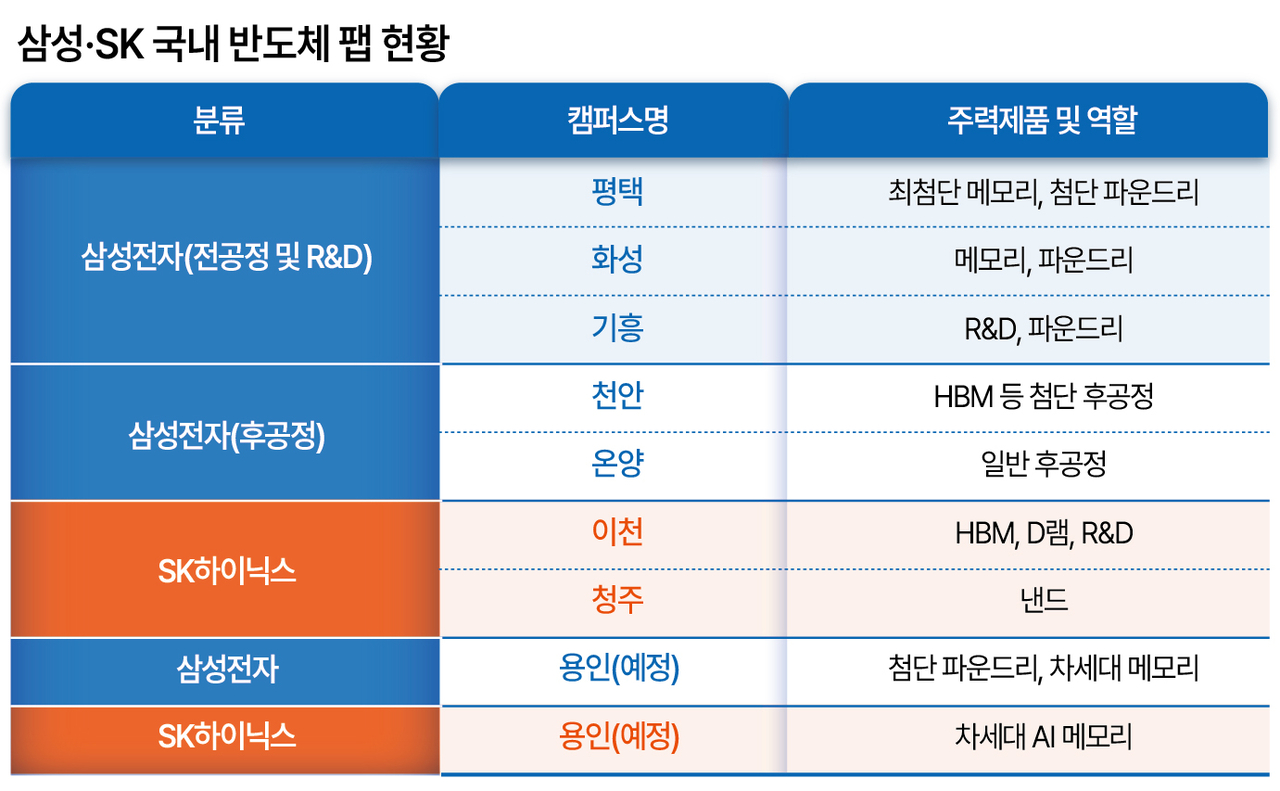
Samsung Electronics' move to lead investment not only in semiconductors but also in advanced materials and components could generate broader synergies for the national economy by strengthening manufacturing competitiveness across the board. Samsung Electronics is also expected to establish additional back-end packaging facilities in Cheonan and Asan's Onyang, giving shape to a semiconductor belt stretching across the southwestern region.
Investment at Samsung Display's facilities in Asan and Cheonan is also included in the plan, with the aim of expanding its small- and mid-sized OLED business. Samsung Electro-Mechanics' sites in Sejong and Busan are also being discussed as additional investment targets to scale up production of semiconductor substrates and MLCCs, both benefiting from strong AI-driven demand.
SK hynix currently operates its Icheon campus in Gyeonggi Province and its Cheongju campus in North Chungcheong Province, and is building its first fab at the Yongin semiconductor cluster in Gyeonggi Province.
Amid a deepening global memory chip shortage driven by the semiconductor boom, Chairman Chey has said he plans to double production capacity within five years.
Securing land and additional power supply in the greater Seoul area is difficult, but Honam holds clear advantages on both fronts.
The region is particularly well positioned to meet global RE100 requirements — which mandate 100 percent renewable energy use — given that it holds the country's highest renewable energy potential through solar and wind resources.
The government has also proposed a special enforcement decree under the Semiconductor Special Act that would cover up to 100 percent of infrastructure costs — including power and water supply — for semiconductor clusters outside the greater Seoul area.
Beyond the Gwangju semiconductor factory, SK Group is expected to announce an investment plan totaling around 1,000 trillion won, which includes expanding its NAND flash factory in Cheongju, North Chungcheong Province, and building AI data centers in major cities across the country.
Also attending the briefing will be executives from the three major telecom carriers — SK Telecom, KT Corp and LG Uplus — all active in the AI data center business, as well as LG Electronics and LG CNS, which are developing physical AI as a new growth engine, and Hanwha Qcells and Hyosung Heavy Industries.
As the focus of new semiconductor investment shifts toward the southwestern region, concerns are growing in other parts of the country. Against that backdrop, the completion of the Yongin semiconductor cluster — where Samsung Electronics and SK hynix have already announced investment plans — is now expected to be moved up from its original schedule.
Kim Jung-kwan, minister of Trade, Industry and Energy, said Sunday on his Facebook page that "Samsung Electronics and SK hynix will each move up their production start dates at the Yongin semiconductor cluster by seven years and 12 years, respectively, significantly ahead of the original schedule."
Samsung Electronics had originally planned to invest a total of 360 trillion won by 2042 to build six fabs at the Yongin national industrial complex, with the first fab set to begin operation in 2030. Land compensation stood at just 43 percent as of March, however, leaving the project behind schedule.
SK hynix broke ground in February last year, starting construction ahead of Samsung Electronics, and has committed to investing a total of 600 trillion won to build four fabs. It plans to begin operating the first fab at the Yongin cluster in February 2027. The company had originally planned to complete the cluster sequentially by 2044 but has moved that timeline up by nearly a decade to 2034.
The Yeongnam region is being discussed as the key hub for physical AI — one of the three pillars of the mega-projects alongside semiconductors and data centers. Leading candidates include Ulsan, home to Hyundai Motor Company's factories, and the Changwon National Industrial Complex in South Gyeongsang Province, where home appliance, defense and automotive plants are concentrated.
The government plans to transform this area, long the heart of South Korea's machinery industry, into an AI- and robot-driven "M.AX (Manufacturing AX) Cluster."
joze@heraldcorp.com




