
Record number of doctorates awarded even as PhD-level jobs fall short
Jobseekers giving up drives surge in economically inactive; gaps widen by field and gender
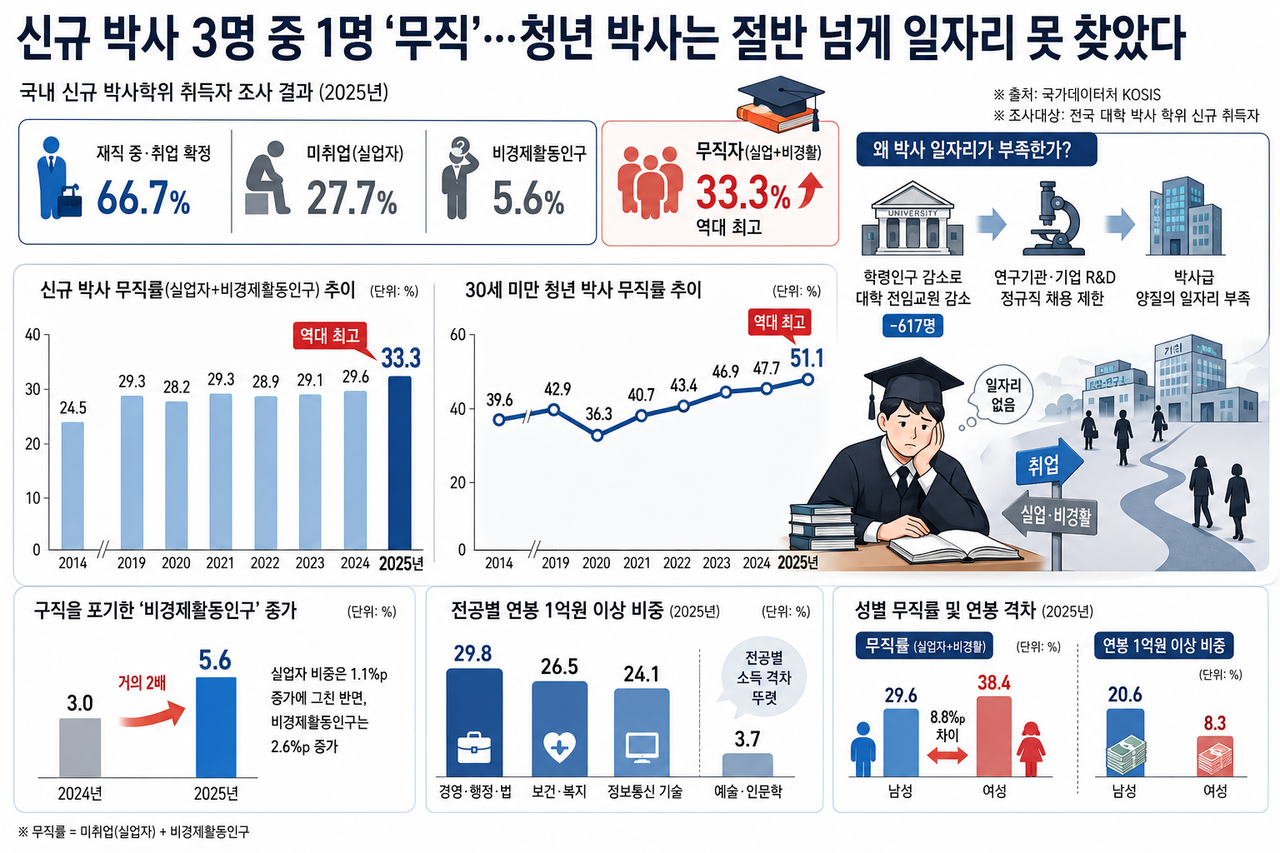
One in three people who earned a doctoral degree in South Korea last year was unemployed at the time of graduation, according to new government data.
Among doctoral recipients under 30, more than half were without work — a record high. The number of new PhDs has reached an all-time peak, but universities, research institutions and corporate research and development divisions have failed to keep pace in creating positions that require doctoral-level qualifications, pushing more graduates out of the labor market entirely.
The "2025 Survey of Domestic New Doctoral Degree Recipients," released Monday through the Ministry of Statistics' national statistics portal KOSIS, found that 66.7 percent of the 10,498 people who earned doctorates last year were employed or had confirmed job offers. The remaining 33.3 percent were jobless — 27.7 percent classified as unemployed and 5.6 percent as economically inactive. The combined jobless rate exceeded 30 percent for the first time since the survey began in 2014.
The jobless rate held in the mid-20 percent range through 2018 before jumping to 29.3 percent in 2019, hovering in the 28–29 percent range for several years, then surging to 33.3 percent last year. The year-on-year increase of 3.7 percentage points was the largest on record.
Particularly striking was the rise in economically inactive graduates — those who have stopped looking for work altogether. The share classified as unemployed edged up 1.1 percentage points, from 26.6 percent in 2024 to 27.7 percent last year, but the economically inactive share nearly doubled, rising 2.6 percentage points from 3.0 percent to 5.6 percent over the same period.
Analysts attribute the trend to a shortage of quality jobs capable of absorbing new doctoral graduates.
Universities, facing a shrinking school-age population, have been cutting full-time faculty positions while expanding the use of non-tenure-track instructors. Regular hiring at government-funded research institutes and in corporate R&D has also remained limited.
Data from the Ministry of Education's 2025 basic education statistics bear this out: the number of full-time faculty at higher education institutions fell by 617 from a year earlier to 86,701, while non-tenure-track instructors increased by 4,261 to 153,923.
The employment crisis was most acute among younger graduates. Of the 569 doctoral recipients under 30 last year, 51.1 percent were jobless — the first time the rate has crossed the 50 percent mark. The economically inactive share in that age group nearly tripled, jumping from 2.6 percent in 2024 to 7.9 percent last year.
The 30–34 age group, which produced the largest number of new doctorates at 3,836, still recorded a jobless rate of 44.2 percent. Rates across all other age groups also hit survey highs: 32.8 percent for those aged 35–39, 22.7 percent for those 50 and older, 22.1 percent for those aged 40–44, and 16.6 percent for those aged 45–49.
The broader slump in youth employment has compounded the problem. The employment rate for young people stood at 43.8 percent in May, down 2.4 percentage points from a year earlier, extending a decline to 25 consecutive months. Some analysts also point to the spread of generative AI as a factor, arguing it has dampened hiring for entry-level research and office positions.
The Bank of Korea noted in a report last year that youth employment in computer programming, information services and publishing had fallen sharply since 2022.
Even among those who found work, salary gaps by field were pronounced. The share of employed doctoral graduates earning 100 million won ($64,800) or more annually rose 1.5 percentage points from the previous year to 15.9 percent.
By field, business, administration and law led at 29.8 percent, followed by health and welfare at 26.5 percent and information and communications technology at 24.1 percent. Arts and humanities, by contrast, had just 3.7 percent of graduates earning 100 million won or more. The share earning less than 20 million won was highest in arts and humanities at 26.8 percent, followed by education at 19.0 percent and social sciences, journalism and information studies at 14.9 percent.
A gender gap was also evident. The jobless rate among female doctoral graduates was 38.4 percent, 8.8 percentage points higher than the 29.6 percent recorded for men. The share earning 100 million won or more was 20.6 percent for men but only 8.3 percent for women, while the share earning less than 20 million won stood at 6.3 percent for men and 17.2 percent for women.
fact0514@heraldcorp.com




