Men out of workforce for childcare, housework up 16.6% in a year; women at record low
Dual-income households, shifting gender roles and rise of professional women drive trend
![A father caring for his child [Getty Images Bank]](https://wimg.heraldcorp.com/news/cms/2026/06/29/news-p.v1.20250608.cd1a12af26f640a6b1e891791ab3cf6d_P1.jpg)
The number of men staying out of the workforce to care for children or handle household duties has surpassed 270,000 — the highest figure since records began. At the same time, the number of women outside the labor force for the same reasons has fallen to an all-time low, reflecting the spread of dual-income households and shifting attitudes toward gender roles.
According to the Ministry of Statistics' national statistics portal KOSIS, 274,000 men were classified as economically inactive due to childcare or housework in the first quarter of this year, up 16.6 percent from the same period last year.
That is the highest first-quarter figure since the current classification system for economically inactive persons was established in 2004. The growth rate was also the highest since 2021, when it stood at 28.3 percent.
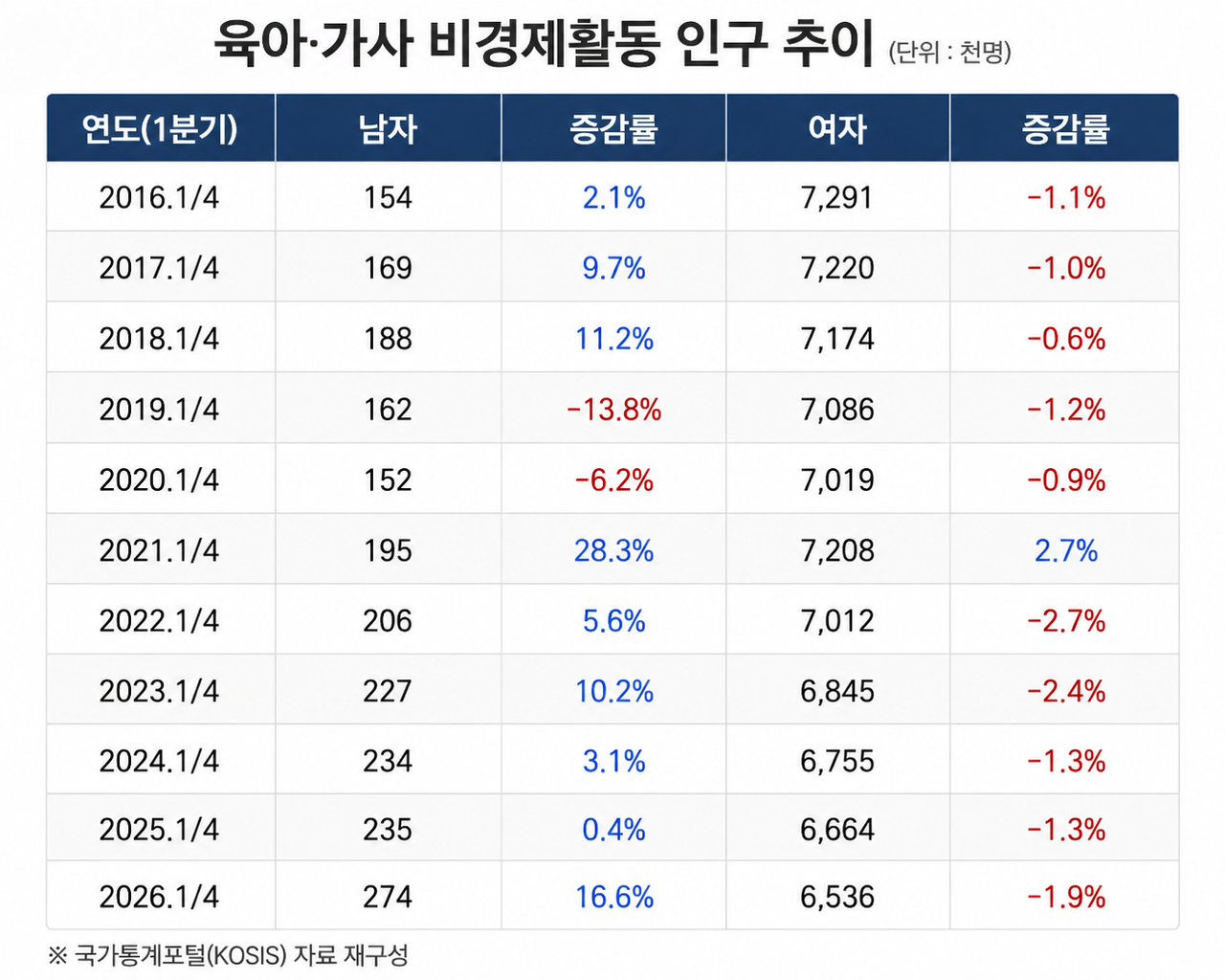
Breaking down the figures, 261,000 men were out of the workforce primarily for housework — the vast majority of the total — up 16.5 percent from a year earlier. An additional 13,000 men were inactive due to childcare, a rise of 18.2 percent. Under the statistical definition, childcare refers to staying home to look after children or grandchildren who have not yet started elementary school.
The number of economically inactive men citing childcare or housework stood at 145,000 in the first quarter of 2004, crossed the 200,000 mark for the first time in 2022, and has now reached 274,000. Compared with the first quarter of 2006 — two decades ago — when the figure was 151,000, the number has nearly doubled.
By contrast, the number of women outside the labor force for childcare or housework fell 1.9 percent from a year earlier to about 6.536 million — the lowest first-quarter level on record. The figure rose from about 6.705 million in the first quarter of 2004 to a peak of about 7.684 million in 2013 before entering a sustained decline.
Analysts attribute the shift to a loosening of traditional gender roles and a steady increase in dual-income households, as more men take on childcare and domestic responsibilities while more women enter the workforce.
Particularly in recent years, growing female employment in high-paying fields such as the professions has given rise to more households where women serve as the primary breadwinner and men take charge of childcare and housework.
A Bank of Korea report released in April showed that the labor force participation rate of women aged 25 to 34 climbed from 51.5 percent of the male rate in 2002 to 95.5 percent last year. Last year, the share of women in professional occupations among young workers rose to near parity with men, and in clerical roles women outnumbered men.
"This reflects a social shift toward greater male participation in childcare and housework," a Ministry of Statistics official said, adding that the Middle East war, which began in late February, appeared to have had only a limited impact on March employment figures.
fact0514@heraldcorp.com