![The Kospi and other market indexes are displayed on a screen at Hana Bank's dealing room in Jung-gu, Seoul, on Wednesday. [Yonhap]](https://wimg.heraldcorp.com/news/cms/2026/06/25/rcv.YNA.20260625.PYH2026062502210001300_P1.jpg)
Even as the Kospi has rocketed to near-record highs and swung by hundreds of points within a single session, retail investors' appetite for debt-fueled trading shows no sign of cooling.
If anything, heightened volatility has drawn more investors chasing short-term gains, driving margin financing balances to successive all-time highs. The rush of short-term trading money into leveraged products has pushed the daily turnover rate of some exchange-traded funds above 120 percent — an extraordinary phenomenon by any measure.
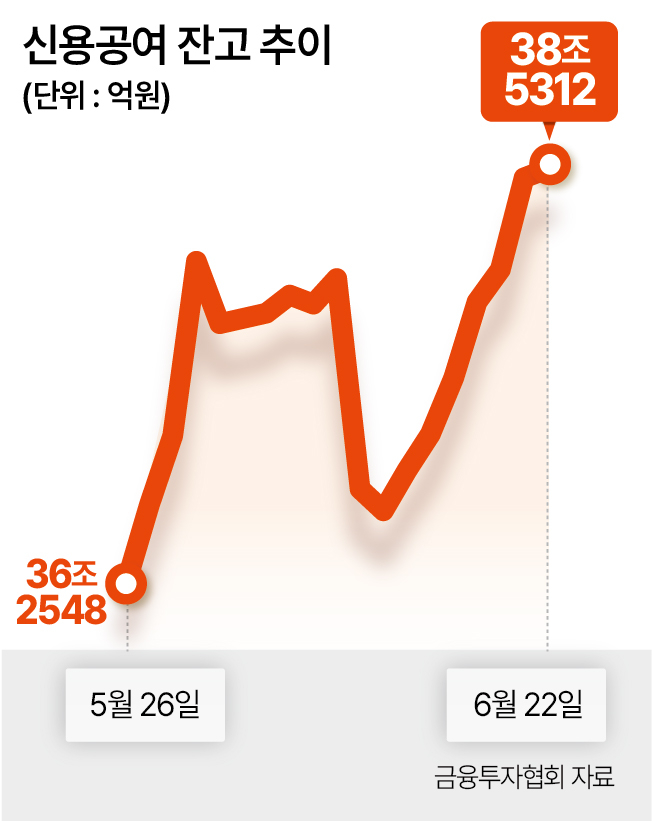
According to the Korea Financial Investment Association, the outstanding margin financing balance reached approximately 38.53 trillion won ($25 billion) as of June 22, surpassing the previous record of 38.48 trillion won set on June 19 and marking the largest figure ever recorded. The balance edged down to 38.09 trillion won on June 23 but remained well above the 38 trillion won threshold.
Margin financing refers to the amount an investor has borrowed from a brokerage to buy shares and has yet to repay. It is a key indicator of the scale of leveraged investing by retail investors.
The margin financing balance first broke through 38 trillion won on May 29 before briefly stabilizing, but it has resumed its climb as market volatility has widened in recent weeks.
The aggressive investor behavior is widely attributed to a growing perception that short-term trading opportunities have multiplied since the Kospi closed above the 9,000 mark on June 18.
Domestic markets have indeed been swinging in unprecedented fashion, with intraday moves of hundreds of points becoming routine. While some investors have managed to book sharp short-term gains in this environment, concerns are also mounting that a wrong-way bet could produce equally severe losses.
Unsettled trades — a form of ultra-short-term leveraged investing — have followed a similar trajectory. Outstanding unsettled trade receivables reached approximately 1.48 trillion won on June 23, up about 180 billion won from the previous session's 1.3 trillion won. The figure remains well below the roughly 2.15 trillion won recorded on March 5, but has been rising consistently in recent weeks.
In an unsettled trade, an investor buys shares using brokerage funds and must settle the payment within two trading days. Failure to do so triggers a forced liquidation of the investor's holdings.
The intensifying short-term trading trend has also sent leveraged transactions jumping. For some products, daily trading value has exceeded total assets under management, pushing turnover rates above 100 percent — meaning the entire product changed hands within a single day.
According to the Financial Supervisory Service, the average daily turnover rate for single-stock leveraged products from May 27 to June 12 reached 122.5 percent — far exceeding the turnover rates for Samsung Electronics and SK Hynix shares in the spot market (below 1 percent) and for domestic equity leveraged and inverse ETFs (30.2 percent).
Margin-financed trades and leveraged products share a common trait: they can amplify gains in a rising market but magnify losses just as sharply in a downturn. Analysts have also warned that a further widening of volatility could increase forced-liquidation selling, adding downward pressure on the market.
Financial regulators are watching the situation closely. The Financial Supervisory Service on Tuesday summoned the Korea Financial Investment Association and the chief risk officers of major brokerages, calling on them to strengthen risk management in response to rising market volatility.
Seo Jae-wan, deputy governor of the FSS's financial investment division, said margin financing and unsettled trades "can become potential risk factors when market volatility expands," and urged firms to go beyond nominal limit management by operating "flexible and preemptive risk management systems."
He added that firms should "strengthen guidance so that investors can fully understand the structure of margin financing and unsettled trades, and the risks of forced liquidation," and called on them to "refrain from business practices that induce excessive speculative demand or in effect encourage unsettled trading."

th5@heraldcorp.com