
Number of cosmetics stores nationwide falls to 34,766, down 1,967 from a year earlier
Cosmetics franchise outlets drop 10.6%; new-store opening rate lowest among major retail sectors
![A customer browses products at a cosmetics store in Myeong-dong, Jung-gu, Seoul. [Yonhap]](https://wimg.heraldcorp.com/news/cms/2026/06/25/news-p.v1.20250714.b92a7f17a50541489b8f7718dbd9c541_P1.png)
Even as K-beauty thrives, the "road shop" — once the dominant channel for cosmetics retail — is vanishing, as demand shifts to multi-brand stores such as CJ Olive Young and e-commerce platforms.
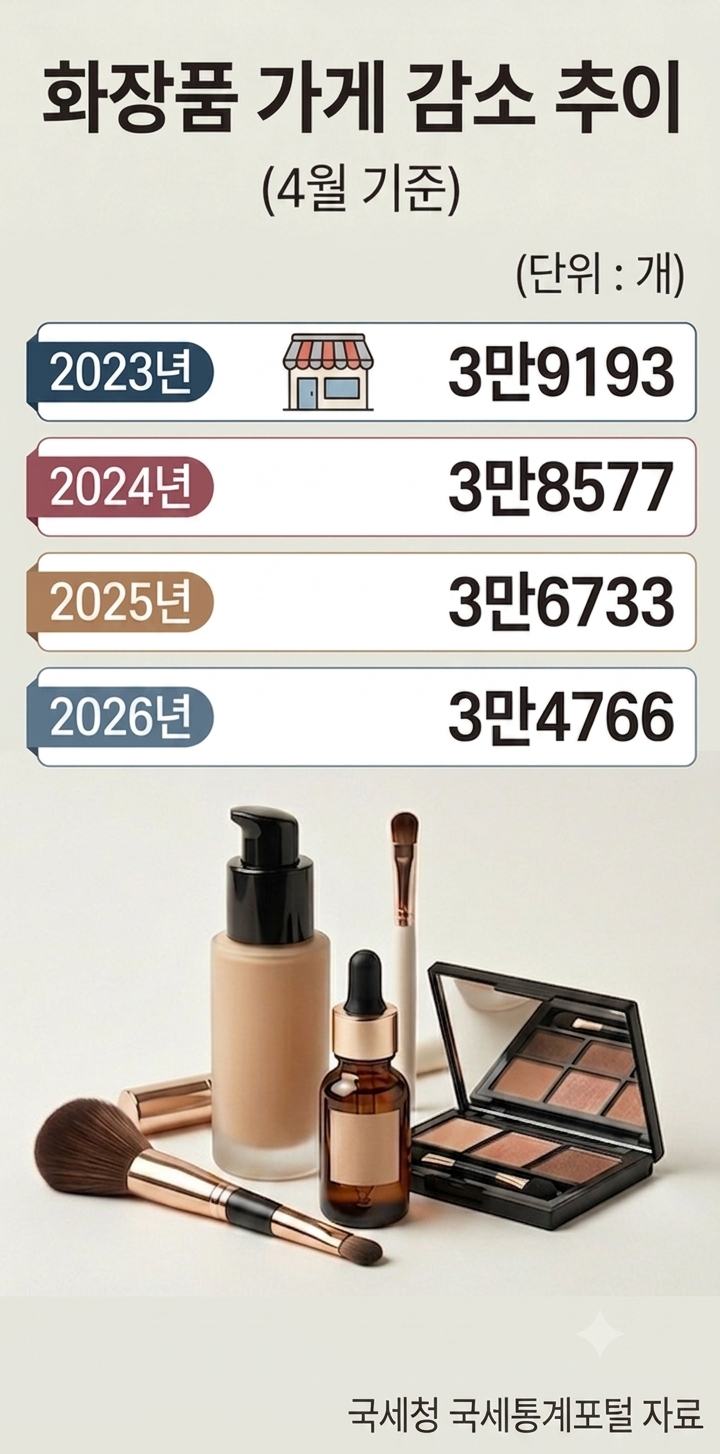
The number of cosmetics stores nationwide stood at 34,766 as of April, down 1,967, or 5.4 percent, from the same period a year earlier, according to the National Tax Service's national tax statistics portal. The count has declined consistently on an April basis — from 39,193 in 2023 to 38,577 in 2024 and 36,733 in 2025 — a loss of 4,427 stores, or 11.3 percent, over three years.
Data from the Korea Fair Trade Commission's franchise industry statistics show that the number of cosmetics franchise outlets fell 10.6 percent to 957 at the end of 2024, from 1,071 the previous year. The new-store opening rate was 3.8 percent, the lowest among major retail sectors, while the closure rate reached 15.9 percent, placing it near the top. Average sales per franchise outlet also plunged 12.6 percent year on year to 201 million won ($131,000).
Store counts at major beauty brand franchises also shrank. Amorepacific's multi-brand beauty shop Aritaum fell from 410 locations to 372, a 9.3 percent drop, while Innisfree contracted from 234 to 190, down 18.8 percent. Tonymoly declined from 111 to 97 stores, a decrease of 12.6 percent.
Multi-brand retailers and e-commerce, by contrast, continued to grow. CJ Olive Young posted standalone sales of 5.8335 trillion won last year, up 21.8 percent from the prior year and a record high. Online cosmetics transaction value reached 1.3322 trillion won as of April, up 15.0 percent year on year. Annual online cosmetics transaction values have risen consistently — from 11.9791 trillion won in 2023 to 12.825 trillion won in 2024 and 13.8153 trillion won last year.
The beauty industry is adapting by securing shelf space in large retail channels such as CJ Olive Young and Daiso, expanding online sales and pivoting toward overseas markets. Amorepacific Group, which operates Aritaum and Innisfree, is scaling back its traditional offline road shops and restructuring its distribution around multi-brand shops and similar channels.
Tonymoly, a first-generation road shop brand, has been cutting its road shop and hypermarket presence while diversifying into CJ Olive Young, Sikorr and Daiso. Its domestic cosmetics sales last year reached 98 billion won, up 9.6 percent from the prior year, with sales through the Daiso channel jumping 324.1 percent.
korean@heraldcorp.com




