Ministry of Land, Infrastructure and Transport adopts 14 regulatory reform measures at second task force meeting; deadline for prospective newlyweds to submit proof of marriage extended beyond one year after recruitment announcement to just before move-in

Prospective newlyweds hoping to move into Sinbon Huimang Taun — public housing complexes reserved for newlywed couples — will have until just before their move-in date to submit proof of marriage, extended from the previous deadline of one year after the initial recruitment announcement. The change is aimed at eliminating what critics called a "marriage penalty," under which couples had to formalize their union before securing a home simply to meet a documentation deadline.
The Ministry of Land, Infrastructure and Transport said Thursday it held the second meeting of its regulatory rationalization task force, chaired by First Vice Minister Kim I-tak, and adopted 14 on-the-ground regulatory reform measures to address unreasonable rules affecting people's daily lives and business activities.
The ministry had reviewed proposals submitted through the Prime Minister's Office regulatory grievance channel and local governments.
The marriage documentation requirement for Sinbon Huimang Taun topped the list of improvements. Previously, couples had to submit proof of marriage within one year of the recruitment announcement — a deadline that drew frequent complaints from applicants whose move-in dates were still far off. Starting this month, couples need only submit the documentation before moving in. The new rule will also apply to complexes where the one-year post-announcement window has not yet elapsed as of the effective date of the revised regulation.
Beginning in December, the exemption from residency obligations for housing-free military personnel who have served 10 or more years will expand from special supply units to general supply units as well. When a long-serving soldier subject to a residency requirement — or a member of their household — is reassigned by official order, they will receive the same residency exemption regardless of transfer destination, in line with the treatment already afforded to soldiers who received housing through special supply. The measure is intended to ease housing instability among military personnel.
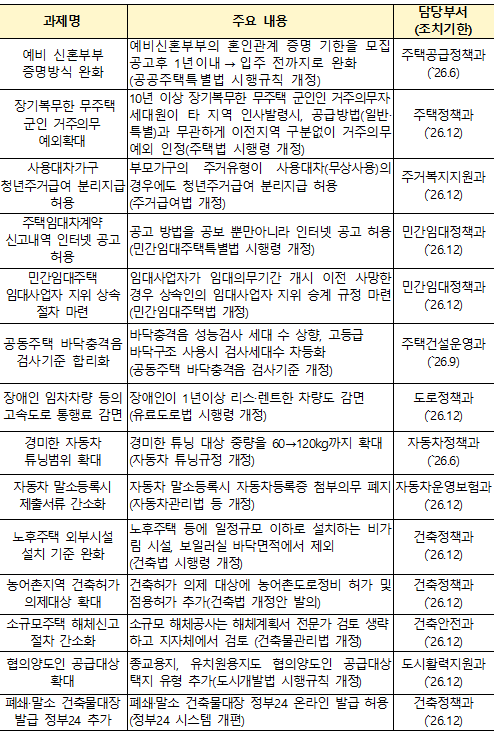
Detailed measures under the Ministry of Land, Infrastructure and Transport's on-the-ground regulatory reform plan
Starting in December, young people applying for youth housing benefits will be allowed to receive separate payments even when their parents' household lives in rent-free accommodation. The ministry will also establish procedures allowing heirs to inherit the status of a rental business operator who dies before the mandatory rental period begins.
Rain shelters and boiler rooms below a certain size installed in aging homes will be excluded from floor area calculations. The change relieves maintenance difficulties caused by building coverage and floor area ratio regulations and supports improvements to residential environments.
The ministry will also broaden the scope of minor vehicle modifications permitted without formal approval, making it easier to install rooftop tents and other lifestyle and leisure accessories. The allowable weight for such modifications will rise from 60 kilograms to 120 kilograms.
People with disabilities who use a vehicle through a lease or rental arrangement for one year or more will be eligible for highway toll discounts. By extending the discount beyond owner-operated vehicles to cover various forms of use, the ministry said it aims to strengthen mobility rights for people with disabilities.
The ministry said it will reorganize the existing Land and Transport Regulatory Reform Committee into a new Regulatory Rationalization Committee, in line with the current administration's push to streamline regulations and strengthen the regulatory improvement function.
The new committee, set to launch in July, will operate under four subcommittees covering land and urban planning, housing and land, mobility and logistics, and construction and infrastructure. The number of members per subcommittee will increase from seven to nine to deepen expertise in each area.
"We will closely analyze the necessity and effectiveness of regulations and boldly reform those that unreasonably constrain people's lives and business activities," Vice Minister Kim said. "Now that we have overhauled the regulatory rationalization framework, we will make sure no small inconvenience on the ground goes unnoticed, address issues swiftly, and ensure the effort translates into a recovery of livelihoods and a boost to economic vitality."
smh@heraldcorp.com