Emergency delegate assembly passes dispute resolution Tuesday
Thursday mediation session seen as key hurdle to legal strike
Last year's partial strike caused 400 billion won in lost production
Avante, Tucson, GV90 launches at stake as second-half recovery hangs in balance
Kia, Hyundai Mobis and subcontractor unions watching closely
![An exterior view of the Hyundai Motor and Kia headquarters in Yangjae, Seoul. [Hyundai Motor Group]](https://wimg.heraldcorp.com/news/cms/2026/06/24/news-p.v1.20260618.9ea90d69c8ad4f27bfc57187ff7484d3_P1.jpg)
Hyundai Motor's labor union has formally launched the process of securing strike rights in this year's wage and collective bargaining negotiations. The union plans to use the strike threat as leverage in ongoing talks with management. However, the wide gap between the two sides over wages, job security and the response to industrial transition means an actual work stoppage cannot be ruled out.
The Hyundai Motor branch of the Korean Metal Workers' Union is holding a strike authorization vote among its roughly 40,000 members Wednesday. The union's emergency delegate assembly voted unanimously to declare a labor dispute Tuesday, and a strike authorization vote at Hyundai Motor has never been defeated, so approval is widely expected this year as well. Last year's vote passed with a 90.9 percent approval rate among those who cast ballots.
The vote follows the union's declaration of a breakdown in negotiations on June 12 and its subsequent filing for labor dispute mediation with the National Labor Relations Commission on June 15. Even a majority vote in favor of strike action would not immediately allow a legal strike, however. The union must first complete the commission's mediation process before it can legally exercise the right to strike.
The pivotal moment comes Thursday, when the commission holds its mediation session and makes a final attempt to bridge the gap between the two sides. If no agreement is reached and the commission determines that the positions are too far apart, it will issue a decision to suspend or terminate mediation — at which point the union will be legally entitled to strike.
Strike rights as bargaining leverage — actual walkout remains uncertain
After securing strike rights, the union is expected to hold a launch ceremony for its dispute response committee as early as June 30, where it will discuss the form, timing and scale of any industrial action. Once the committee is in place, options such as partial strikes, overtime refusal and extra-shift refusal are expected to come onto the table.
Whether the union will actually follow through with a strike remains uncertain. Hyundai Motor's union has frequently used strike authorization as a bargaining chip to pressure management into a tentative agreement without walking out. In both 2023 and 2024, the union secured strike rights but did not carry out an actual strike.
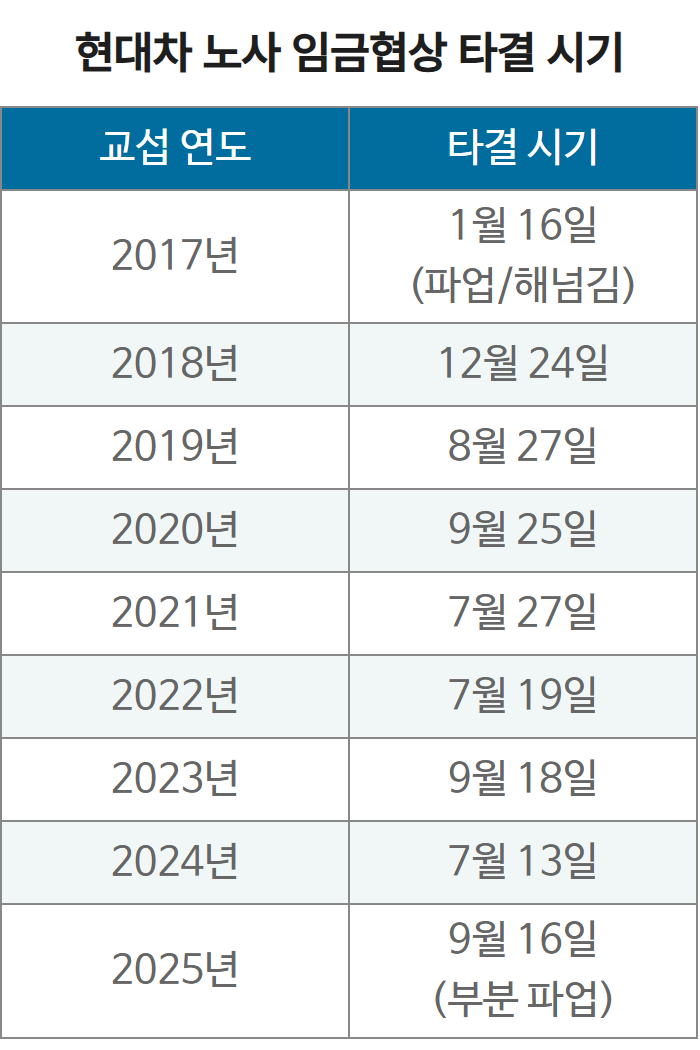
Hyundai Motor's labor and management have typically wrapped up wage and collective bargaining negotiations around the summer vacation period or the chuseok holiday. Agreements were reached on Aug. 27, 2019; Sept. 25, 2020; July 27, 2021; July 19, 2022; Sept. 18, 2023; July 13, 2024; and Sept. 16, 2025.
Bonuses, retirement age and AI job guarantees remain sticking points
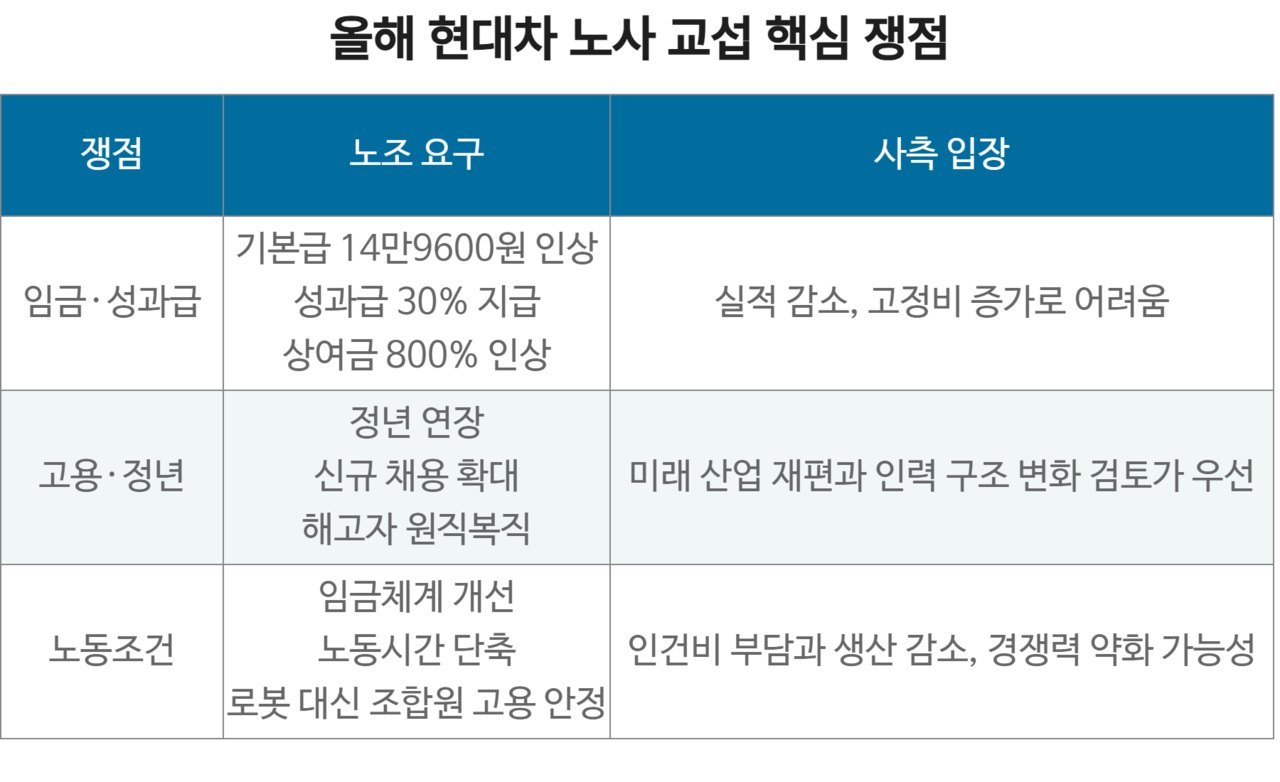
Some observers warn that the gap between the two sides is wide enough to make a strike a real possibility. The union is demanding a base wage increase of 149,600 won ($97) per month, a performance bonus equivalent to 30 percent of salary and an 800 percent increase in annual bonuses.
The union argues that while Hyundai Motor has grown to rank third globally in sales and second in operating profit, the annual bonuses of the 40,000 members who drove that growth have remained frozen for 19 years. "The demand for an 800 percent bonus is not a privilege — it is deferred, rightful compensation and the bare minimum of respect for the value of labor," the union said.
Management says it cannot accept the demands, citing global economic uncertainty, potential sales volatility and rising fixed costs. The company's operating profit for the second quarter of this year is forecast at 3.3 trillion won, down 8.4 percent from the same period last year and 22.8 percent below the second quarter of 2024.
The two sides are also far apart on employment and retirement. The union is calling for an extension of the mandatory retirement age, expanded new hiring and the reinstatement of dismissed workers, arguing that job protection measures are needed as electrification, AI and automation threaten existing positions. Management counters that restructuring for the future industry landscape and workforce efficiency must come first, with staffing adjusted to match changes in the production system.
Working conditions are another major sticking point. The union wants to close wage gaps created by an overtime-heavy pay structure, secure a stable living wage, reduce working hours and guarantee job protection for existing members through the industrial transition. Management argues that expanding fixed pay would strain the overall labor cost structure and that the risk of reduced production and weakened competitiveness must also be weighed.
![Hyundai Motor labor and management representatives meet for the opening session of wage negotiations at the Ulsan plant on May 6. [Hyundai Motor]](https://wimg.heraldcorp.com/news/cms/2026/06/24/rcv.YNA.20260506.PYH2026050607740005700_P1.jpg)
Production halt would deal inevitable blow to earnings
A strike that halts production lines would inevitably hurt Hyundai Motor's earnings, as disruptions would quickly translate into delivery delays and lost sales. Last year, labor and management staged a partial strike for the first time in seven years since 2018, resulting in an estimated 400 billion won in lost production.
The damage was even greater during the 2017 wage negotiations, one of the most disruptive strikes in the company's history. The union staged 24 rounds of partial strikes, with production losses estimated at more than 76,900 vehicles worth approximately 1.62 trillion won. Negotiations dragged on for nine months before a final agreement was reached on Jan. 16 of the following year.
A strike would also derail Hyundai Motor's plan to offset a weak first half with new model launches in the second half. The company has already faced pressure on both production and sales in the first half of this year due to parts shortages following a fire at a key supplier, a Palisade recall and logistics disruptions stemming from instability in the Middle East. Sales of recreational vehicles and key Genesis models were particularly soft, contributing to a sharp decline in domestic sales.
Group-wide labor relations under strain
The Hyundai Motor union's moves could also ripple across other unions within the group, adding to management's concerns. As the most influential union in the conglomerate, Hyundai Motor's bargaining trajectory has often shaped negotiations at affiliates including Kia and Hyundai Mobis. Both are currently conducting their own wage and collective bargaining talks this year.
Subcontractor unions are also stepping up pressure. About 2,000 members of the Hyundai Steel irregular workers and refractory maintenance union are holding a large rally Wednesday outside Hyundai Motor Group's Seoul headquarters in Yangjae. The Hyundai Motor Group subcontractor union has also announced a general strike planned for July.
"Even if the Hyundai Motor union secures strike rights, whether it actually walks out will depend on how further negotiations unfold," an industry official said. "This year, however, the talks are complicated not only by wage issues but also by job security concerns tied to AI and electrification, which could make it harder for the two sides to narrow their differences."
kwater@heraldcorp.com