Posco ranked 2nd in 2000, now 8th in 2025
Output down 13.4% from 2019 peak
Hyundai Steel falls from 13th to 20th
Both companies seek overseas breakthroughs amid domestic limits
![An electric arc furnace at Hyundai Steel's Incheon factory. [Hyundai Steel]](https://wimg.heraldcorp.com/news/cms/2026/06/23/news-p.v1.20250804.05941ef2a77247a9a2220046fd5e6e57_P1.png)
South Korea's two largest steelmakers, Posco and Hyundai Steel, have been sliding down the global rankings since the early 2000s. Both companies have grown their absolute output over the years, but the rapid expansion of Chinese and Indian rivals — and a broader trend toward consolidation among the world's biggest steel producers — has eroded their relative standing.
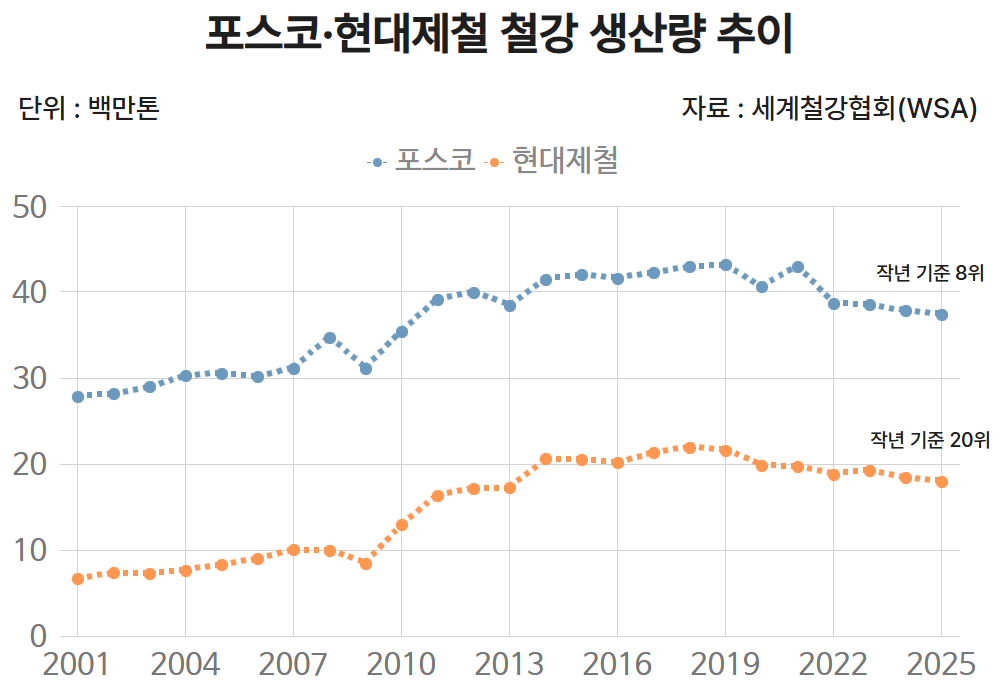
According to the World Steel Association's "World Steel in Figures 2026" report released Tuesday, Posco produced 37.36 million tons of crude steel last year, placing it eighth among global steelmakers. Hyundai Steel ranked 20th with 17.95 million tons.
Posco: once No. 2 in the world, now ranked 8th
Posco was the world's second-largest steelmaker in 2000, producing 27.7 million tons. The company's standing began to slip in the mid-2010s. It ranked fourth in 2015 with 41.97 million tons, then held fifth place from 2016 to 2019. It fell to sixth in 2020 and 2021, seventh in 2022 and 2023, and eighth in both 2024 and 2025 — a gradual but steady decline through the 2020s from the top-tier position it held in the previous decade.
Output has also passed its peak. Posco's steel production reached a high of 43.12 million tons in 2019 but has since fallen by 5.76 million tons over six years, a decline of about 13.4 percent. Last year's output was also down 430,000 tons from 37.79 million tons the year before.
Hyundai Steel also past its peak after integrated steelmill push
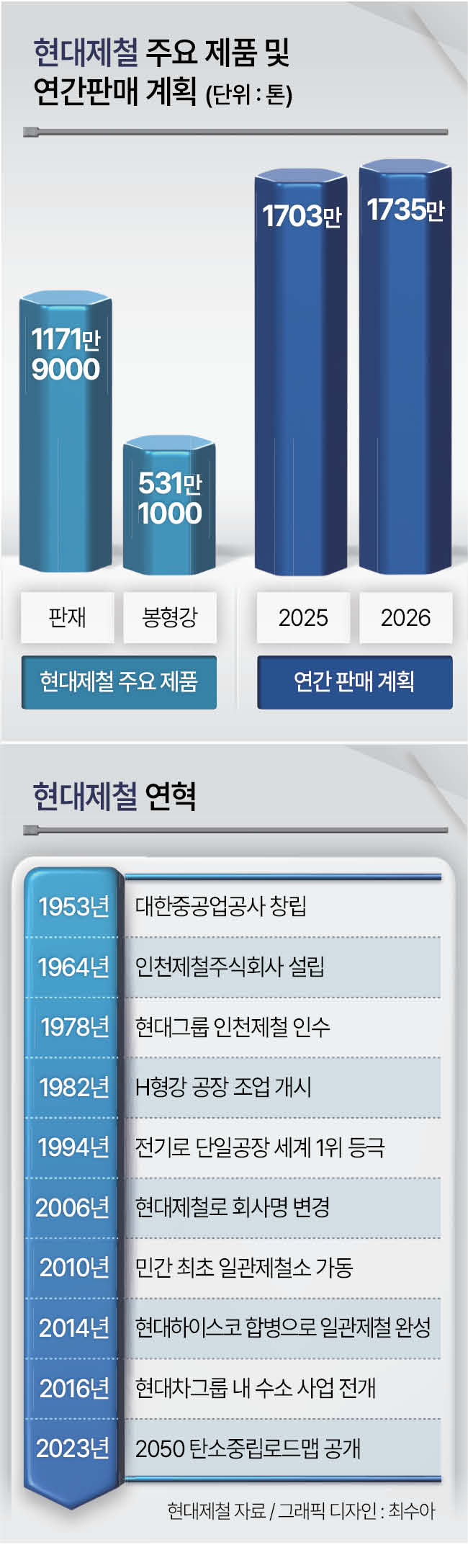
Hyundai Steel climbed the global rankings rapidly from the early 2000s but has since retreated. The company produced 6 million tons in 2000, ranking 30th in the world. By 2005, output had grown to 8.2 million tons, yet its ranking slipped to 33rd. The company then committed heavily to building an integrated steelmill in Dangjin, which was completed in 2010. That year, production reached 12.9 million tons and Hyundai Steel rose to 20th place.
Hyundai Steel climbed to 13th in 2015 with 20.48 million tons and held that position for three consecutive years, producing 20.09 million tons in 2016 and 21.23 million tons in 2017. The ranking then slipped to 15th in 2018 and 2019, 16th in 2020, 17th in 2021, 18th in 2022 and 2023, and 21st in 2024. Last year it edged up one spot to 20th, but that is still seven places below its best-ever ranking of 13th.
By output, Hyundai Steel has also passed its peak. Production hit a record 21.88 million tons in 2018 but fell to 17.95 million tons last year — a drop of 3.93 million tons, or about 18.0 percent, over seven years. Output last year was also lower than the 18.36 million tons recorded in 2024, though the company's ranking edged up from 21st to 20th amid a broad slump across global steelmakers.
Hyundai Steel's struggles are closely tied to the construction sector. The company produces both flat steel products such as automotive steel sheet and long products such as rebar and H-beams, but long products account for a significant share of sales, leaving it heavily exposed to the domestic construction downturn. Even with a leading position in rebar and H-beams at home, the company has little room to defend output when overall demand for construction steel shrinks.
The ranking declines at both companies cannot be explained by weakening competitiveness alone. South Korea's steel industry faces a triple squeeze: a domestic demand contraction driven by the construction slump, an influx of low-cost Chinese steel, and rising protectionism centered on the United States and Europe. Carbon regulation adds further pressure on the domestic production base.
Posco bets on full localization in India
Both companies are looking to overseas markets for a way forward.
Posco is focusing its efforts on India. In April, the company agreed to build an integrated steelmill with an annual capacity of 6 million tons in a 50-50 joint venture with JSW Steel, India's largest steelmaker. The plant, targeted for completion in 2031 in the eastern state of Odisha, is designed as a fully localized operation covering everything from raw material procurement to production and sales on the ground. Where past overseas ventures involved making steel in Korea and exporting it for local processing and sale, this project shifts the entire production process to India.
![Map of Odisha state in eastern India. [123rf]](https://wimg.heraldcorp.com/news/cms/2026/06/23/news-p.v1.20260420.4070da5a72254128b055718f2a89332f_P1.png)
The plan combines India's low-cost iron ore and labor with Posco's advanced steel technology to improve profitability. Posco intends to focus on high-value products such as premium automotive steel sheet while integrating low-carbon processes and smart factory capabilities to align with India's push for green steel.
India stands out as the market with the strongest steel demand growth among major economies. According to the World Steel Association, Indian steel demand is forecast to reach 171.6 million tons this year and 187.4 million tons in 2027, representing increases of 7.4 percent and 9.2 percent, respectively.
India is also a market with a strong drive to develop its own steel industry, however, so Posco plans to pair its entry with a strategy of partnering with local companies, concentrating on high-grade steel supply, and linking up with demand sectors such as automotive and infrastructure.
![The steelmaking process at Posco's Gwangyang steelworks. [Herald DB]](https://wimg.heraldcorp.com/news/cms/2026/06/23/news-p.v1.20251201.1a2a8bb0a5d74cbc9d7d2cce7340282b_P1.jpg)
Hyundai Steel eyes US market with electric arc furnace localization
Hyundai Steel sees the United States as its primary overseas opportunity. US steel demand is expected to grow 1.7 percent this year and 2.0 percent in 2027, driven by infrastructure investment, manufacturing onshoring and data center construction.
Hyundai Steel plans to build an electric arc furnace steelmill in Louisiana at a total cost of $5.8 billion, targeting commercial production in the first quarter of 2029. The facility will operate as an integrated line capable of producing everything from direct reduced iron to galvanized steel, with an annual capacity of 2.7 million tons — comprising 1.8 million tons of automotive steel sheet and 900,000 tons of general steel.
The urgency of securing local production has grown as the United States raises trade barriers, applying tariffs of up to 50 percent on steel imports. Hyundai Steel aims to cut carbon emissions through electric arc furnace-based production and supply automotive steel sheet directly from within the United States, reducing its exposure to tariffs and trade risks.
![Steel products stacked at Pyeongtaek port in Gyeonggi Province in February last year. [Lee Sang-sub, The Herald Business]](https://wimg.heraldcorp.com/news/cms/2026/06/23/9/news-p.v1.20250211.2f51845369994008bb4cc09166b2ed8e_P1.jpg)
Overseas investments need time — the key is securing high-value markets first
Most of the new overseas projects are still in early stages, however, meaning it will take time before they make a meaningful contribution to overall earnings.
"It is difficult for domestic steelmakers to grow the way they once did — by expanding domestic sales and export volumes," an industry official said. "Going forward, the deciding factor for competitiveness will be which markets they can secure stable demand in, and with what high-value products."
![韓 철강, 세계 6위 지켰지만…생산 15년·내수 23년 전으로 뒷걸음질 [흔들리는 K-스틸]](https://wimg.heraldcorp.com/news/cms/2026/06/23/news-p.v1.20241226.9f32c61e6b764f4e9b01dafb3818c495_T1.jpg)
![시름 깊어지는 철강업계…‘K-스틸법’ 보완 요구 커진다 [흔들리는 K-스틸]](https://wimg.heraldcorp.com/news/cms/2026/06/23/news-p.v1.20260114.00fa5f7b40934a9a9d0321627eb72445_T1.jpg)
kwater@heraldcorp.com