Tightening real estate finance regulations widen funding gap; Aegis says 2026-2027 is prime window for market entry
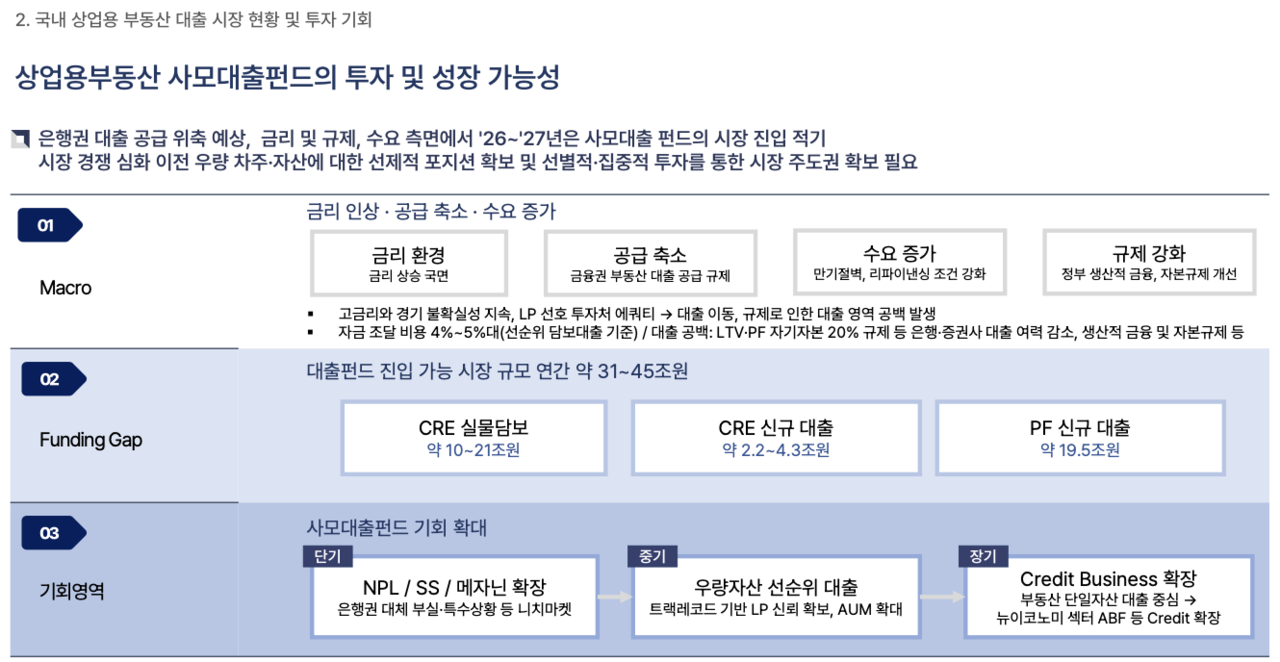
South Korea's commercial real estate private debt market is projected to grow to as much as 45 trillion won (about $29.3 billion) annually, as tightening capital regulations and the government's productive finance policy curb banks' and securities firms' capacity to supply real estate loans.
The strategic research division of Aegis Asset Management said Monday in a report titled "Investment Opportunities in the Private Debt Market and Real Estate Loan Funds" that the annual investable market for domestic commercial real estate private debt is estimated at between 31 trillion and 45 trillion won.
Private debt is an investment strategy in which non-bank institutions such as private equity funds provide capital directly to companies or real assets — bypassing banks — and earn interest income. The asset class expanded rapidly after the global financial crisis, filling the credit gap left by tighter banking regulations.
The report found that the global private debt market has grown roughly fivefold over the past 15 years, reaching approximately $2.2 trillion as of the third quarter of last year.
Stricter bank regulations following the global financial crisis and a prolonged low-interest-rate environment that drove institutional investors toward alternative assets are cited as key growth drivers. In the United States, private debt has established itself as an independent alternative asset class bridging banks and capital markets.
Aegis Asset Management said conditions for growth are also taking shape in the domestic market. The government's productive finance policy, tighter project financing regulations and newly introduced caps on securities firms' real estate investment are all constraining financial institutions' ability to supply real estate financing. At the same time, demand for refinancing of maturing commercial real estate loans is rising.
The strategic research division estimated the market accessible to private debt funds at between 10 trillion and 21 trillion won for refinancing of existing commercial real estate mortgage loans, between 2.2 trillion and 4.3 trillion won for new commercial real estate loans, and approximately 19.5 trillion won for the commercial real estate portion of new project financing loans.
The division noted that demand for alternative capital will grow as project financing equity regulations are tightened in stages. Financial authorities plan to raise the project financing equity ratio incrementally starting in 2027, reaching 20 percent by 2030. As developers are required to secure larger amounts of equity capital, a cumulative equity gap of approximately 11 trillion won is expected to emerge.
"In terms of interest rates, regulation and demand, this year and next year represent the optimal window for private debt funds to enter the market," Aegis Asset Management said, adding that it is necessary to "secure preemptive positions in high-quality borrowers and assets ahead of intensifying competition, and establish market leadership through selective and concentrated investment."
moon@heraldcorp.com