
![The Kospi and international oil prices are displayed on a screen at the Hana Bank dealing room in Jung-gu, Seoul, on Tuesday. The Kospi fell 2 to 3 percent in early trading, extending its losing streak to five consecutive sessions. [Yonhap]](https://wimg.heraldcorp.com/news/cms/2026/10/13/rcv.YNA.20261013.PYH2026101302850001300_P1.jpg)
The Kospi is failing to keep pace with rallies in US semiconductor stocks while amplifying every downturn, falling more than 4 percent intraday Tuesday to slip below the 6,100 mark. Earnings downgrades for Samsung Electronics and SK hynix, persistent foreign selling, and a supply-demand gap left by the end of share buybacks have all converged to widen the gap between the two markets.
As of 9:45 a.m. Tuesday, the Kospi stood at 6,094.96, down 289.28 points, or 4.53 percent, from Monday, according to Korea Exchange. The index opened down 198.16 points, or 3.10 percent, at 6,186.08 before sliding further to 6,083 in early trading.
Foreign investors extended their net selling on the Kospi market to a sixth consecutive session, offloading a net 611.4 billion won ($458 million) worth of shares. Retail and institutional investors were net buyers of 273.7 billion won and 310.7 billion won, respectively.
Samsung Electronics and SK hynix were each down more than 5 percent. Samsung Electronics fell 5.29 percent from Monday to 237,250 won, while SK hynix dropped 5.79 percent to 1,512,000 won. Both stocks opened with losses of 3 to 4 percent before extending their declines.
Wall Street closed mixed overnight amid weakness in semiconductor shares. The Dow Jones Industrial Average rose 0.38 percent, while the S&P 500 and the NASDAQ Composite fell 0.06 percent and 0.44 percent, respectively. The Philadelphia Semiconductor Index tumbled 2.67 percent.
Over the weekend, Chinese chipmaker CXMT announced plans to begin mass production of next-generation four-square-architecture DRAM chips before year-end, a development analysts cited as a fresh headwind for Korean chipmakers.
Samsung Electronics and SK hynix had already tumbled 4.4 percent and 4.5 percent, respectively, on Monday as the market priced in the latest negative developments. Foreign selling continued Tuesday, keeping both stocks in the red amid subdued buying interest.
"The recent decline in large-cap semiconductor stocks reflects a confluence of concerns — funding and profitability worries around AI infrastructure investment, the technological catch-up by China's CXMT, and supply-demand pressure from sustained foreign selling," said Yang Hyeon-gyeong, a researcher at iM Securities.
The Kospi has been underperforming US semiconductor stocks more visibly of late. The index has been rattled by macroeconomic headwinds including interest rates and oil prices, and has failed to ride the tailwinds when US technology stocks rally, effectively cutting off the transmission of positive momentum from Wall Street.
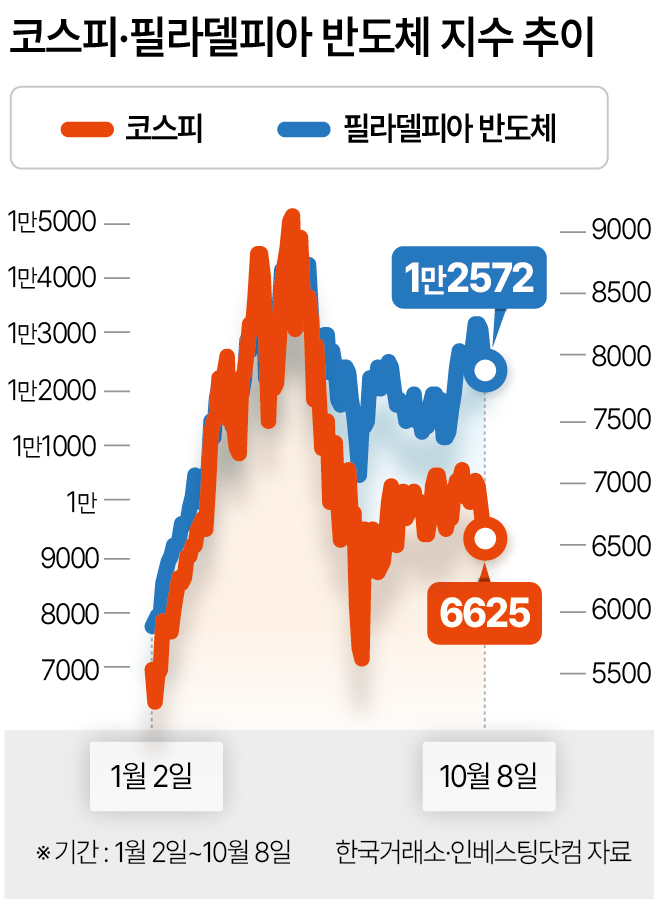
Historically, the Kospi has moved in close tandem with the Philadelphia Semiconductor Index, which tracks the share prices of 30 major semiconductor companies listed in the United States and serves as a barometer of the global chip industry. Because Samsung Electronics and SK hynix together account for roughly half of the Kospi's market capitalization, the index has tended to mirror the Philadelphia gauge closely. It was common for the Kospi to rise the following day whenever US chipmakers such as Micron or SanDisk surged.
That pattern has broken down recently. The monthly correlation coefficient between the two indexes dropped from 0.943 at the start of the year to 0.68 this month. The coefficient had peaked at 0.97 in April, when the two indexes moved in effect as one. A coefficient closer to 1 indicates stronger alignment between the two indexes.
The performance gap has also widened. At the end of June, the Kospi and the Philadelphia Semiconductor Index had risen roughly 98 percent and 96 percent, respectively, from the start of the year — nearly identical gains. Since then, the Kospi has fallen back sharply, and as of Monday the year-to-date gains stood at 48 percent for the Kospi versus 66 percent for the Philadelphia Semiconductor Index.
Positive US market signals have repeatedly failed to lift domestic stocks. After NASDAQ and Nvidia hit all-time highs on Oct. 5 (local time), the Kospi fell 0.89 percent the following day. NASDAQ, Nvidia and AMD all set fresh records the next session, yet the Kospi still fell 1.98 percent on Oct. 7.
"The Kospi has historically tracked the Philadelphia Semiconductor Index more closely than NASDAQ because of the heavy weighting of Samsung Electronics and SK hynix," a securities industry official said. "More recently, downward revisions to earnings forecasts for both companies, combined with intensifying foreign selling, have blocked the positive spillover from US markets into domestic stocks."
Analysts agree that the Kospi's near-term direction hinges on the earnings outlook for Samsung Electronics and SK hynix. "Starting this week, analyst reviews will begin updating Samsung Electronics' earnings estimates for next year in earnest — how much those estimates can be revised upward, and how strongly that feeds through to broader Kospi earnings upgrades, is what matters most right now," said Han Ji-young, a researcher at Kiwoom Securities.

moon@heraldcorp.com




