
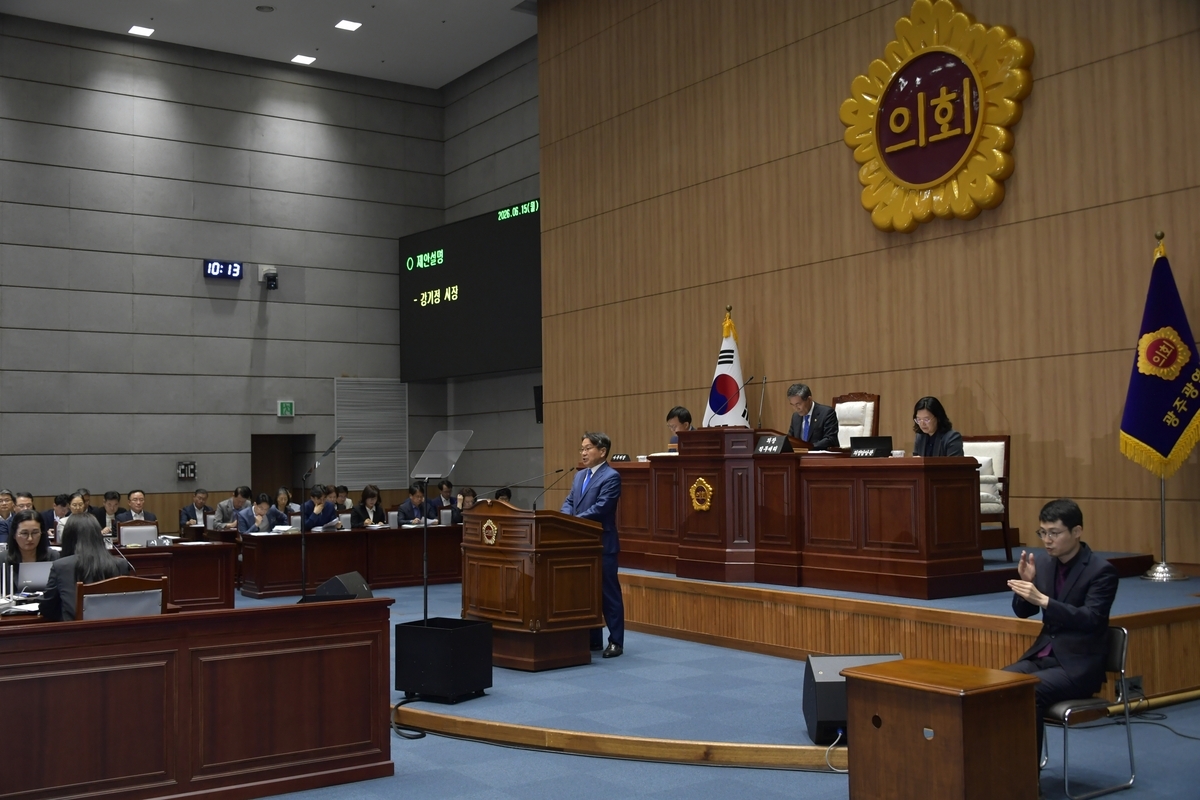
"Gwangju will become a future industrial city embracing AI, mobility and semiconductors," Gwangju Mayor Kang Ki-jung said Monday as he presented the city's first supplementary budget proposal for 2026 at the opening plenary session of the 344th extraordinary session of the Gwangju City Council.
Kang said additional investment from a global company had already been confirmed, adding that a major multinational's plan to build a new fabrication plant would position Gwangju as the hub of the semiconductor industry in the southern region.
He did not disclose the company's name or the scale of the investment, but his mention of a possible new semiconductor production facility signaled that the city's industrial strategy is expanding beyond AI and future mobility into semiconductors.
Kang also said the military airport relocation project, laid out during the eighth elected-term administration, would break ground in the ninth term and be completed in the tenth.
The first supplementary budget submitted by the city Monday totals 381.4 billion won (about $274 million) above the original budget, with 358.1 billion won added to the general account and 23.3 billion won to special accounts.
Revenue sources include 67.5 billion won in ordinary local allocation tax, 8.3 billion won in special allocation tax, 254.1 billion won in national subsidies and 30.4 billion won in surplus carried over from the 2025 fiscal year.
On the expenditure side, the budget includes 3 billion won for consulting services related to the military airport relocation, 2.1 billion won to build the administrative foundation ahead of the planned July 1 launch of the Jeonnam-Gwangju integrated special city, and 10 billion won for construction of Urban Railway Line 2, alongside projects tied to the central government's own supplementary budget.
Kang said the revenue side of the budget was significant because the city assembled it without issuing local government bonds.
Gwangju Superintendent of Education Lee Jeong-seon also presented a first supplementary education budget of 3.1685 trillion won on Monday, an increase of 342.8 billion won over the original budget.
Lee said the supplementary budget focused on easing the burden on schools amid high energy and consumer prices, strengthening students' future learning capabilities and building safer educational infrastructure. He added that 100 billion won in legally mandated city government transfers that had not been included in the original budget was incorporated as previously agreed, with an emphasis on securing stable funding ahead of the administrative merger.
sij@heraldcorp.com



