
Genesis unveils mid- to long-term growth strategy at Le Mans
Brand to enter 4 more European countries next year, reaching 11 total
Dealer-led model to replace direct sales, mirroring US success
Service network to expand to 200 locations
Hybrid, EREV and Magma lineup to anchor product push
![Hyundai Motor Co President Jose Munoz speaks at the Genesis press conference held Friday in Le Mans, France, outlining the brand's participation in the 24 Hours of Le Mans and its strategy for the European market. [Genesis]](https://wimg.heraldcorp.com/news/cms/2026/06/13/news-p.v1.20260613.5bc16641e19847f9956398d5340e8298_P1.jpg)
Hyundai Motor Co President Jose Munoz has set a mid- to long-term target of growing Genesis into a brand selling 350,000 vehicles globally by 2030, with plans to expand European sales to five times their current level and sharply increase the brand's dedicated dealer and service network to accelerate its push into the premium market.
Munoz announced the targets Friday at a Genesis press conference at the La Sarthe Circuit in Le Mans, France. "By 2030, we will achieve 350,000 Genesis sales globally and expand European sales fivefold," he said.
Genesis has set a global sales target of 225,000 units this year and plans to raise that figure to 350,000 by 2030.
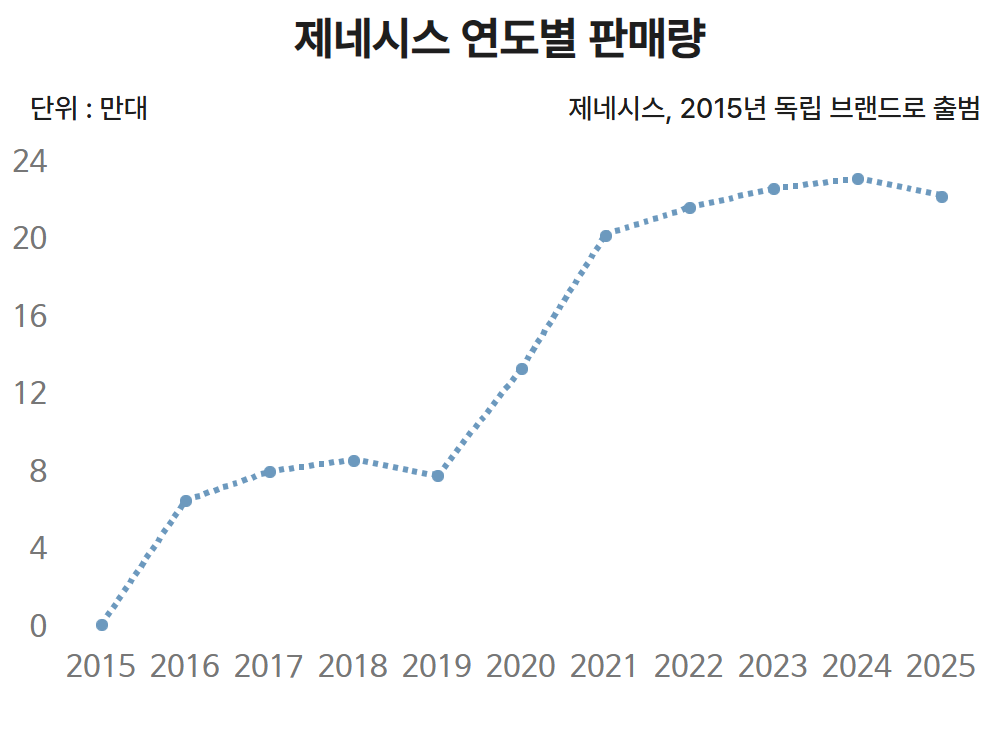
Europe was identified as a key growth market. Genesis sold 2,476 vehicles in Europe last year, down 6.7 percent from the prior year. Munoz's plan calls for raising that figure to roughly 12,000 units or more by 2030 — about five times the current level.
To support that goal, Genesis will enter four additional European countries next year: Poland, Portugal, Denmark and Austria. That will bring the total number of European markets where the brand operates from seven — currently Germany, the United Kingdom, France, Italy and Spain, among others — to 11.
Europe sales shift from direct to dealer model
Genesis also plans to establish more than 50 dedicated sales outlets and more than 200 official service centers across Europe. The brand will also overhaul how it sells cars there. Genesis initially entered Europe using a direct sales model in which the manufacturer controlled pricing and vehicle ownership, selling directly to customers. Going forward, it will transition to a dealer-led model with established local networks to accelerate expansion.
The shift mirrors the approach that drove rapid sales growth in the United States. Genesis opened its first dedicated European dealership in Almere, the Netherlands, in April, and has also begun dealer operations in Padua, Italy.
![The Genesis X Gran Convertible Concept in Midnight Teal. The concept model features a subdued teal finish and tartan-patterned materials. [Genesis]](https://wimg.heraldcorp.com/news/cms/2026/06/13/news-p.v1.20260612.4e254706a0bc4f2cb82f578023708401_P1.jpg)
Additional dealerships are planned for Lille, France, and Rome in the second half of this year. Meanwhile, a 150 million euro ($174 million) investment is underway at Hyundai Motor's European Technical Center in Rüsselsheim, Germany. The strategy goes beyond expanding sales channels — Genesis aims to broaden its touchpoints with local customers and deliver a brand experience unique to the marque.
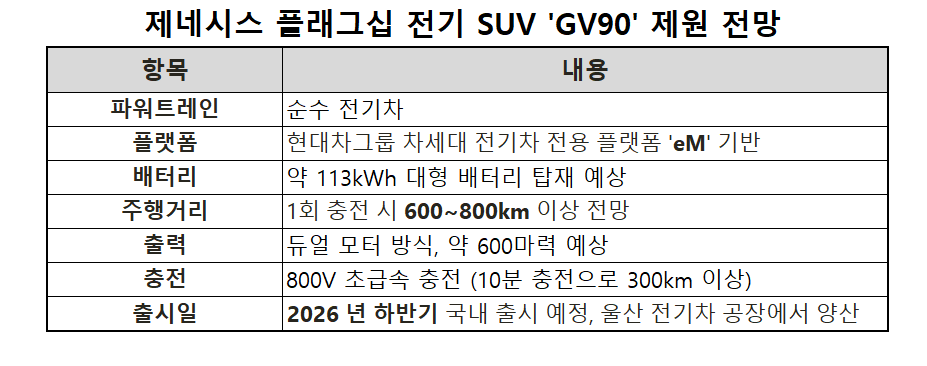
A broader product lineup will accompany the network expansion. Genesis plans to launch 22 new models worldwide by 2030. Hybrid models will arrive in the second half of this year, followed by a sequential rollout of extended-range electric vehicles. The high-performance Magma lineup will also launch in earnest, starting with the GV60 Magma. The next-generation flagship electric SUV, the GV90, is also being prepared for a European launch.
![The Magma GT Concept unveiled by Genesis at the 24 Hours of Le Mans. The two-seat luxury grand tourer concept reflects the direction of Genesis's high-performance Magma brand. [Genesis]](https://wimg.heraldcorp.com/news/cms/2026/06/13/news-p.v1.20260612.db320e085b5143f5aa51a2a274cfa908_P1.jpg)
European sales at 3% of US levels — German trio remains the wall to climb
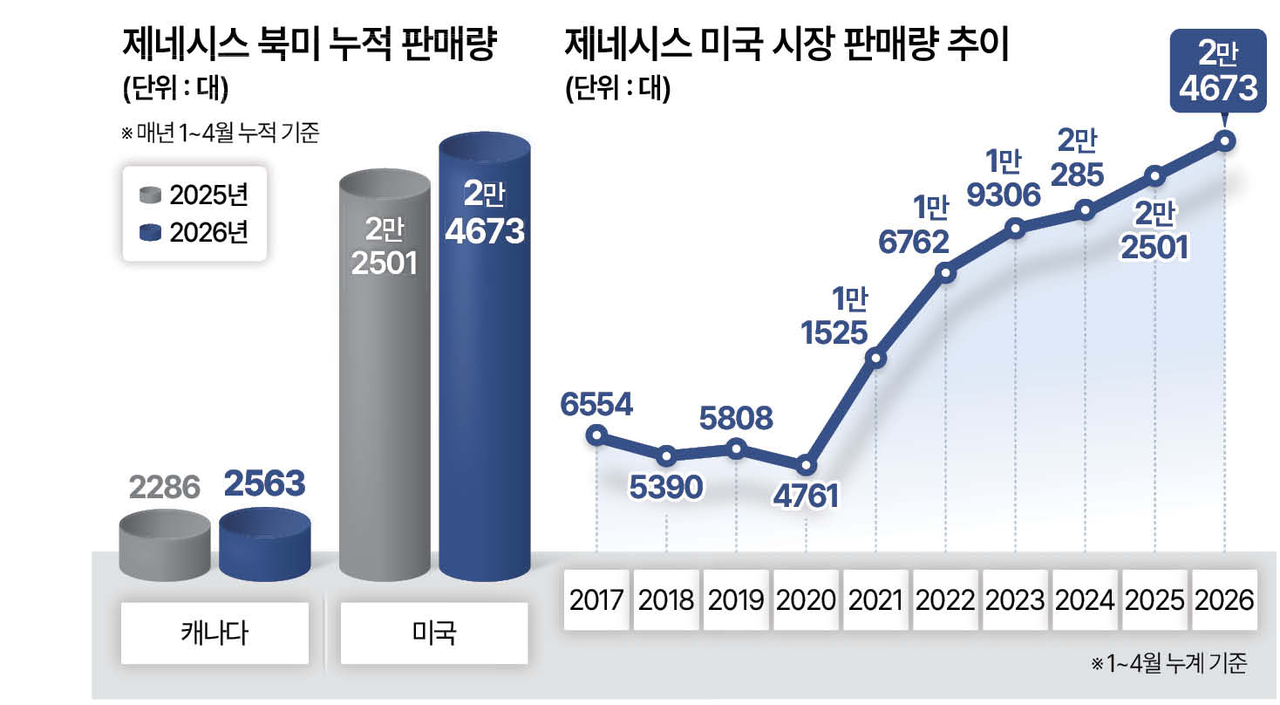
Genesis remains a relatively new entrant in Europe. The brand made its official US debut in 2016 with the G80 before entering Europe in 2021, starting in Germany, Switzerland and the United Kingdom and gradually expanding to France, Spain, Italy and the Netherlands.
Yet last year's European sales of 2,476 units amounted to just 3 percent of the 82,331 vehicles Genesis sold in the United States. Unlike in North America, the brand has no local production base in Europe and relies almost entirely on imports from South Korea. To establish itself as a true luxury brand, Genesis must carve out a meaningful presence in a market long dominated by the German trio of BMW, Mercedes-Benz and Audi.
'Fastest to 1 million' — Munoz confident in growth trajectory
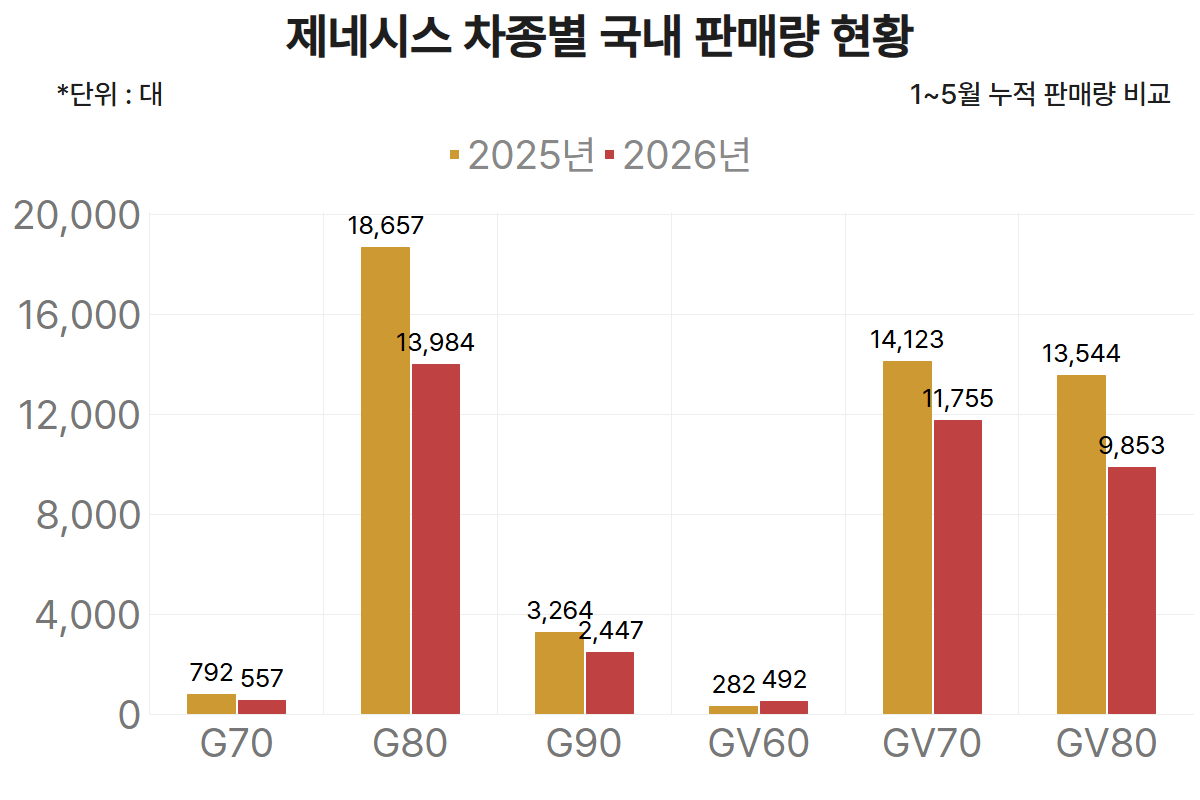
Munoz expressed confidence in Genesis's recent momentum. "Combined Hyundai Motor and Genesis sales surpassed 1 million units in the first quarter of this year, with Genesis alone accounting for more than 50,000," he said. First-quarter sales rose 3.4 percent year-on-year to a record high, he added, while Genesis sales in North America and Europe were up 8.5 percent so far this year. "In the United States, we have set a new sales record for 20 consecutive months," he said.
Munoz also noted that Genesis reached cumulative global sales of 1 million units in just seven years and eight months. "That is faster than Lexus, Tesla and Infiniti," he said.
He acknowledged, however, that the market environment remains challenging. Key headwinds cited included uncertainty over US tariffs, supply chain instability, rising oil prices, weakening consumer sentiment driven by high inflation, an aggressive push by Chinese brands, and intensifying price competition in the electric vehicle segment. European passenger car demand remains roughly 2.5 million units below pre-COVID-19 levels, while Chinese automakers' market share in Europe reached 7.3 percent in the January–April period this year, nearly double the 3.7 percent recorded in the same period last year.
In the EV market in particular, average price cuts of around 4 percent and incentive competition exceeding 10 percent have persisted, squeezing profitability for European dealers. Despite these pressures, Munoz said Genesis would stay the course. "We are executing our plan without wavering," he said, reaffirming the brand's commitment to its European investment and new model launch schedule.
![Hyundai Motor Co President Jose Munoz speaks at the Genesis press conference held Friday in Le Mans, France, outlining the brand's participation in the 24 Hours of Le Mans and its strategy for the European market. [Genesis]](https://wimg.heraldcorp.com/news/cms/2026/06/13/news-p.v1.20260613.759b3065e3b14a77a5884350156b99b5_P1.jpg)
'Not just a car company' — Munoz stresses tech identity
Munoz also positioned Hyundai Motor Group as a technology company that has moved beyond conventional automaking. "We are not an ordinary car company," he said, citing partnerships with Boston Dynamics, 42dot, Motional, Waymo, Momenta, Nvidia and Amazon. He highlighted the group's robotaxi collaboration with Waymo, autonomous driving software development and robotics ventures as examples of the future mobility ecosystem Hyundai Motor Group is building.
Munoz also cited the group's vertical integration as a competitive advantage. "Hyundai Motor Group is a conglomerate with more than 50 affiliates," he said, "operating across steel, components, logistics and finance, as well as robotics, software and urban air mobility." He said the vertically integrated structure gives the group the ability to execute faster, improve cost efficiency and respond flexibly to market shifts.
He said the market has taken notice of the group's potential. "Hyundai Motor Group has seen one of the steepest increases in corporate value among global automakers," Munoz said, noting that the company's share price climbed from 189,000 won to 689,000 won between May last year and May this year — a gain of 275 percent.
Genesis is using its participation in the 24 Hours of Le Mans as a symbolic stage for brand expansion. Genesis Magma Racing entered the world endurance racing scene in earnest with its GMR-001 hypercar.
"Le Mans is not simply a race — it is a stage where Genesis proves its performance, technology and brand identity all at once," Munoz said. "Motorsport is a vital process through which we test the technologies we develop under extreme conditions and translate them back into production vehicles and brand experiences." He added that the 24 Hours of Le Mans "will mark another important milestone in Genesis's journey toward becoming a global luxury brand."
![[르망 24시] 레이싱판 월드컵…제네시스, 13일 ‘한국 대표’로 첫 도전](https://wimg.heraldcorp.com/news/cms/2026/06/12/news-p.v1.20260612.e0224eba423248ec8c821d3ee6a9a805_T1.jpg)
kwater@heraldcorp.com




